On this page
- Compare the Main B2B SaaS Lead Generation Channels
- How Buyers Research Before They Talk to Sales
- Why Qualified Leads Beat Raw Lead Volume
- Find and Score Buying Intent in Public Threads
- Build Content and SEO for AI-Mediated Discovery
- Add Outbound and Paid Channels Without Burning Budget
- Measure Pipeline Instead of Form Fills
- Run a Reddit Lead Generation Playbook in 30 Days
AI-native platforms were already the second-most-common source of qualified leads, at 34%, in a 2025 survey of 400 B2B technology marketing executives reported by Business Wire. That changes the B2B SaaS lead generation question. You aren't just trying to get someone onto your website. You're trying to become a credible option wherever they investigate a problem.
For a small team, that doesn't mean publishing everywhere. I would start with relevant community conversations and a useful content asset, then add distribution only when the offer attracts qualified interest. A specific answer to a migration question can start a sales conversation while also becoming public evidence that other buyers, search engines, and AI tools may discover. Broad automated promotion rarely deserves the same confidence.
Compare the Main B2B SaaS Lead Generation Channels
Lead generation channels compared for B2B SaaS
| Channel | Time to first leads | Cash cost | Team time | Best use |
|---|---|---|---|---|
| Outbound email and cold outreach | After list preparation and initial reply cycles | Low to medium, for data and tools | High, daily | Starting conversations with named target accounts |
| Inbound content and SEO | Slowest to establish, requires publishing and discovery | Low cash if written internally, steady effort | Medium, weekly | Capturing buyers already researching the problem |
| Reddit and community replies | Can start with an existing active discussion | Free to low, primarily time or a paid tool | Low to medium, daily | Catching active comparison and migration questions |
| Paid search and paid social | Can begin after approval and launch | High and ongoing | Regular checks, plus deeper weekly optimization | Testing offers and high-intent keywords |
| Partners, referrals and integrations | After partner recruitment or customer introductions | Low upfront, potentially revenue share | Medium, relationship-driven | Reaching buyers through someone they already trust |
These are planning expectations, not delivery guarantees. Launching an advertisement is fast; finding an advertisement that brings qualified buyers isn't necessarily fast. Community participation costs little cash, but reading context and writing credible answers still consumes founder time. SEO can become a durable acquisition source, but it's a poor emergency response to an empty pipeline. Partnerships work best when the other party has a concrete reason to introduce you, such as helping their customers complete a workflow.
Choose for your constraints
A solo founder with little cash and some daily availability should start with community replies plus a focused content asset. Use the asset to answer a recurring buying question, not to create another generic category overview. An early team with a pipeline budget can add outbound to reach named accounts instead of waiting for those accounts to discover it. If you're evaluating outside help, Outbound Consulting's lead generation services provide a useful starting point for defining the scope you'd want a provider to own. Keep targeting, qualification, and reporting requirements explicit.
Pick a pair of channels for your next planning cycle and write down the metric each must move. Community participation might need to generate qualified conversations; outbound might need to create accepted opportunities. Don't commit to every row in the table just because each channel could work. Commit to the channels you can operate consistently without neglecting onboarding or product development.
How Buyers Research Before They Talk to Sales
B2B SaaS lead generation works better as a blended buying experience: digital discovery helps buyers understand their options, and sales adds context where the decision feels risky or complex.
In a 2017 survey of more than 1,000 B2B buyers across four countries, McKinsey found that 76% considered speaking with a salesperson helpful when researching a new product or service, while 46% said they'd buy through a supplier's website if the process were available and efficient. Those preferences aren't contradictory. Buyers can value expert advice without wanting every basic answer hidden behind a demo form.
The buying process includes independent research before a vendor gets the chance to speak.
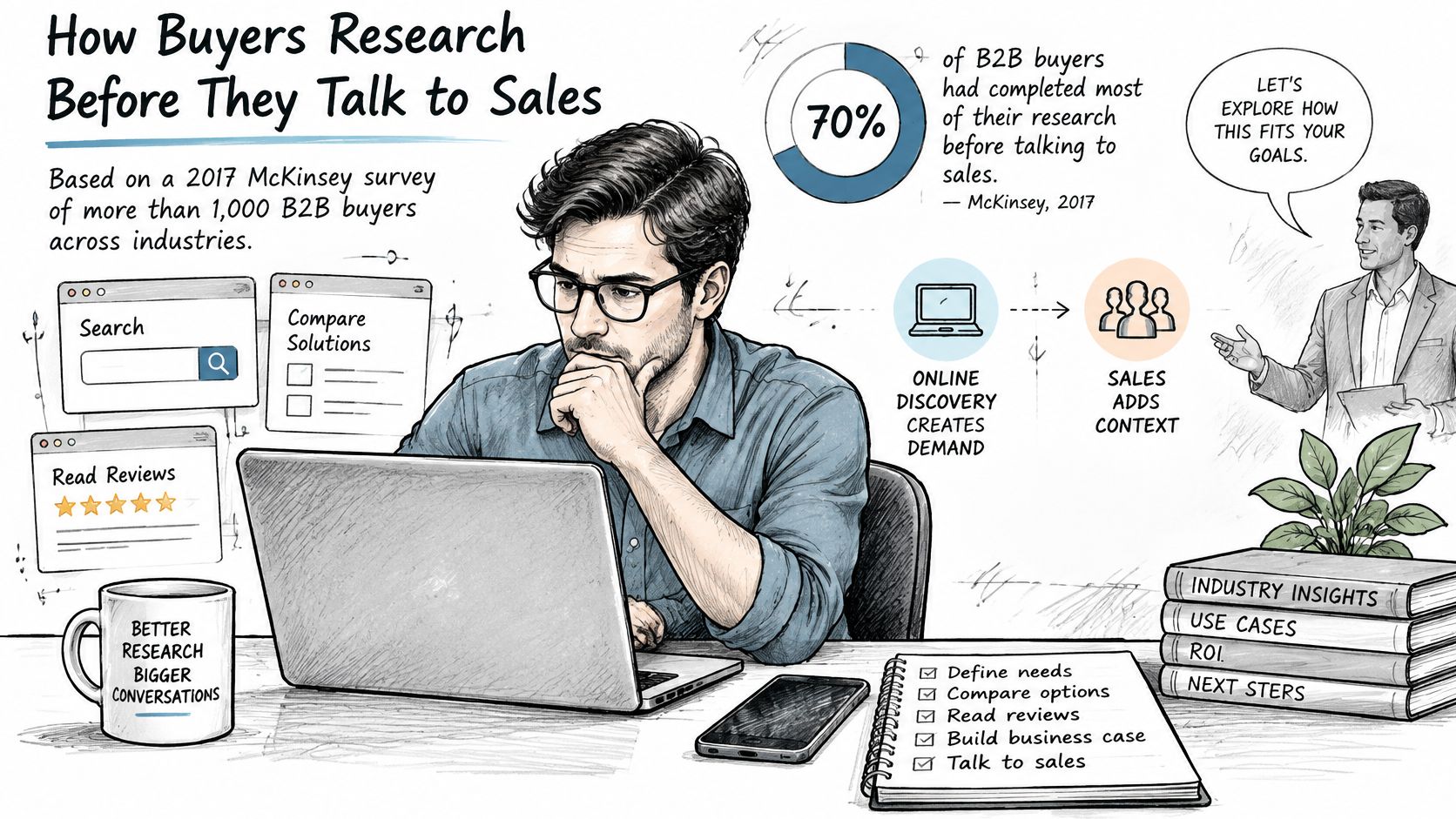
McKinsey's 2026 Global B2B Pulse, drawing on nearly 4,000 decision-makers across 13 countries, found that buyers use an average of 10 touchpoints during purchasing. Say a founder searches for an onboarding problem, reads a Reddit comparison, asks an AI assistant for a shortlist, checks implementation documentation, then books a demo. It's like checking reviews before walking into a showroom: the conversation starts before the salesperson arrives.
Match the answer to the question
- Category learning: Publish educational guides that explain the problem and available approaches.
- Vendor evaluation: Provide searchable comparisons and candid product explanations.
- Implementation confidence: Offer documentation, prerequisites, and a clear route to technical help.
- Self-qualification: Make intended users, limitations, and next steps easy to find.
Sort current prospects into first-time learners and people already familiar with the problem. Give the former orientation and the latter decision-making detail.
Why Qualified Leads Beat Raw Lead Volume
Median B2B SaaS funnel conversion by stage
| Stage | Median conversion | First lever to pull |
|---|---|---|
| Lead to MQL | About 35% | Lead capture quality and source tracking |
| MQL to SQL | About 13% | Intent and fit scoring |
| SQL to opportunity | About 50% | Discovery call quality |
| Opportunity to closed-won | About 22% | Proof, pricing clarity and objection handling |
| End to end | Roughly 0.5%, before traffic-to-lead | Improve the weakest stage first |
Those medians come from Plura's summary of speed-to-lead benchmarks, which places stage conversions at approximately 35% lead to MQL, 13% MQL to SQL, 50% SQL to opportunity, and 22% opportunity to closed-won, compounding to roughly 0.5% end to end before traffic-to-lead conversion. Read the table as a diagnostic reference. Your stage definitions and customer segment matter more than matching an external median.
The pattern worth noticing is where the funnel loses the most prospects. The gap between lead capture and a sales-accepted conversation is the widest drop in the chain, so qualification quality decides how much of your acquisition spend ever turns into real pipeline.
Fix acceptance before buying more traffic
Consider a change that costs nothing in spend: raise MQL acceptance into SQL while holding acquisition volume flat. More of the demand you already paid for reaches a meaningful sales conversation. For a small team, that usually beats adding another channel, and it beats broad outreach that fills the CRM with people sales rejects on the first call.
The gain only counts if it reflects better qualification. Renaming every signup an SQL makes reporting look healthier without creating buying intent. ContentBuck's guide to qualified leads is a useful reference when documenting what marketing and sales should accept.
Community replies earn their keep twice in this math. A specific, useful answer in a public thread captures demand from the person who asked, and it stays visible to buyers who later ask an AI assistant for a shortlist or search the same problem. I would rather have ten replies like that than a thousand cold touches, because each one keeps working after you post it.
Build a weighted qualification score around:
- Explicit intent: Is the person selecting software or merely discussing the category?
- Problem-to-product fit: Can your product solve the stated problem without an invented workaround?
- Company segment: Does the organization fit your deployment model and commercial requirements?
- Urgency: Is there a migration deadline, failed rollout, or active replacement project?
- Engagement quality: Does the person provide concrete constraints and participate in the discussion?
Give intent and product fit more influence than superficial engagement. A detailed implementation question deserves more attention than an enthusiastic reaction from someone who can't use the product.
Qualification rule: A strong buying signal doesn't compensate for a product that can't meet the buyer's requirements.
Calibrate your thresholds against accepted SQLs, opportunities, and revenue. If high-scoring prospects keep failing discovery, revise the scoring assumptions instead of telling sales to try harder. Start by finding the weakest stage in your own funnel and writing down one specific change to its input, handoff, or buyer experience.
Find and Score Buying Intent in Public Threads
An opportunity is a Reddit post worth replying to in public. A lead is the person who wrote a matching post, surfaced so you can reach out privately by DM. Keeping those separate prevents a useful public question from automatically becoming permission for private outreach.
Reddit intent tiers and the right response
| Tier | Example post pattern | Right response |
|---|---|---|
| 1. Active switch | Leaving a tool, asking for alternatives or migration help | Specific answer within hours, offer a DM if relevant |
| 2. Active evaluation | Comparing tools for a named workflow | Balanced comparison, no push |
| 3. Problem research | Asking how to fix a process or reduce a metric | Substantive answer, no link |
| 4. Off-target or restricted | Subreddit hostile to promotion, or no product fit | Skip, or read the rules before any reply |
Read the whole thread before scoring it. A request for alternatives might come from a buyer with an active project, a student researching software, or someone whose mandatory requirements rule you out. The words alone aren't enough.
Respond to constraints, not keywords
For an active switch, address the difficult part first: data export, compatibility, permissions, or migration effort. If someone needs historical records preserved, explaining that limitation is more helpful than listing your dashboard features.
For an evaluation, describe the trade-off fairly. Say which option fits the stated workflow, including when it isn't yours. SignalVan's explanation of signal-led prospecting for B2B sales offers a useful framing: use an observable event to establish relevance rather than treating every matching profile as ready to buy.
Timing matters, but don't turn urgency into indiscriminate messaging. An MIT/InsideSales study covering more than 15,000 leads and 100,000 call attempts, summarized by Cirrus Insight, found that waiting from 5 to 30 minutes reduced the odds of qualifying a lead by 21 times. That concerns lead qualification in a calling context, not a proven Reddit revenue effect.
Use it as a reason to timestamp the first observable buying signal and assign an owner promptly. Route active-switch discussions for same-day attention rather than leaving them in an unread digest.
A public question is an invitation to help with that question, not blanket consent to a sales sequence.
I would prioritize a small set of highly relevant replies over broad automation. You can verify the answer, respect community rules, and recognize genuine interest. Once someone invites further detail, move privately with their permission and carry the original context into the conversation.
Build Content and SEO for AI-Mediated Discovery
An AI-generated shortlist is another discovery surface, not a replacement for product positioning. Your job is to make reliable information available when a buyer asks which product fits a particular situation.
Responsive's 2025 buyer research, summarized by Gracker, found that one in three buyers used AI chatbots to surface vendors. That supports investing in discoverable answers, but it doesn't mean you can guarantee inclusion by publishing a particular page format.
Publish answers buyers can evaluate
- Competitor comparisons: Answer how products differ for a named workflow. Explain capabilities, constraints, and the evidence behind your assessment.
- Alternatives pages: Address why someone might leave an incumbent, including migration friction and features they could lose.
- Problem explainers: Show how to diagnose and solve the underlying issue, including approaches that don't require your product.
- Implementation documentation: Explain prerequisites, integrations, permissions, and deployment steps so technical evaluators can assess feasibility.
State who each asset fits and who it doesn't. A vague promise to serve every business gives neither buyers nor an AI assistant much useful context. Precise descriptions of supported workflows and limitations give them something concrete to evaluate.
For practical publishing considerations, use our guide to AI overview optimization alongside ordinary search fundamentals: crawlable pages, descriptive headings, internal links, and current documentation.
Connect public answers to owned evidence
Target a narrow set of problem and competitor searches rather than an enormous keyword spreadsheet. Inspect the results manually, including Reddit discussions that already appear for those queries. A useful contribution to an indexed thread can provide independent context, although indexing, citation, and shortlist inclusion aren't guaranteed.
Keep public replies self-contained. Publish deeper explanations on your website when the topic warrants them, not merely to manufacture a reason to drop a link. Treat inbound publishing as sustained weekly work, with time reserved for updates and distribution rather than a launch-and-forget content sprint.
Add Outbound and Paid Channels Without Burning Budget
Outbound gives you account selection. Paid gives you controlled distribution. Neither fixes an offer that buyers don't understand or a product that doesn't meet their requirements.
Account-based targeting is established practice: 71% of surveyed B2B marketing practitioners reported using an ABM strategy in Demand Gen Report's 2025 ABM Benchmark Survey. A small team doesn't need elaborate account-specific campaigns to apply the principle. Start with companies you can serve and a reason each might care now.
Use outbound for named accounts
Build the list around your ideal customer profile, then verify the contact's role and relevance. Write a short message that references a specific public problem without pretending you've spoken before. Ask a question the recipient can answer without booking a meeting.
For social prospecting, our LinkedIn lead generation strategy can help you coordinate account research and conversations. Record replies and objections in the CRM so the next message reflects what the person said.
Use paid to test a defined offer
Paid search can capture explicit software demand; paid social can introduce an offer to selected audiences. Search intent is clearer, while social targeting doesn't necessarily indicate an active purchase.
Budget discipline: Decide what would make you pause a campaign before spending starts.
Set a fixed spending cap, run a focused offer, and send visitors to a matching landing page. Review search terms and exclude irrelevant intent. For social, separate curiosity-driven downloads from genuine evaluation.
A solo founder with little cash should generally wait until the offer attracts qualified organic interest. Include creative production, landing page work, and follow-up time in the cost calculation. Judge campaigns by accepted opportunities, not a cheap click or a full calendar of mismatched demos.
Measure Pipeline Instead of Form Fills
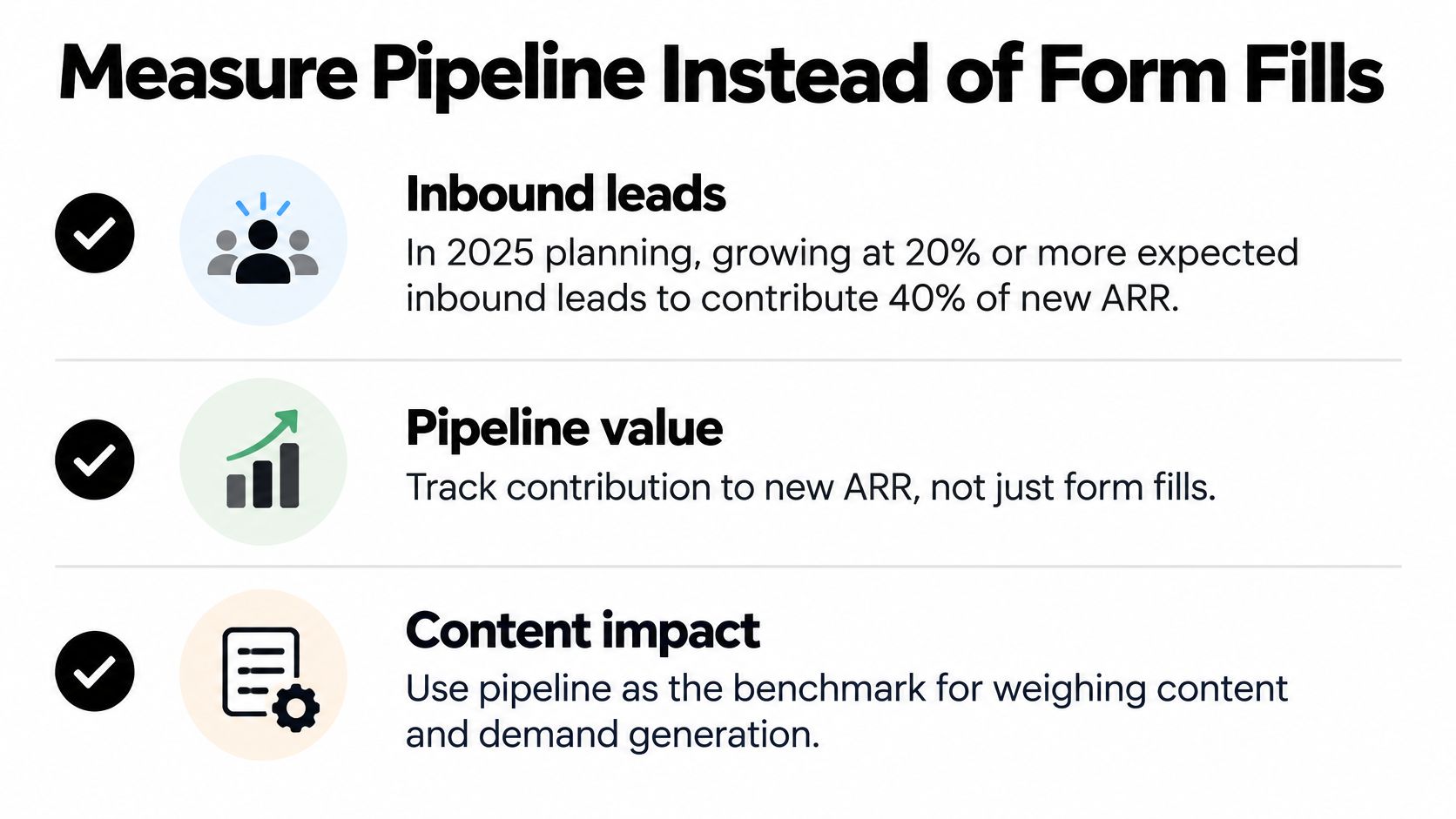
For 2025 planning, B2B SaaS companies growing at 20% or more expected inbound leads to contribute 40% of new ARR, according to Ray Rike's 2025 B2B SaaS Marketing Benchmarks. That's an expectation from a particular company group, not proof that inbound will produce the same contribution for your business.
Use pipeline contribution to decide whether content and community work deserve more resources. A form submission is an observable action, but it isn't evidence of commercial fit.
Keep the measurement objective visible to everyone reviewing acquisition.
Build a compact pipeline checklist
- Opportunity rate by intent tier: Check whether your classification predicts actual sales progress.
- Closed-won revenue by subreddit or channel: Distinguish commercially useful discussions from communities that generate engagement alone.
- Assisted conversions: Record relevant interactions before signup, not just the final clicked link.
- Signal-to-response time: Track the median and the 90th percentile to expose slow outliers.
- Acquisition cost: Include tools, advertising, and team labor when comparing sources.
Use our guide to B2B customer acquisition cost to keep the cost side consistent. Unpaid distribution isn't costless if it takes substantial staff time.
Combine attribution methods
Use tagged links where links are welcome, a self-reported discovery field on signup, and CRM notes from sales conversations. Ask what prompted the buyer to look and what helped them choose, rather than forcing every answer into a single channel.
A Reddit discussion might influence someone well before they request a demo. If they later arrive directly, last-touch attribution won't capture that earlier influence. Don't invent person-level tracking to fill the gap.
Review cohorts periodically and preserve uncertainty. Record confirmed touchpoints separately from plausible influences, then look for repeated patterns across won and lost opportunities. Before the next campaign starts, create a source field and put a pipeline review date on the calendar.
Run a Reddit Lead Generation Playbook in 30 Days
Treat this as a bounded operating experiment, not a promise of customers by the end of the month. The deliverable is a repeatable way to find suitable discussions, respond responsibly, and decide whether the channel deserves continued attention.
Use this workflow to organize the work.
Work through a weekly sequence
-
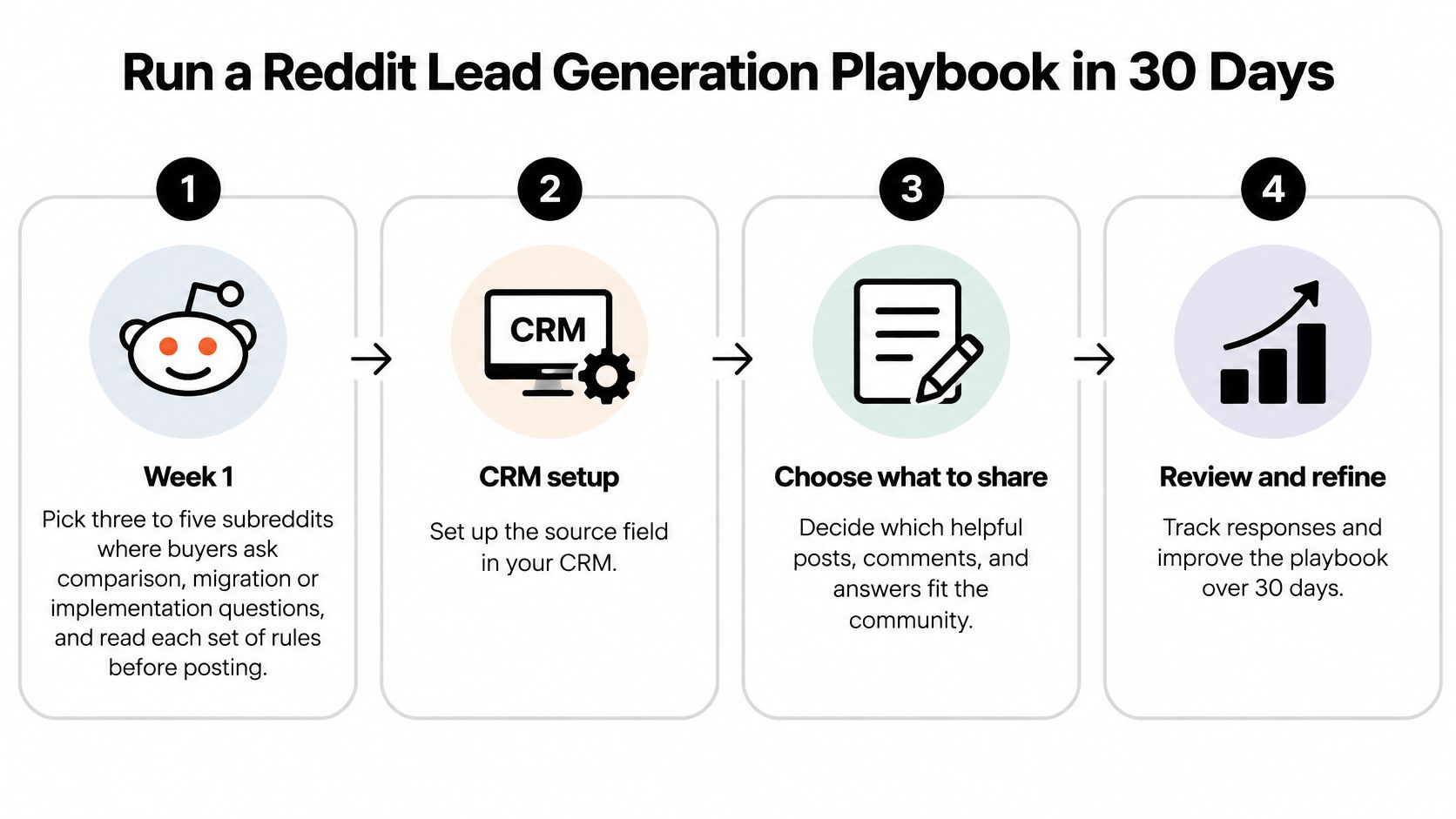
Week one, establish boundaries. Choose a small group of subreddits where buyers discuss comparisons, migrations, or implementation, and read each community's rules before participating. Create CRM fields for the thread URL, intent tier, response, and outcome so you can review the work later.
-
Week two, map existing demand. Write a focused list of problem and competitor searches, then inspect the Reddit threads Google returns. Note the vocabulary buyers use and which questions remain unanswered. Don't revive an old thread merely to add a product mention.
-
Week three, run the response workflow. Classify new discussions and prioritize active evaluation or replacement projects. Answer the actual question, disclose your affiliation when relevant, and mention your product only when it meets the stated requirements. Offer a private follow-up rather than sending an unsolicited pitch.
-
Week four, make an operating decision. Review which communities produced suitable opportunities, which replies moderators removed, and which private conversations progressed to calls. Keep, revise, or stop each activity based on fit and progression, not comment count.
Automate preparation, retain editorial control
Bazzly can scan your chosen subreddits and draft context-aware replies for review. Setup takes 2 minutes, and finding opportunities, leads, and brand signals is free. Autopilot AI drafts and sending a DM cost no credits; for leads, we fill the DM template with what the person wrote so the message reads as a reply to them.
The workflow walkthrough provides another way to assess how this fits your daily routine.
Don't confuse a relevant draft with permission to post. Check community rules, factual accuracy, and whether the answer helps without its product mention. Promotional replies in strict communities risk removal and damage your credibility with the people you're trying to reach.
For the next cycle, make a concrete decision: concentrate on the communities and question types that produced qualified conversations, and stop spending time where the fit wasn't there.
Visit Bazzly to find Reddit buying signals and prepare replies grounded in what prospective buyers ask. Start with a focused set of communities, review each response before posting, and connect the resulting conversations to your sales pipeline.
Written by Bazzly Team
Bazzly builds software that finds buyer conversations on Reddit and posts helpful replies in them (227,592 posts flagged for customers since June 2, 2025). The Bazzly numbers we quote come from our own data, published with the method in our research studies. About us