On this page
- What AI Overview Optimization Covers and What It Doesn't
- How Google Chooses Which Sources to Cite
- Technical Eligibility Checklist for Overview Sources
- Writing Passages AI Overviews Can Lift
- Measuring Citations, Clicks and Pipeline Together
- Three Teams and Where Each Should Start
- Common Pitfalls and How to Fix Them
- Confirm Eligibility Before Writing New Pages
Users clicked a source link embedded directly in an AI Overview in only 1% of visits, according to a Pew Research Center study of 68,879 Google searches from 900 U.S. adults in March 2025. That study also found 58% of participants encountered at least one AI-generated summary, and 26% of searches with an Overview ended the user's activity on Google, compared with 16% without one. Those numbers reframe the work. AI Overview optimization isn't a race for a blue link that someone will almost certainly click. It's a bid to become a cited source inside an answer that often ends the search. If you measure it only by organic sessions, you'll misread both success and failure.
What AI Overview Optimization Covers and What It Doesn't
AI Overview optimization means making your pages eligible to be cited in Google's AI-generated summaries above ranked results, and easy for Google to extract a usable passage from. The prize isn't just position. It's the source link attached to the summary and the brand exposure that comes with it. That is a narrower job than the phrase "AI optimization" suggests in other contexts.
Teams often mix this up with model-side work. Tuning your own model, writing better prompts for an internal tool, or cutting inference costs can improve a product you ship. None of it changes which pages Google cites. Retrieval is the closest cousin, because Google also selects passages before it writes, but you don't control Google's retrieval system. You control the pages it can retrieve from.
Meanings of AI Optimization Compared
| Term | What it involves | Affects AI Overview visibility? |
|---|---|---|
| AI Overview optimization | Making pages eligible to be cited in Google's summaries and easy to extract from | Yes, directly |
| Model tuning | Adjusting a model's weights using your own training data | No, unless you train your own search model |
| Prompt engineering | Writing instructions that shape a model's output | Indirectly, for drafting content only |
| Retrieval | Fetching relevant documents or passages before a model writes an answer | Conceptually close, since Google runs its own version |
| Inference optimization | Reducing the latency and cost of running a model | No, it affects your infrastructure bill |
The surface is large enough to justify separating the terms. A 2025 analysis by OtterlyAI of 10,000 prompts found Google AI Overviews appeared for 33.38% of queries and included an average of 7.77 links when triggered. If you publish content people search for, that's your arena. Readers who want a second walkthrough of the Google-specific tactics can compare notes with Blog Health App's AI Overviews guide, and teams thinking more broadly about answer engines should read this overview of answer engine optimization and how it differs from classic SEO. If you're building an AI feature on your own data instead, the model-side rows are your playbook, not this one.
How Google Chooses Which Sources to Cite
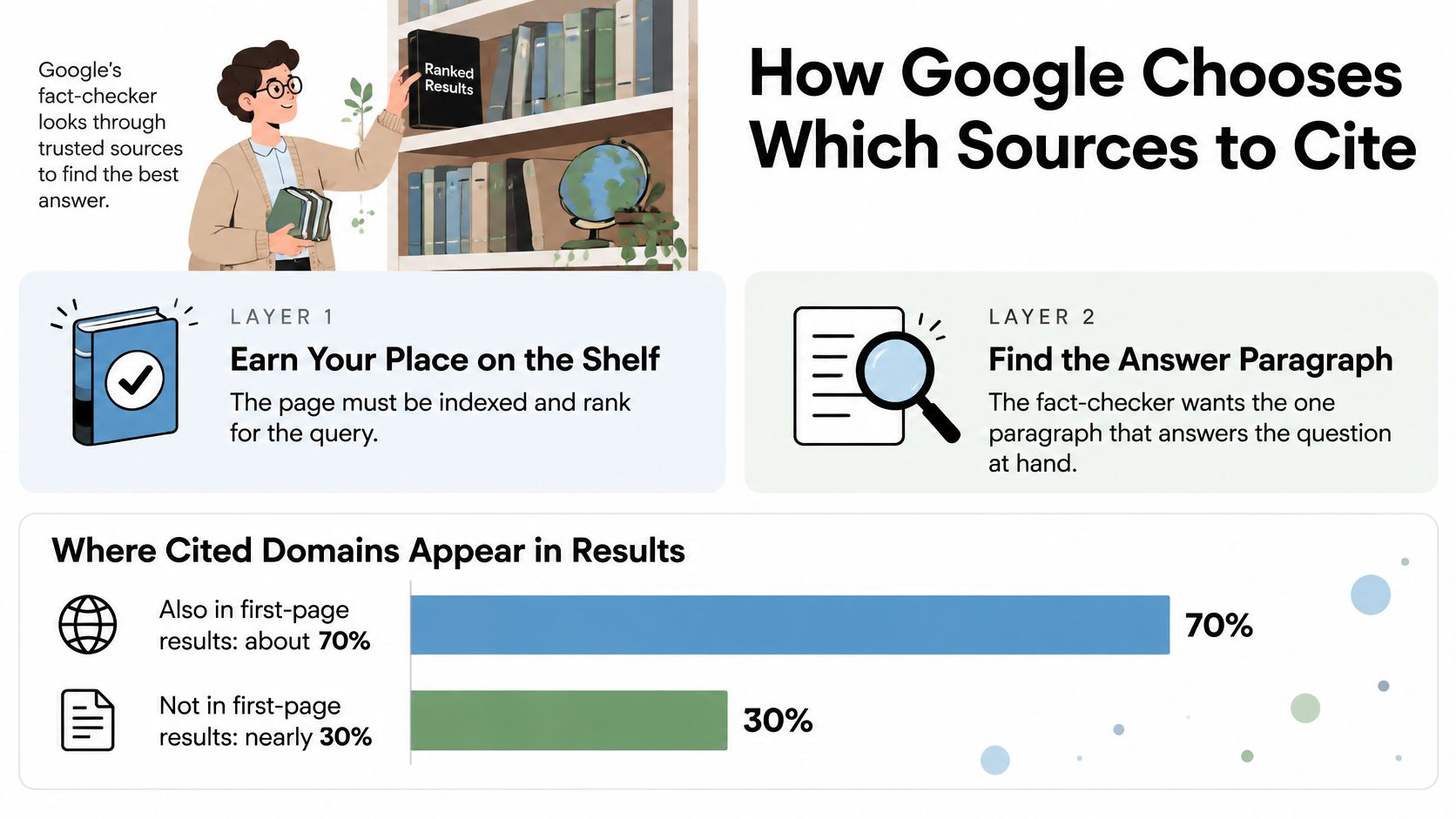
Think of a fact-checker at a reference shelf. The shelf is the ranked results. The fact-checker doesn't want the whole book, though. She wants the one paragraph that answers the question in front of her, with enough context to trust it. Citation works the same way, in two layers.
First, your page earns a place on the shelf. It needs to be useful, authoritative, and technically accessible enough to rank conventionally. Second, individual passages on that page need to resolve specific intents on their own. Definitions, comparisons, constraints, prices, procedures, and evidence should sit in clear sections, because Google can select a supporting passage instead of treating your page as one undifferentiated document.
The chart below sums up that two-layer logic.
What the Citation Split Actually Shows
An Ahrefs analysis of 1.9 million citations across 1 million Google AI Overviews found 76.1% of cited pages ranked in Google's top 10, 9.5% ranked positions 11 to 100, and 14.4% ranked below position 100 or did not rank in the conventional results. The three most visible cited URLs had a median organic ranking of 3. Ranking is therefore a strong predictor of citation. It isn't a guarantee, and the data doesn't prove that moving from position 6 to position 3 causes a citation.
Reading the split: Most citations come from the top 10, so ranking work still pays. The minority outside it proves ranking alone doesn't explain selection.
That distinction changes where you spend effort. A page can rank well and never be cited if its answers are buried in long, mixed-purpose paragraphs. A lower-ranking page can win a citation when it supplies evidence nobody else on the shelf provides, such as a dated test result or a precise constraint. So you need two checks, not one. Track organic position, and separately track whether the page appears as a cited supporting link.
Start with inventory, not new writing. List the queries where a citation would matter commercially, then mark which of your pages already rank in the top 10 for them. Those pages have layer one handled. Your next hour belongs to layer two, tightening the passages those pages would contribute.
Technical Eligibility Checklist for Overview Sources
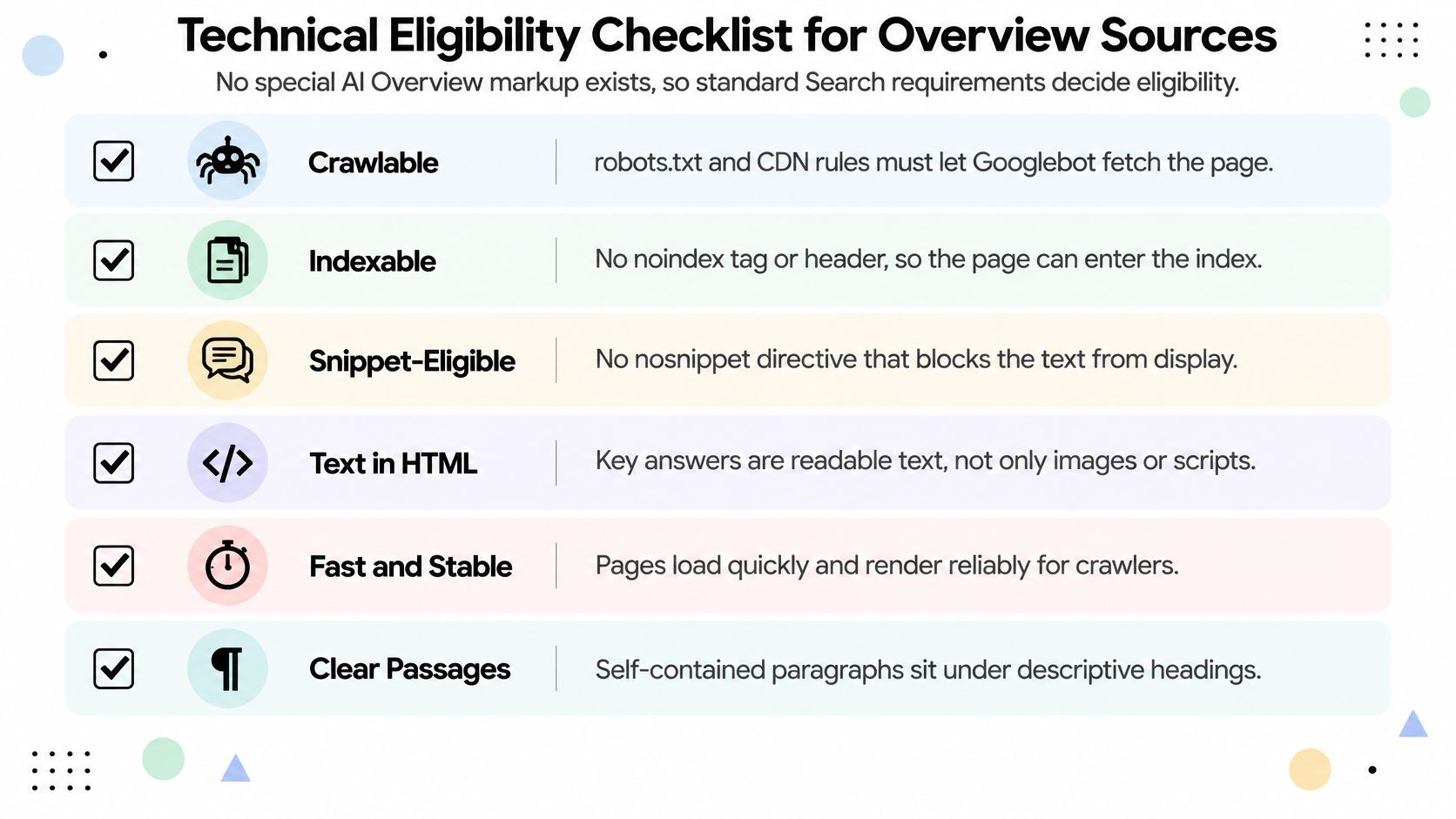
There's no separate doorway into AI Overviews. Google's documentation on AI features in Search states that AI Overviews require no separate optimization system, special schema markup, or additional technical eligibility criteria beyond standard Google Search requirements. A page must be crawlable, indexable, eligible to receive a search snippet, and compliant with Google Search policies. If Google can't crawl, index, or extract a page reliably, it can't use that page as a supporting link. Technical hygiene is a prerequisite, not an AI tactic.
The checklist visual below condenses the six checks worth running first.
Six Checks Before You Rewrite Anything
- Crawlable: Confirm robots.txt and CDN rules don't block Googlebot, because a blocked fetch ends the process before content quality matters.
- Indexable: Check canonical tags and remove accidental noindex directives, since a page outside the index can't be retrieved as a source.
- Snippet eligible: Remove any directive that blocks snippets, because Google needs permission to display extracted text.
- Visible text in HTML: Put key claims, prices, and specifications in machine-readable HTML text, not only inside images or scripts that may not render cleanly.
- Internally linked: Link related pages to the target page with descriptive anchors, so discovery doesn't depend on the sitemap alone.
- Structured data that matches: Keep any schema consistent with visible page content, and validate it in Google's Rich Results Test.
Schema deserves a specific warning. It can support search understanding and rich-result eligibility, but no dedicated AI Overview markup guarantees inclusion. Teams that spend a sprint adding FAQPage schema to pages Google can't index have bought decoration for a locked room.
For a broader audit sequence, small teams can borrow structure from search optimisation guidance for small businesses, then apply the eligibility lens above. If you want the visibility side framed end to end, this guide on how to appear in AI search results covers the adjacent surfaces. Your practical test this week is simple. Run your top 20 pages by business value through the URL Inspection tool in Google Search Console, and fix any page that isn't indexed or shows missing text before you write a single new paragraph.
Writing Passages AI Overviews Can Lift
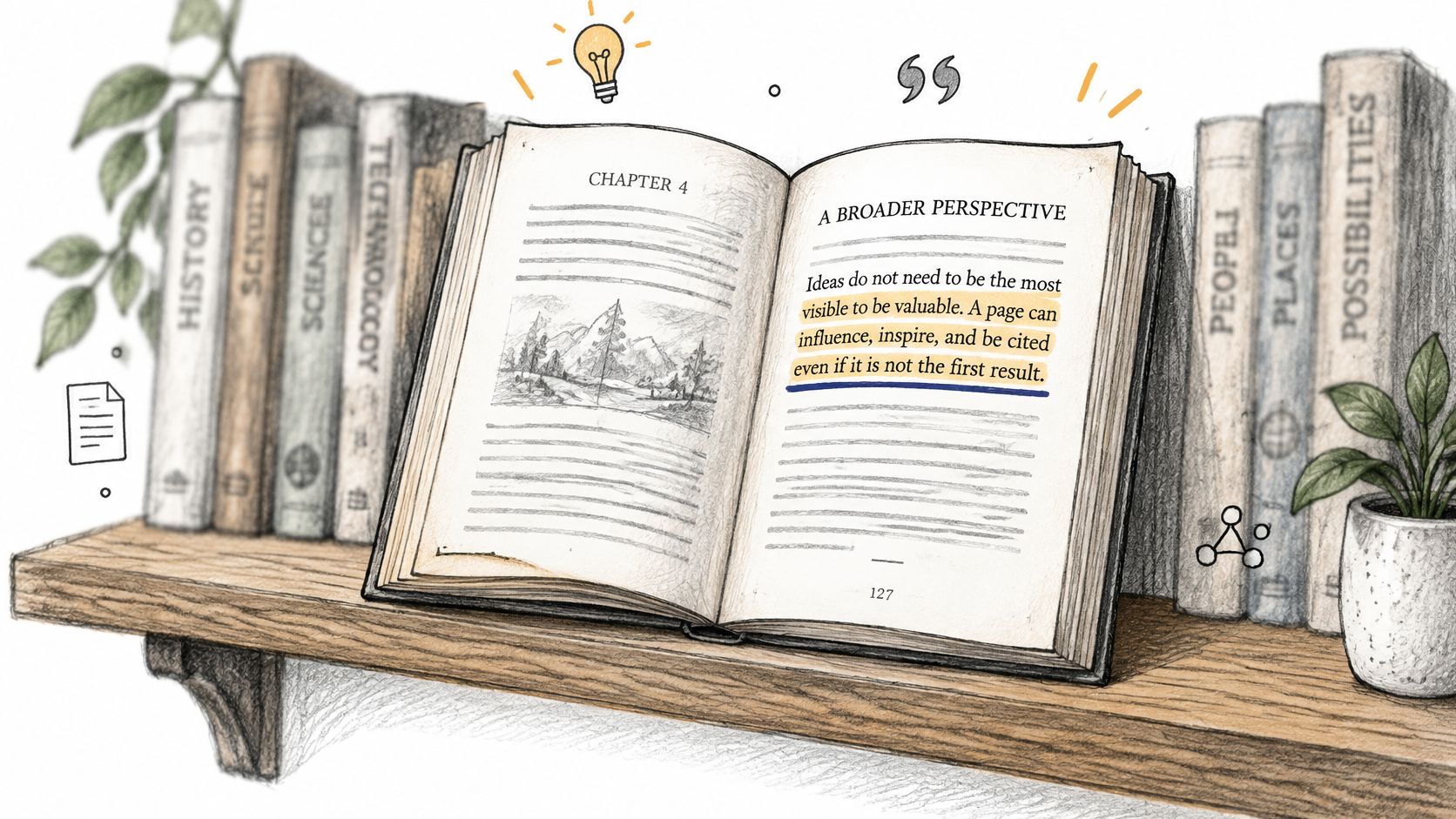
A page can rank outside the first page and still be cited. A large 2026 measurement study reported in ACM proceedings found nearly 30% of domains cited in AI Overviews did not appear on the accompanying first-page results. The finding separates citation from ranking: visibility inside an answer is a distinct outcome, so teams should shape passages for clear, specific claims rather than rely on position alone.
This image captures the shift from whole-page thinking to passage-level visibility.
Five Qualities That Make a Passage Citable
First-party evidence gives a passage a distinct basis: a benchmark, test run, or customer dataset can support a claim that competitors may only repeat. Original datasets can help too, even when small, if the method and date are clear.
Precise claim-to-source matching makes each figure understandable on its own. Name the source and date in the same sentence, so the passage retains its provenance if extracted. Clear, narrow passages answer one question under a heading that resembles the way users ask it. Aim for 40 to 80 words per passage. Corroboration adds support when independent sources agree, helping distinguish a well-supported point from a lone assertion.
Compare two versions of the same claim:
- Weak: "Our tool is fast."
- Strong: "Median report generation took 4.2 seconds across 1,200 test runs in March 2026."
The second is a scenario, but it demonstrates the mechanics: a measure, a sample, and a date. A reader can assess what “fast” means and check the method, while an answer system can quote the claim without interpreting vague marketing language.
A page with one strong, dated data point can outperform a longer page with none, because extraction rewards the passage, not the word count.
Claims also need maintenance. Unverifiable or stale information is less useful as a source. A precise figure can be skipped when outdated, or quoted after it no longer reflects reality. Date figures and schedule reviews so the passage remains dependable.
Track which passage is cited for each query, along with its source type and organic position at the time. That record makes citation actionable: “Our pricing constraints paragraph got cited for three comparison queries” identifies a passage and query pattern worth examining, unlike the vague report “We appeared.” Citation tracking can therefore guide writing even when ranking and clicks tell a different story.
Measuring Citations, Clicks and Pipeline Together
A page can be cited and still lose traffic. Pew Research findings reported by The Indian Express show users clicked a traditional result in only 8% of visits when an AI Overview appeared, versus 15% when one did not, based on browsing activity from more than 900 U.S. adults. Treating inclusion as an uncomplicated win ignores that trade-off. You need four separate outcomes, because each one can move without the others.
The funnel below shows why those outcomes shouldn't be collapsed into one metric.
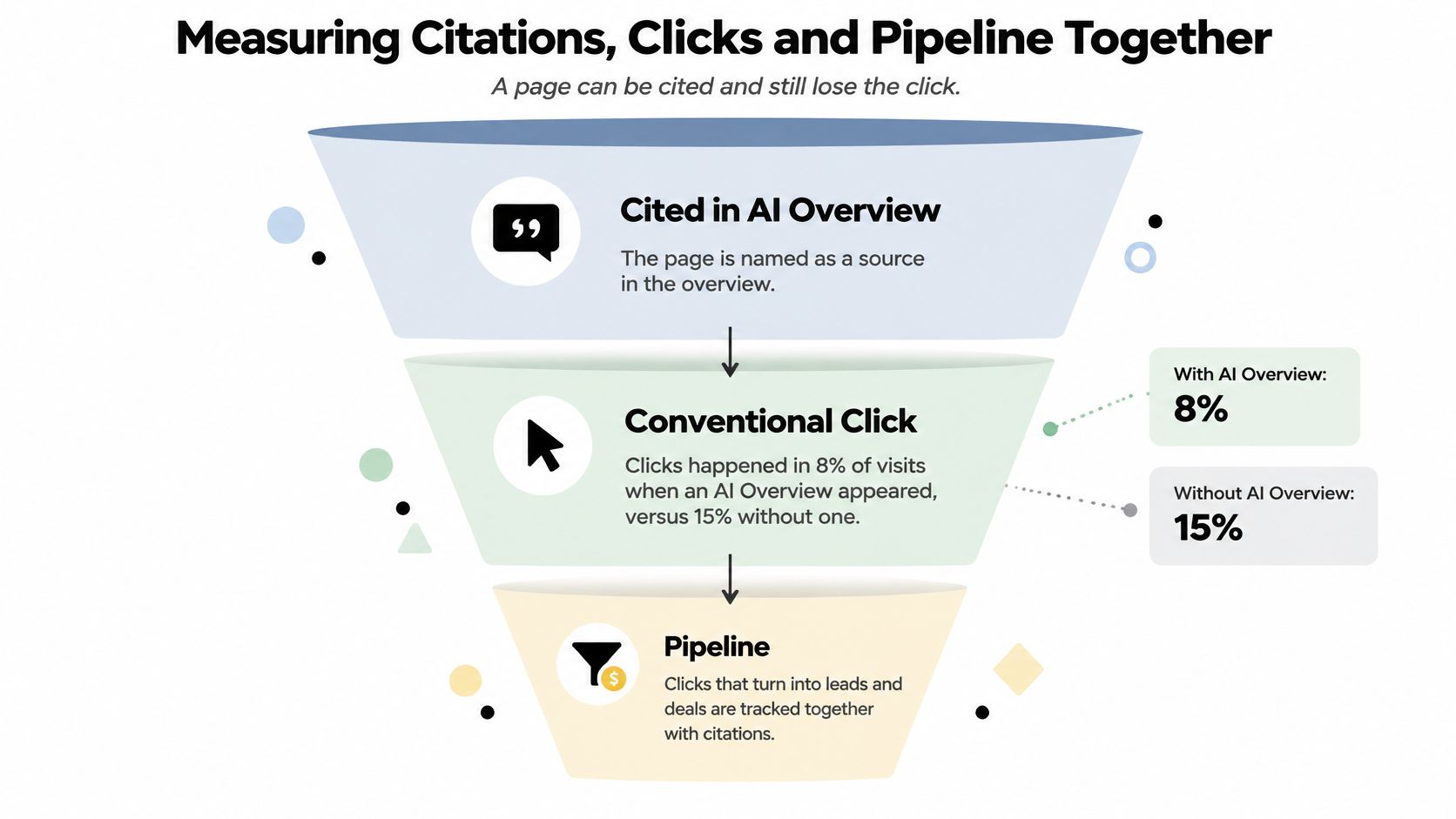
Separate being cited as a source, being mentioned without a link, receiving a click, and producing a conversion. Then add the demand signals clicks miss, namely branded searches, direct traffic, and assisted conversions. The logic runs in sequence. A citation creates awareness inside the answer. Branded search shows whether anyone remembered you. Signups show whether the exposure was persuasive. Google reported in 2025 that AI Overviews increased Google usage by more than 10% for query types that trigger an overview in the United States and India, which suggests more searching overall, but it doesn't prove any given site gains visits from that growth.
This video walks through how AI answers change click behavior in practice.
Outcomes to Track for AI Overview Optimization
| Outcome | How to track it | Warning sign |
|---|---|---|
| Cited as a source | Monthly check of a fixed query list, logged by passage | Cited on queries that never produce visits or signups |
| Mentioned without a link | Brand mentions in the summary text for your query list | Mentions rise while branded searches stay flat |
| Click from the cited page | Search Console clicks filtered to the page | Clicks fall while impressions hold steady |
| Branded search | Search Console query report filtered to brand terms | No change in brand queries after citations begin |
| Conversion | Analytics signups or purchases from organic and direct visits | Visits rise but signups stay flat |
Small SaaS sites often lack the traffic to infer impact from ranking reports, so use a fixed panel instead. Pick 30 to 50 buyer questions, check them monthly, and log citation status, cited passage, and branded search movement afterward. To keep position data trustworthy alongside that log, use a consistent method to check your Google rankings reliably, and connect the results to revenue using the framework in this guide to measuring SaaS marketing ROI. The contrarian conclusion follows. Some businesses should optimize for answer inclusion and demand creation even when no click follows. Others should stop investing in informational queries where zero-click behavior dominates and no branded lift appears.
Three Teams and Where Each Should Start
Scale makes this decision urgent for everyone, not just large publishers. TechCrunch reported Google's 2025 figure that AI Overviews had reached 2 billion monthly users, up from 1.5 billion in May of that year. Budget decides how many queries a team can cover. It doesn't decide whether the method applies.
Solo Indie Founder Selling a Developer Tool
Say a founder sells an uptime monitoring tool. Most buyer questions are informational, such as how to monitor uptime or what a good response threshold is, so the Overview often answers without a click. She can't out-produce larger rivals, and she doesn't need to. She writes a short, sourced answer for ten buyer questions, each with one verifiable claim from her own product data. Her first move is a monthly log of citations and signups for those ten queries, accepting low clicks as the cost of appearing in the answer.
Small B2B Marketing Team With a Content Budget
A four-person team at a B2B SaaS company has writers but limited analyst time. They skip broad educational posts and prioritize comparison and pricing passages with verifiable numbers, because those sections lift cleanly and sit closer to purchase decisions. They track clicks and conversions per page in Search Console and their analytics tool, and they kill pages that earn citations but never assist a signup. Their first move is rewriting the pricing and comparison sections on pages that already rank, with named sources and dates on every figure.
Agency Managing Several Client Products
An agency with six SaaS clients can't hand-craft a process per account. It builds one audit template covering eligibility, passage quality, and citation logs, then ranks each client's queries by buyer value before anyone writes. Reporting shifts from traffic alone to citation share by client each month, paired with branded search and pipeline notes. Their first move is running the eligibility template across every client's top pages, because one blocked crawl path can silently zero out a whole quarter of content work.
Common Pitfalls and How to Fix Them
Most failures start as reasonable beliefs. Rankings matter, so teams optimize only for rankings. Inclusion feels like winning, so teams count it and stop. Each belief contains enough truth to survive a quarterly review, which is why the mistakes compound. A vague claim on an unindexed page wastes both the writing and the measurement, because you can't tell whether the passage failed or was never eligible.
Verification deserves its own warning. A 2025 Tow Center for Digital Journalism study covered by Nieman Lab tested 1,600 queries across eight AI search engines and found the engines retrieved incorrect citation information more than 60% of the time. If your figures are wrong or stale, a citation can spread the error under your name.
Pitfalls, Why They Hurt and the Fix
| Pitfall | Why it hurts | Fix |
|---|---|---|
| Optimizing only for rankings | Misses citations from pages outside the top 10 | Track citations by query and passage |
| Counting inclusion as a win | Citations can coincide with lost clicks | Pair citations with clicks and conversions |
| Vague claims without sources | Passages have nothing to match against | Name the source and date for each figure |
| Treating schema as the fix | No markup guarantees inclusion | Fix crawl access and visible text first |
| Chasing every query | Zero-click informational queries may not pay | Rank queries by buyer value before writing |
| Leaving figures unverified | Wrong numbers get cited and damage trust | Re-check every figure on a fixed schedule |
Use the table as a review checklist, not a reading list. For each page you care about, mark which row it currently fails. The fix column points to the discipline that resolves it, whether that's passage rewriting, technical repair, or measurement. If a page fails three rows, it isn't an optimization candidate yet. It's a rewrite candidate.
Confirm Eligibility Before Writing New Pages
Start with the pages and questions most likely to produce useful citations. Work through these actions in order.
- Check your top 20 pages by business value against the eligibility checklist. Fix pages that are not indexed or lack visible text, since content that cannot be crawled cannot be cited.
- List 10 to 20 buyer questions. Check which trigger an AI Overview and which pages it cites. This identifies where citation opportunities exist.
- Rewrite passages on pages ranking in the top 10 for those questions. Add named sources and narrow answers. These pages already have the ranking layer in place, so passage improvements can focus on making their evidence and answers easier to cite.
- Start a monthly citation log with the query, cited passage, and organic position. Tracking all three helps distinguish citation changes from ranking changes.
- Review after 90 days. Compare citations with branded search and signups before deciding which pages to expand.
Forum threads, including Reddit posts, can rank in Google and be cited by AI assistants. Treat them as an optional channel: contribute only when a thread addresses a real buyer question and your reply follows the subreddit's rules. Bazzly monitors relevant subreddits and drafts context-aware replies for high-intent threads, helping teams handle that monitoring without doing it manually.
If relevant Reddit threads are part of your citation plan, Bazzly monitors subreddits around the clock, identifies high-intent conversations, and helps you post useful replies that can keep your product visible beyond Reddit. Use insights from those threads to refine your buyer-question list and citation log. Citation appearance is a separate outcome from ranking or clicks, so track whether answers cite your content, then assess the branded search and signups that follow.
Written by Bazzly Team
Bazzly builds software that finds buyer conversations on Reddit and posts helpful replies in them (227,592 posts flagged for customers since June 2, 2025). The Bazzly numbers we quote come from our own data, published with the method in our research studies. About us