LinkedIn Lead Generation Strategy That Actually Converts
The most popular advice on LinkedIn is also the most expensive to follow. You're told to post more, use native forms because they convert better, and celebrate every download as a lead. That playbook fills dashboards. It rarely fills pipeline.
A working LinkedIn lead generation strategy starts from a different question. How many of these contacts match your buyer, reply to follow up, book a meeting, and become revenue? If you can't answer that, you're not running lead generation. You're buying form fills and hoping sales can sort them out.
Table of Contents
- Why Most LinkedIn Lead Generation Strategies Stall
- Defining the Right Audience Before You Spend a Dollar
- Choosing Between Thought Leadership, Lead Forms, and Landing Pages
- Building Content That Earns Replies, Not Just Impressions
- Outreach and Automation Without Burning the Account
- Qualifying Leads and Routing Them to the Right Next Step
- Measuring What Matters and Closing the Loop
Why Most LinkedIn Lead Generation Strategies Stall
LinkedIn gets used like a broadcast channel, then judged like a sales channel. Teams post broad content, run broad targeting, and push a demo to people who have never named the problem. Activity looks healthy. Pipeline doesn't move.
That's not because the audience isn't there. LinkedIn Marketing Solutions reports that 89% of B2B marketers use LinkedIn for lead generation, while 62% say the platform generates leads for their organizations, more than twice the rate attributed to the next highest social channel in the cited Wpromote research. The same source notes that 75% of prospective buyers say thought leadership influences which vendors make their shortlist, which tells you credibility has to come before conversion.
The four hidden costs
Most stalled programs share the same four problems, and none of them show up in a click report.
- Cheap leads that cost sales time: A low cost per lead means little if the contact has no budget, no authority, or no active problem. Every unqualified submission still gets opened, researched, and chased.
- Slow follow up: A lead who downloaded a guide on Tuesday and hears from you the following week isn't warm. They're someone who already moved on or talked to a faster competitor.
- Misaligned offers: A generic ebook attracts generic curiosity. If the offer doesn't map to a specific, painful job your buyer owns, intent stays low no matter how tight the targeting is.
- Vanity metrics: Impressions, clicks, and raw submissions reward volume. They hide whether targeting, creative, or routing is working.
The best LinkedIn campaign may produce fewer leads than the cheap one. If it produces more sales ready conversations, it's the cheaper campaign.
Treat LinkedIn as a precision channel. Its value is professional context and segmentation by title, seniority, industry, company size, and account, not raw reach. When you optimize for qualified pipeline instead of submission volume, every downstream decision changes, including who you target, what you offer, and how much friction you deliberately keep in the form.
Defining the Right Audience Before You Spend a Dollar
Targeting mistakes are the hardest to fix after launch. Creative can't rescue an audience that never had the problem, and a great offer sent to the wrong seniority band produces polite downloads from people who can't buy. Do the segmentation work first.
Start with an ideal customer profile built from your best existing customers, not from who you wish would buy. If you're early and don't have that data, build it from won calls, lost deals, and the accounts your competitors visibly serve. Approaches from practical customer segmentation strategies for small teams help here, because the discipline is the same. Segment on fit and buying context before you segment on reach.
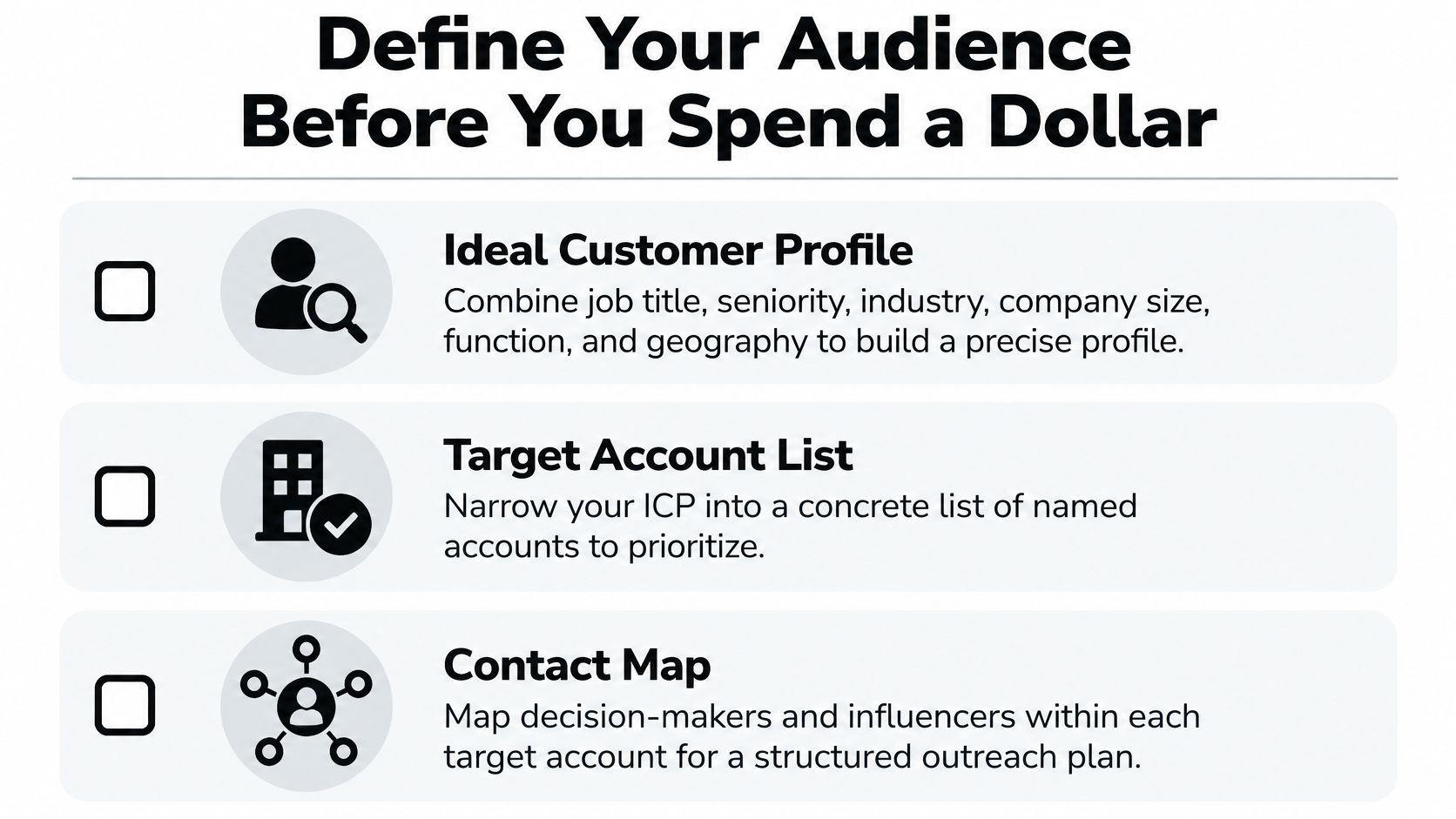
Build in three layers
First, define firmographic fit. Industry, company size, geography, and business model decide whether your product is even relevant. A workflow tool built for small operations teams shouldn't target enterprise accounts just because the logo looks impressive in a report.
Second, build a target account list. Turn the profile into named companies you can research, prioritize, and hand to sales. Account based targeting beats persona targeting alone. Personas tell you who to reach. Accounts tell you where budget and urgency live.
Third, map contacts inside each account. You need the economic buyer, the person who owns the painful workflow, and the people who influence or block the decision. Selling to one enthusiastic user with no path to the other two is how deals stall after a good first call.
Score fit before launch
Give sales a simple rubric they helped write, so qualification later isn't an argument.
- Strong fit: Right industry and size, right function and seniority, clear trigger such as hiring, expansion, or a relevant tool change.
- Workable fit: Right company profile, but the contact influences rather than owns the decision.
- Weak fit: Right title, wrong company context, or right company with no plausible owner for the problem.
Watch two common filter mistakes. Targeting by job title alone overshoots, because the same title means different things at different company sizes. Stacking too many narrow filters undershoots and leaves you with an audience too small to learn from. Size the audience against your sales capacity. If one founder handles follow up, a tight, high fit list beats a large list nobody can work properly.
Choosing Between Thought Leadership, Lead Forms, and Landing Pages
These three paths do different jobs, and comparing them on cost per lead alone leads to bad budget calls. Thought leadership builds shortlist credibility. Native forms reduce friction. Landing pages let you qualify harder and tell a fuller story. You need to know which job you're paying for.
The paid numbers set realistic expectations. A 2025 benchmark of 138 B2B advertisers reported an average LinkedIn cost per click of $9.39, a 0.67% click through rate, and a $202 cost per lead. Native Lead Gen Forms in that dataset averaged a $11.93 CPC and 0.61% CTR, at roughly $193 per lead versus $346 for traffic sent to a landing page, with a 6.2% click to lead rate for native forms.
Read that carefully. Native forms cost more per click but less per lead, because prefilled profile data removes friction between the click and the submission. That's a statement about conversion efficiency. It says nothing about whether those leads reply, qualify, or buy.
LinkedIn acquisition paths at a glance
| Path | Typical cost per lead | Conversion friction | Lead quality signal |
|---|---|---|---|
| Thought leadership content | No direct media cost, paid in time | Low, no form required | Weak at capture, strong for shortlist trust |
| Native Lead Gen Forms | Lower in the benchmark cited above | Very low, prefilled profile fields | Weak unless you add a qualification question |
| External landing page | Higher in the benchmark cited above | Higher, page load plus manual fields | Stronger, effort itself signals intent |
When each path earns its budget
Use thought leadership when buyers don't yet trust you or can't articulate the problem. Webinars, teardown posts, and problem specific guides do the credibility work that a form can't. Skipping this layer and going straight to gated offers is why cold audiences ignore good targeting.
Use native forms when the offer is tightly matched to a narrow, high fit audience and follow up is fast. The friction you remove is only an advantage if the people converting were already the right people. Add one problem specific question so a submission tells sales something useful.
Use a landing page when qualification depth matters more than volume, when the offer needs explanation, or when you want behavioral data from the visit itself. A lower conversion rate here isn't automatically failure. If the page filters out casual downloaders, your cost per qualified opportunity can improve while cost per lead looks worse.
Practical rule: Test native forms against landing pages on the same audience and offer, then judge the winner on meetings and opportunities, not submissions.
Building Content That Earns Replies, Not Just Impressions
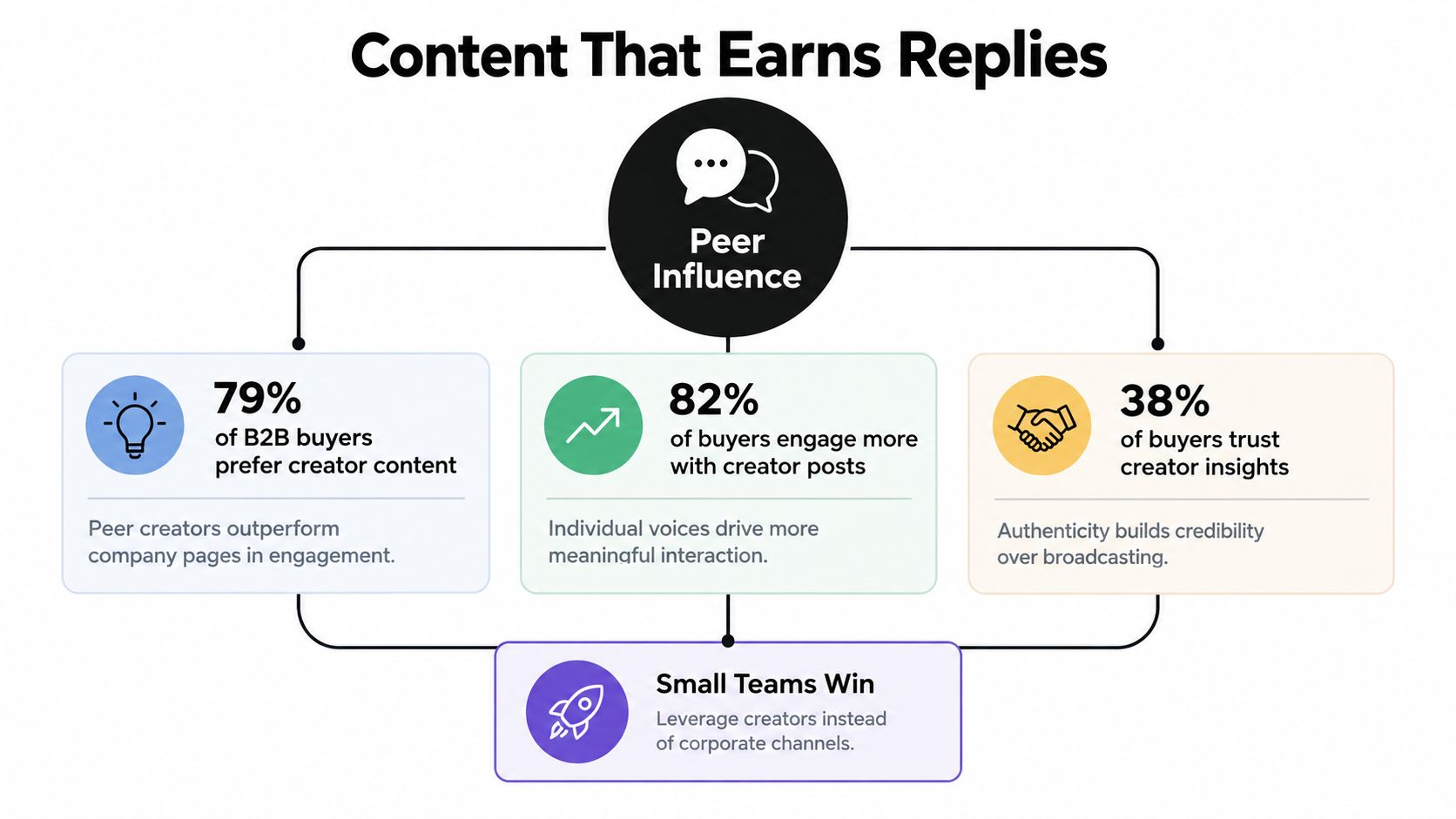
Company page broadcasting is losing to people. Buyers scroll past polished brand posts and stop for a peer who names a problem they recognize. Research covering B2B buyers in the US, UK, and India found that 79% engage with B2B creator content at least monthly, 82% say it influences them, and 38% have connected with a salesperson in response to creator content.
That doesn't mean a small team should pretend to be influencers. It means distribution runs through trusted individuals, so founder expertise, customer evidence, and employee perspective need to do the work your company page can't. Tactics for consistency are covered in guides on how to grow on LinkedIn as a small team, and the insights from Bruce and Eddy on LinkedIn content strategy make a similar point about planning content around audience intent rather than posting volume.
Four pillars that start conversations
- Problem framing: Name a specific, costly situation in your buyer's words. Specificity is what makes someone comment that they're dealing with exactly that.
- Risk reduction: Explain what goes wrong with common approaches, what to check before buying, and what a bad implementation looks like. Buyers use creator content to evaluate risk, not just to discover products.
- Comparison: Help readers weigh alternatives, including doing nothing or using a competitor. Content that only praises your category reads as advertising.
- Proof: Customer stories, teardowns of real workflows, and behind the scenes decisions. Evidence travels further than opinion because readers can forward it internally.
Formats matter less than point of view, but some travel better. Teardowns of a broken process, contrarian takes backed by your own operating experience, and short case narratives with a clear before and after tend to earn substantive replies. Generic tips lists earn likes from peers, not messages from buyers.
Keep the cadence sustainable. A founder publishing two considered posts a week and commenting usefully on buyer conversations will outperform a daily schedule of filler. Comments deserve real effort, since a sharp comment on a prospect's post often starts the relationship that a later message converts.
Measure this layer on assisted conversations, profile views from target accounts, and replies, not impressions. If a post reaches many people outside your account list and starts no buyer conversations, it performed well as media and poorly as lead generation.
Outreach and Automation Without Burning the Account
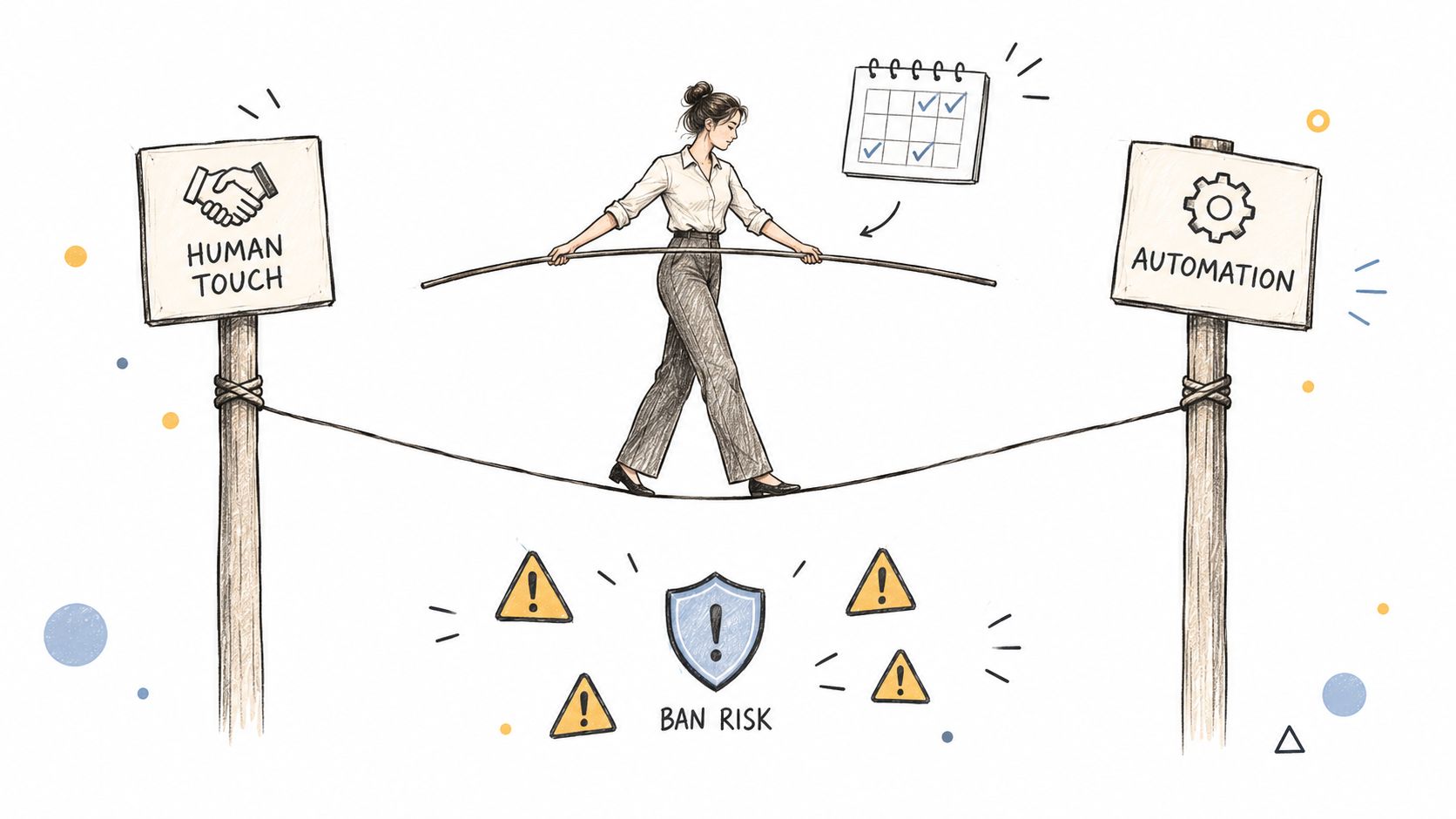
Outreach fails in two opposite ways. Teams either send careful messages so slowly that nothing compounds, or they automate aggressively and damage the account and the brand at the same time. The workable middle is narrow targeting, genuine personalization, and restraint.
The balance between a human touch and tooling is easier to see than to describe.
A sequence that respects the reader
Connection request. Reference something real, a post they wrote, a shared account context, or a specific problem their role owns. Don't pitch in the request. You're asking for permission to be in their feed, nothing more.
First message after acceptance. Lead with the problem, not your product. One relevant observation and one easy question beats a feature list. If your content layer is working, many of these people have already seen your name, and the message feels like a continuation rather than an ambush.
Follow ups. Space them out, change the angle each time, and add something useful, a relevant teardown, a customer example, or a direct question about how they handle the workflow today. Repeating the same ask louder is what gets you ignored or reported.
Handoff. When a conversation turns real, move it to email or a call and log it in your CRM with the context intact. Don't keep substantive selling inside a chat thread your team can't see.
Where automation becomes a liability
Tools that scrape aggressively, send at inhuman volume, or rotate activity to dodge platform limits put the account at risk, and many off platform tools sit outside LinkedIn's terms. The account you're risking usually belongs to a founder whose name carries your credibility. Losing it costs more than any sequence gains.
Compliant scaling looks boring. Small, well researched batches, human review before sending, and personalization variables that reflect actual research rather than a merged first name. If you're evaluating sending tools as part of that stack, a quick guide to replacing providers is useful context for what switching involves before you commit a domain or a profile to a new platform.
This walkthrough shows the mechanics of structuring outreach so each touch has a reason to exist.
Qualifying Leads and Routing Them to the Right Next Step
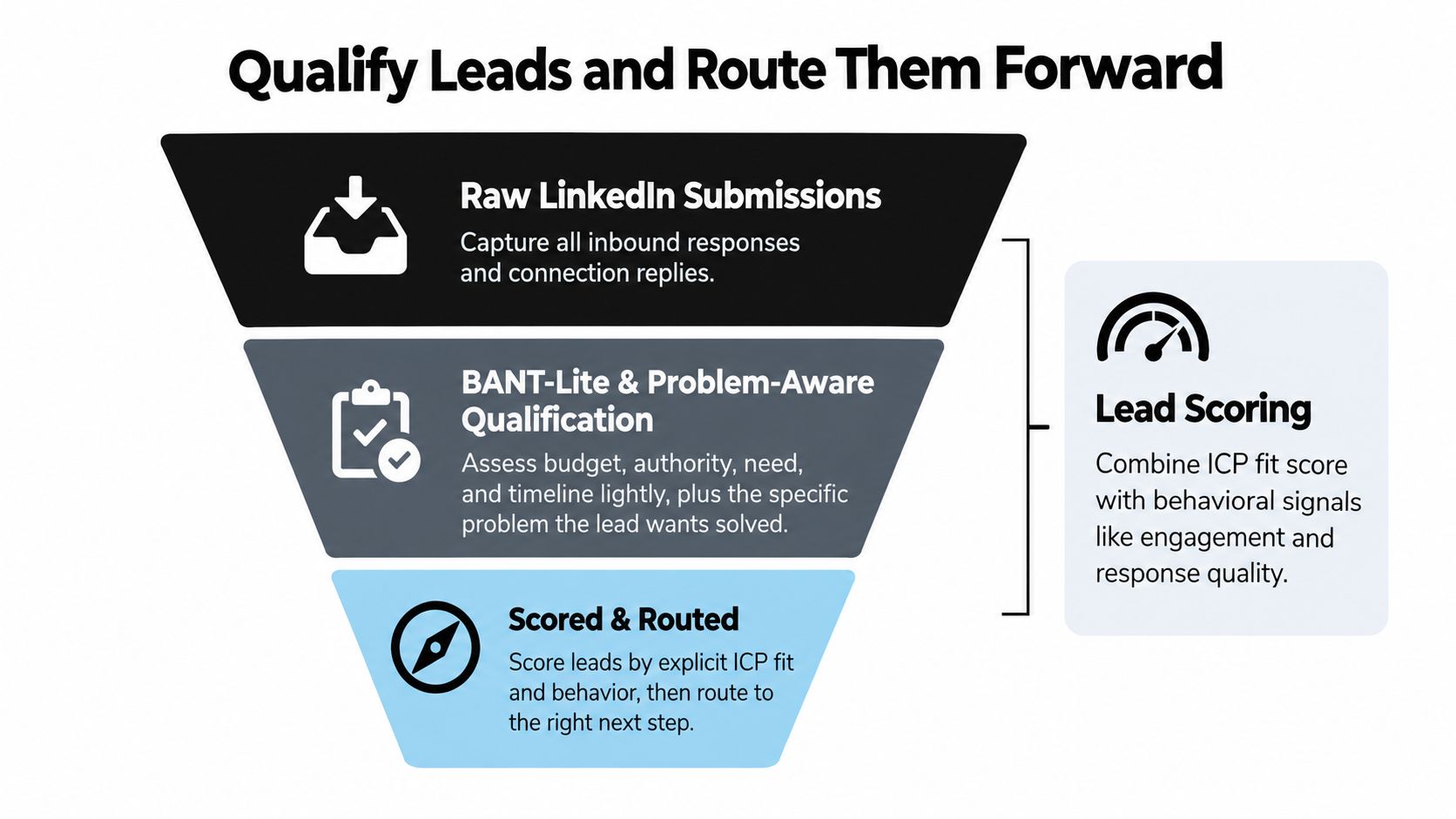
A submission is raw material, not pipeline. The gap between the two is a qualification layer, and most small teams skip it because the form already collected a name, title, and company. Those fields tell you who someone is. They don't tell you whether they have the problem, own the decision, or want to talk.
That is precisely the point where low-cost acquisition becomes pricey. Benchmark reporting on native forms versus landing pages measured cost per lead, but lead quality, sales acceptance, and opportunity creation were not measured in the same dataset, so a cheaper submission can still produce worse pipeline if it's routed to sales unfiltered.
Qualify lightly, but qualify
Full BANT interrogation on a first touch kills replies. Use a BANT lite approach instead, one or two signals gathered naturally. Ask which problem prompted the download, how the team handles it today, or what timeline they're working to. A single problem specific question on the form does more filtering than five demographic fields, because casual downloaders won't bother answering it well.
Sometimes friction is the point. A longer form or a required open text answer lowers conversion and raises intent. For a founder led team with limited follow up capacity, that trade is usually worth making deliberately rather than discovering it after a month of chasing dead contacts.
Score and route with explicit rules
- Fit score: How closely the account and contact match the profile you defined before launch.
- Behavior score: Reply quality, content engagement from target accounts, repeat visits, and the specificity of their answers.
- Route to sales: Strong fit plus a named problem or a direct request to talk. These get fast, personal follow up.
- Route to nurture: Good fit, no active problem yet. Send proof and problem framing content, not meeting requests.
- Route out: Poor fit or no plausible owner. Thank them, deliver the asset, and spend no sales time.
Push enriched data straight into the CRM, including the campaign, offer, and qualification answer, so nobody retypes profile information or opens a call blind. Sales should see why this person was routed to them in one glance. If they can't, the routing rule isn't finished.
If sales can't explain why a lead reached them, you don't have a routing problem. You have a qualification problem upstream.
Measuring What Matters and Closing the Loop
Most LinkedIn dashboards answer the wrong question in great detail. Click through rate and form fills tell you whether an ad got attention. They don't tell you whether the channel is worth its cost, and LinkedIn is expensive enough that you need that answer.
Track a short list weekly and review it with sales in the room.
- Cost per qualified opportunity: Total spend divided by opportunities sales accepted. This is the number that decides whether a campaign lives.
- Sales accepted lead rate: The share of routed leads sales agrees were worth working. A falling rate points at targeting or offer problems.
- Meeting booked rate: Separates polite replies from real intent.
- Opportunity to close rate and payback period: Connects acquisition cost to revenue and cash, which is where a small team should judge any channel. The mechanics behind your lead generation rate matter here, because a healthy rate at the top can still hide weak qualification below it.
A 30 day starter sequence
Week one. Finalize the profile, account list, and fit rubric with sales. Pick one problem specific offer.
Week two. Publish founder led problem and proof content, engage in buyer conversations, and warm the account list before spending.
Week three. Launch one native form campaign and one landing page variant to the same audience with one qualification question on each. Run small, personal outreach batches in parallel.
Week four. Compare the paths on accepted leads, meetings, and cost per qualified opportunity. Cut the loser, tighten the routing rules, and feed what sales learned back into targeting and creative.
On the common questions, ads and outbound aren't rivals. Ads scale a proven message, outbound starts conversations before you have one. First pipeline takes as long as your buying cycle demands, so judge early weeks on reply and meeting quality. An agency rarely fixes an undefined audience or offer, so settle those before outsourcing execution.
A smaller, qualified pipeline you can work will beat a large list of strangers every quarter.
If LinkedIn is only one of the places your buyers ask for recommendations, Bazzly helps founders and small teams turn high intent Reddit conversations into qualified leads by monitoring relevant subreddits around the clock and placing context aware replies where people are actively looking for solutions. It's built for busy teams that want repeatable acquisition without spending their week hunting threads manually, so visit Bazzly and see how it fits alongside your LinkedIn pipeline.
