On this page
- Where Agency Leads Come From and What Each Source Returns
- How to Turn Public Buying Intent Into Conversations
- Qualification Criteria to Set Before You Pay for Leads
- Measuring Cost per Qualified Opportunity, Not Lead Count
- Contract Terms and Attribution Rules for Outsourced Leads
- Confirm Your First Two Channels This Week
Your team can fill a client's pipeline, but your own sales calendar has gaps. A referral has gone quiet, a proposal is sitting unanswered, and the founder is spending delivery time chasing prospects who may never buy.
Lead generation for agencies needs a qualification system, not just more activity. Build around the sources that already produce suitable clients, answer public conversations where buyers have named a problem, and measure what it costs to create an accepted sales opportunity.
Where Agency Leads Come From and What Each Source Returns
Lead sources and reported results for agencies
| Source | Reported figure | Where the figure comes from | How to use it |
|---|---|---|---|
| Client referrals | 66% rank referrals from existing and past clients as their top source of new business | SparkToro and Paddy Moogan's survey of 612 agency owners and consultants, cited by Reach Marketing | Build referral requests into successful client milestones |
| Social outreach | 60% identify it as their most successful business-development method | Scaled's State of Agency 2025 report | Test public, intent-based replies |
| Social media overall | 50% say it drives the most leads | The same Scaled agency survey | Maintain a useful presence in buyer communities |
| Conferences and trade shows | 14% rate them successful | The same Scaled agency survey | Make them a low priority unless buyer access is unusually strong |
| Referral-sourced leads | 56% lead-to-MQL conversion | Cross-industry benchmark reported by IvyForms | Prioritize relevant warm introductions |
| All lead sources | 31% average lead-to-MQL conversion | The same cross-industry benchmark | Use as context, not an agency-specific target |
These figures measure different things. A channel's popularity, a respondent's assessment of success, and a funnel conversion rate aren't interchangeable measures of return. Your own accepted opportunities and acquisition costs decide where you invest.
Build the base before buying volume
Referrals should be an operating habit rather than a pleasant surprise. Ask after a client acknowledges a useful result, and describe the person and problem you want an introduction to. A vague request for anyone who needs marketing makes the client do your targeting work.
Social outreach is the next channel I would test for a small team. You can inspect a buyer's situation before investing in a conversation, unlike a broad campaign that captures contact details first and discovers relevance later.
Conferences deserve a stricter spending test. Attend when named buyers will be there and you can arrange relevant conversations, not because the event promises networking. Travel, preparation, attendance, and follow-up all belong in the acquisition cost.
Judge the conversion, not the channel label
A qualified lead still isn't a signed client. In 2025, 39% of agencies reported converting 25%–49% of qualified leads into clients, according to SparkToro's State of Digital Agencies survey.
Keep case studies and service pages available to help prospects validate your expertise, but don't mistake publishing for distribution. Use Lead Printer's agency lead generation playbook to pressure-test your acquisition plan, and build a focused LinkedIn lead generation strategy if that's where your buyers discuss their work.
Start by listing your last ten won clients and tagging their originating channels. Compare that list with the table, then investigate any channel consuming time without producing suitable clients.
How to Turn Public Buying Intent Into Conversations
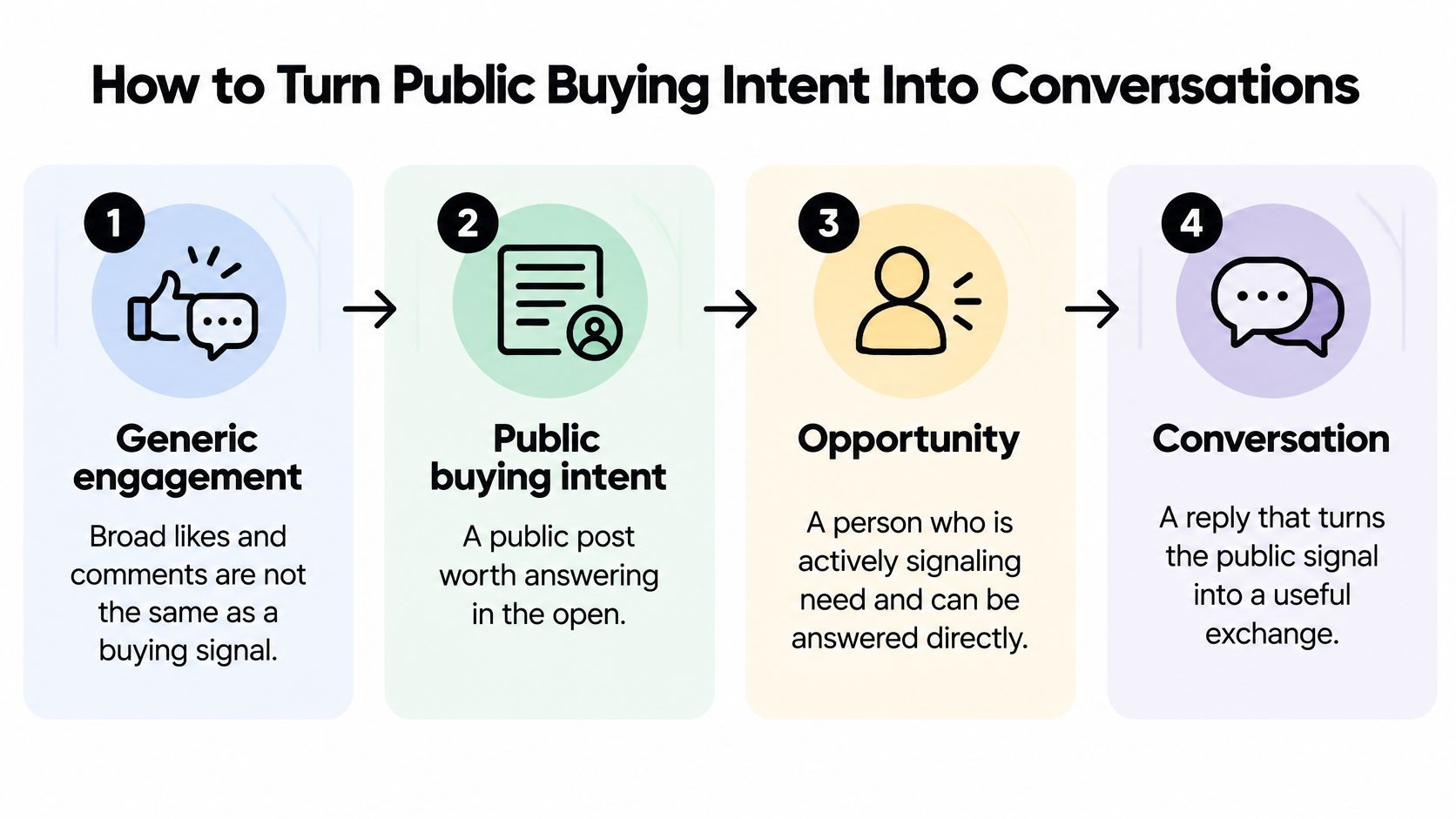
A like isn't a buying signal. Neither is a broad question about marketing trends. Someone describing an agency handover problem and asking how to evaluate replacements gives you a much stronger reason to respond.
For this workflow, an opportunity is a Reddit post worth replying to publicly. A lead is the person who wrote a matching post, surfaced so you can reach out privately by DM. Neither should automatically become a sales opportunity in your CRM.
The distinction helps you keep useful participation separate from prospecting.
Run a context-first routine
-
Choose communities by buyer presence. Find subreddits and professional groups where your target clients ask operational questions, not just places where marketers promote services. Collect their problem phrases, such as inconsistent lead quality, unreliable attribution, or replacing an agency.
-
Set a relevance threshold. Prioritize posts where someone names a problem, compares alternatives, or requests a recommendation. Skip broad engagement prompts and questions unrelated to the service you can deliver.
-
Score intent before answering. Classify the post as active provider evaluation, live problem-solving, or general learning. Keep fit separate from intent, because an urgent problem at an unsuitable company still isn't a commercial opportunity.
-
Answer the exact situation publicly. Offer a useful diagnostic question, decision criterion, or next action without putting a link in the first comment. Read community rules, disclose relevant affiliations, and don't turn someone's discussion into an unsolicited pitch.
-
Ask permission before moving privately. A response gives you context for a permission request, not blanket permission to sell. Reference what they wrote and offer a specific next step they can decline.
-
Log the thread's outcome. Record the post, intent category, reply, response, permission status, and subsequent meeting outcome. Include skipped threads and rejection reasons so you can improve targeting rather than merely send more replies.
Bazzly can monitor chosen subreddits and draft contextual replies, while your agency decides what to post. For leads, we fill the DM template with what the person wrote; many start in manual mode for a week to learn what a good opportunity looks like before switching Autopilot on.
Set up Reddit alerts around buyer problems, not just your service category. Someone discussing failed sales handoffs may be more relevant than someone mentioning lead generation in passing.
Use language that earns the next response
Good public reply
You're weighing a switch from in-house ads to an agency. Before you pick one, check whether they report cost per qualified meeting instead of clicks. Happy to share the questions I'd use to assess their reporting.
Bad public reply
Hey! We're a top growth agency and can double your leads. DM me for a free audit.
The first response gives the buyer a decision criterion. The second makes an unsupported promise and asks for attention before earning it.
Permission DM after a relevant response
Thanks for sharing the churn problem you mentioned. Would a short call this week help you assess whether a lifecycle messaging fix is worth testing?
Referral ask after a successful delivery milestone
Who in your network is dealing with the same reporting problem we just solved for you?
These are suggested scripts, not claims about results. Adapt them to the person's actual situation rather than pasting them mechanically.
If the founder becomes the follow-up bottleneck, use the Hire Appointment Setter resource from hireSDR.com when considering delegated scheduling. Keep qualification and permission requirements intact when handing the work over.
Narrowing activity is the point. A relevant answer to a defined problem is a better test than a larger batch of messages to people who haven't expressed a need.
Qualification Criteria to Set Before You Pay for Leads
If a prospect fails fit or authority, stop qualification. Strong interest doesn't compensate for a company you can't serve or a contact with no buying role.
Treat qualification as a written rule set. A marketing-qualified lead, or MQL, matches your target market and shows a buying signal. A sales-qualified lead, or SQL, requires sales acceptance or a booked discovery meeting under your agreed definition.
A meeting alone shouldn't override the underlying criteria. Otherwise, a provider can fill your calendar while your team absorbs the cost of discovering that nobody can buy.
Make acceptance observable
Qualification criteria for a billable agency lead
| Criterion | Billable when | Reject when |
|---|---|---|
| Fit | Matches your target market and the service you sell | Outside your ideal client profile |
| Authority | Controls or influences the budget | Student, freelancer, or researcher with no buying role |
| Stated need | Describes a relevant problem in their own words | Vague curiosity with no problem named |
| Geography | In a market you serve and can staff | Outside contracted regions |
| Timing | Has a live budget window or deadline | No timeline and no owner |
| Consent | Agreed to a conversation or DM | No reply or permission for the agreed outreach |
Specify what evidence satisfies each row. A job title can suggest authority, but a contact's explanation of how approval works is stronger evidence. Likewise, a company address doesn't prove you can support its operating hours or delivery requirements.
Consent here is a commercial acceptance standard, not a substitute for checking applicable privacy, marketing, or platform rules. Keep the prospect's permission and the context in which they gave it.
Compare plausible prospects
Say a marketing manager at a small SaaS company describes customers leaving after onboarding and has a quarterly deadline to address it. If your agency sells lifecycle marketing, that's a credible fit and a stated need, but authority still needs checking.
Ask who approves the work and whether the manager can bring that person into the evaluation. Confirm the service region, the decision window, and permission to continue before accepting the lead as billable.
Now consider a freelancer asking for free audit advice. They may ask excellent questions, but if they're collecting ideas for their own learning and have no purchasing role, they fail your acceptance test. Don't confuse professional curiosity with a client opportunity.
Practical rule: Qualification should explain why a buyer can progress, not justify why a contact should stay in the pipeline.
Store rejection reasons in the CRM using consistent categories. Repeated wrong-region submissions suggest a targeting filter needs changing; repeated advice-only inquiries suggest your offer or community selection attracts learners rather than buyers.
Keep a separate category for unknown information. A missing budget owner isn't evidence of authority, and a provider shouldn't mark an unverified assumption as a passed criterion.
Measuring Cost per Qualified Opportunity, Not Lead Count
Say one channel produces many inquiries but few suitable meetings, while another produces fewer inquiries and more accepted sales conversations. The second deserves attention, but it hasn't automatically won: compare its total cost, opportunity quality, and eventual revenue.
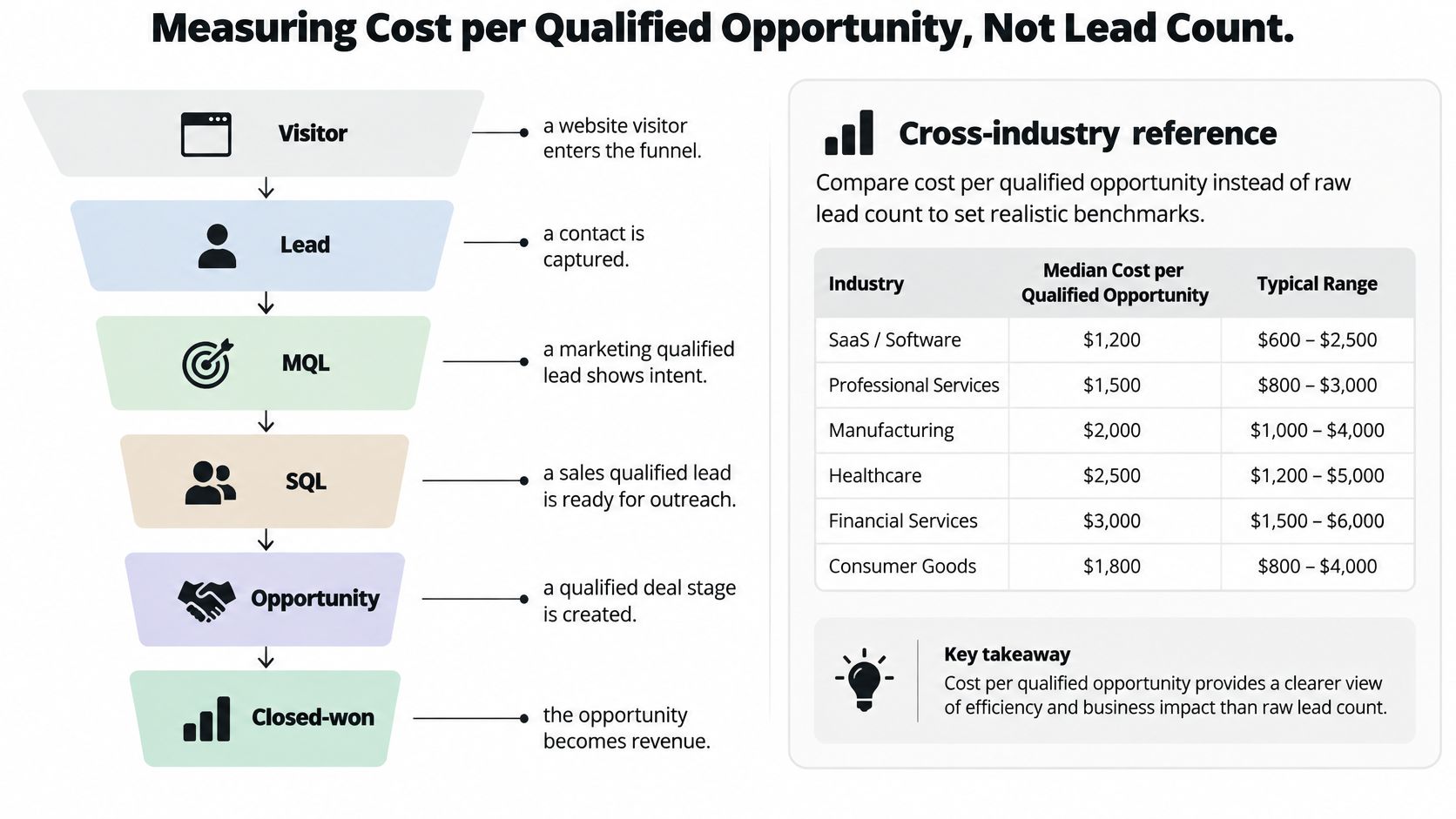
Cost per qualified opportunity makes that comparison harder to manipulate. Divide the channel's attributable acquisition costs by the number of opportunities sales accepted under your written rules.
Map the stages before building the dashboard.
Track the handoffs consistently
Use the sequence visitor → lead → MQL → SQL → opportunity → closed-won. A captured contact, an accepted sales lead, and an active deal need distinct entry conditions.
The following approximate cross-industry reference rates come from Reach Marketing's B2B lead-generation guidance, which also recommends building a two-to-four-quarter baseline segmented by channel and client profile.
Cross-industry funnel reference rates
| Funnel stage | Reference rate | What to track |
|---|---|---|
| Visitor to MQL | 1.8% | Conversion by channel and landing page |
| MQL to SQL | 13.7% | Share accepted by sales through your qualification process |
| SQL to opportunity | 38.4% | Accepted SQLs that become active, qualified deals |
| Opportunity to closed-won | 23.8% | Win rate by service line and deal size |
These are directional references, not targets for your agency. Firms define leads, MQLs, and SQLs differently. Don't multiply these rates together to forecast revenue unless your stage definitions and measurement periods match.
Visitor-to-MQL also combines earlier steps. Keep visitor-to-lead and lead-to-MQL visible in your own reporting so you can distinguish weak capture from weak qualification.
Build a dashboard that changes decisions
-
Write the stage rules. Specify the evidence needed to enter and leave each stage. Name who can accept an opportunity and who resolves disputed classifications.
-
Require the CRM fields. In HubSpot or Pipedrive, capture source, campaign, ICP fit, qualification reason, meeting outcome, proposal status, contract value, and close date. Add a thread URL or referral record where applicable.
-
Calculate a comparable baseline. Segment by acquisition channel and client profile, then compare cohorts that have had enough time to progress. A newly launched campaign shouldn't be judged against mature opportunities with completed sales cycles.
-
Find the weakest handoff. Plenty of MQLs but little sales acceptance suggests a targeting or qualification problem. Accepted opportunities that stall after proposals suggest a different issue, such as weak urgency, unclear scope, or missing decision-makers.
-
Change one variable at a time. Tighten the audience before rewriting every message. If targeting remains fixed, test a different offer or qualification question and record when the change began.
Review stage conversion weekly to catch execution problems. Review pipeline-to-revenue monthly, with attention to how long opportunities have been open and which deals have closed.
Use this video alongside your CRM review, keeping your own acceptance definitions as the reference.
Include the costs people leave out
Count media, software, provider fees, and the staff time spent researching, replying, qualifying, and attending calls. Founder time isn't free just because it doesn't appear on an advertising invoice.
Compare these measures together:
- Cost per accepted opportunity: Total channel cost divided by accepted opportunities.
- Cost per meeting held: Acquisition cost divided by completed meetings, with qualified meetings identified separately.
- Pipeline generated: The value of accepted deals, without presenting it as earned revenue.
- Acquisition payback: Acquisition cost assessed against the gross profit the resulting client generates over time.
A cheap inquiry becomes expensive when a senior person spends an afternoon proving it was never a fit.
If a channel produces no accepted opportunities, report that directly. Don't substitute a low cost per contact to make the campaign look productive.
Contract Terms and Attribution Rules for Outsourced Leads
A low contact price tells you little about the work your team will inherit. A provider can deliver accurate contact details while still delivering the wrong buyers, weak permission, or conversations with no commercial next step.
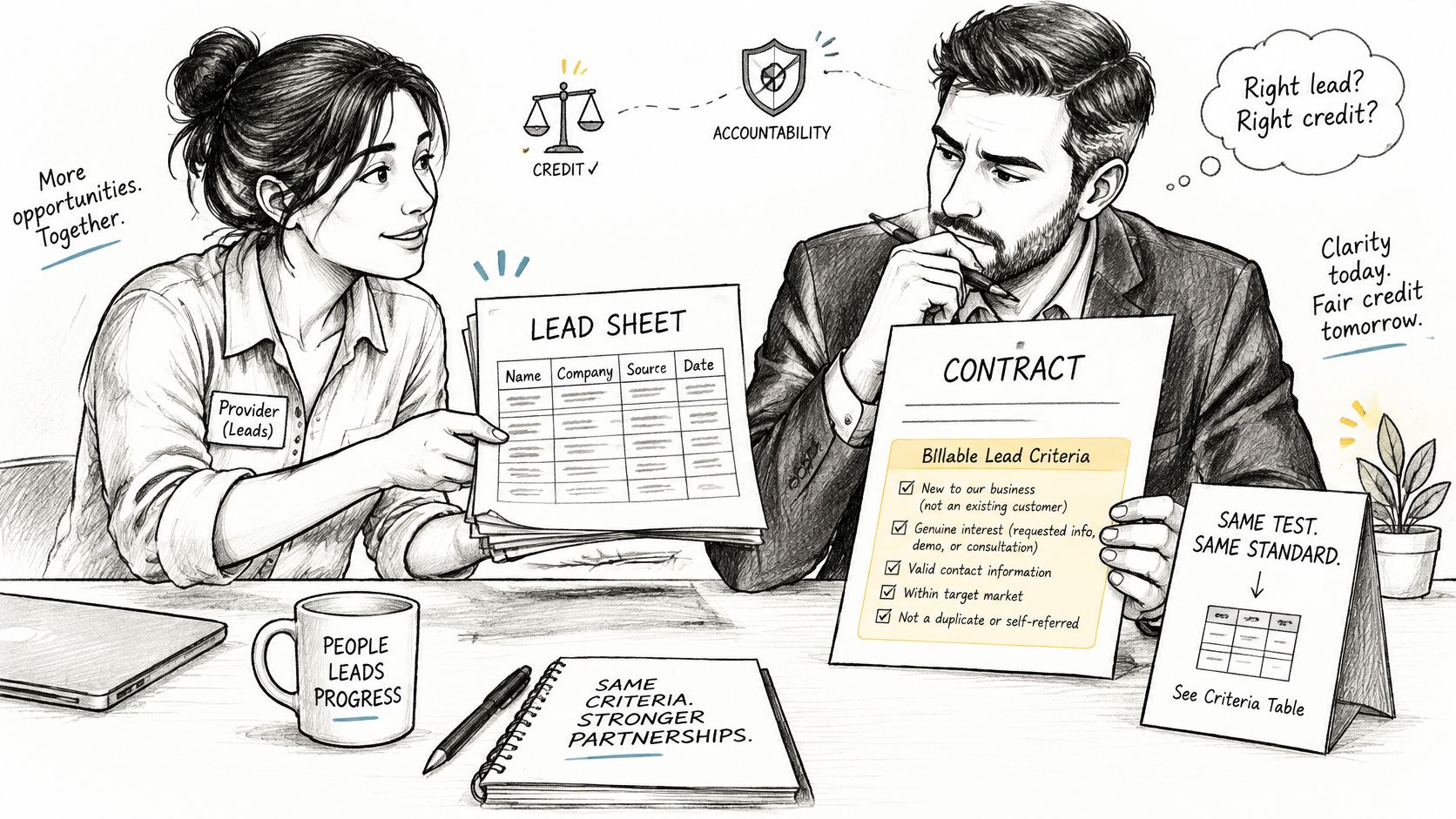
Make acceptance, not delivery, the commercial checkpoint. Attach the qualification criteria to the contract and state whether you're paying for contacts, accepted leads, meetings held, or accepted opportunities.
Reviewing the criteria together before outreach prevents avoidable disputes.
Define who pays for failed qualification
Set a fixed review window, a named reviewer, and the evidence required for rejection. Agree whether invalid submissions earn a replacement, invoice credit, or refund, and specify how disputes get escalated.
Distinguish invalid leads from valid leads that don't close. A contact outside the contracted geography fails a verifiable criterion; a qualified buyer choosing a competitor doesn't automatically mean the provider breached the agreement.
Also define duplicate contacts, existing pipeline accounts, cancellations, and no-shows. Without those rules, the provider and agency can both describe the same submission as correctly handled.
Separate sourcing from assistance
Track the originating source, subsequent meaningful touches, the opportunity record, and closed revenue. Keep assisted influence separate from last-touch credit, and don't add overlapping attribution totals together as if they represented separate deals.
Suppose a past client introduces a buyer who later responds to your public social advice. Preserve the referral as the originating source and the social exchange as an assisted touch. Only assign last-touch credit under the attribution rule you agreed before invoicing.
Use that same discipline for marketing spend optimization, so you don't reward whichever channel happened to appear nearest the booking.
Request these clauses before work starts:
- Acceptance evidence: Required qualification fields and supporting conversation context.
- Review deadline: A fixed window and named approver.
- Rejection handling: Standard reasons, evidence requirements, and remedies.
- Duplicate rules: Treatment of existing contacts, accounts, and opportunities.
- Attribution rules: Separate sourcing, assistance, and last-touch reporting.
- Data ownership: Lead-level exports and access after termination.
- Monthly reconciliation: Accepted submissions, rejections, credits, opportunities, and revenue.
A junior teammate should work under the same operating rules, even without a vendor contract. Delegation changes who performs the work, not what counts as success.
Confirm Your First Two Channels This Week
Start with referrals and an intent-based social test. Keep referrals anchored in relationships where you've delivered value, and use public conversations to test whether a new audience recognizes the problem you solve.
Choose the social community from your buyers' behavior, not your team's preferred platform. If your best-fit buyers don't discuss relevant problems there, find another community rather than forcing the channel.
Run a focused working week
- Day one: Review your last ten client wins, write the acceptance rules, and configure the CRM fields. Assign an owner to follow-up so a useful response doesn't sit unattended.
- Days two through four: Work manually, answer only relevant threads, and record outcomes. Keep skipped-post reasons so you can distinguish scarce demand from poor search terms.
- Day five: Count qualifying threads, responses, permission-based conversations, and discovery meetings. Include time spent, not just software expenses.
Don't scale because you received friendly replies. Inspect whether the people responding match your market and can move a buying decision forward.
Make the next decision from evidence
In the following week, retain activity that creates accepted opportunities. Pause or revise activity that produces inquiries without commercial progression, but don't declare a channel permanently ineffective before prospects have had a reasonable decision window.
Keep manual review until your team agrees on what deserves a response. The same process works with a monitoring tool, a spreadsheet, or saved searches.
Your end-of-week diagnostic is accepted opportunities per ten qualified threads. Treat it as your own operating measure, not an industry benchmark, and read it beside total cost and the reasons prospects didn't progress.
Bazzly helps you find relevant Reddit opportunities, leads, and brand signals for free, with contextual drafts that support a more focused prospecting routine. Visit Bazzly to test your buyer-problem keywords, review matching conversations, and decide which threads deserve your agency's attention.
Written by Bazzly Team
Bazzly builds software that finds buyer conversations on Reddit and posts helpful replies in them (227,592 posts flagged for customers since June 2, 2025). The Bazzly numbers we quote come from our own data, published with the method in our research studies. About us