On this page
- What Brand Mention Monitoring Covers and Why It Matters
- Reputation and Lead Capture
- Setup Options Compared for Small Teams
- Signals to Watch on Reddit, Forums and Google
- Filtering Relevant Mentions from Noise
- Tracking Whether AI Answers Cite You
- How to Turn Mentions into Responses
- Set Up Your First Monitoring Loop This Week
Roughly 98.89% of brand-related discussions were initiated outside brands' own accounts in Brandwatch's analysis of 718.6 million online mentions across 347 brands from February through July 2024. Checking your own posts and notifications means watching the small part of the conversation you started, not the much larger conversation happening without you.
What Brand Mention Monitoring Covers and Why It Matters
Brand mention monitoring is the continuous search for public references to your brand, products, founder and relevant terms across sources you don't control, followed by classification of who said what and why it matters.
Think of it as a smoke detector. An alert tells you where to investigate, but it doesn't establish what caused the problem or whether you need to intervene. Someone mentioning your product might be recommending it, asking how it works, quoting a complaint or discussing something unrelated with the same name.
Your company's notifications won't catch all those situations. A customer can describe your product without tagging your account, leave a review on a separate platform or compare you with a competitor in a community your team doesn't follow.
Start with the language customers use
Build a term list that reflects how people talk, not just how your website names things.
- Brand variants: Include your official name, common abbreviations, misspellings and domain name.
- People and products: Add founder names, product names and distinctive feature names.
- Category language: Include the problem customers want to solve and the phrases they use instead of your official terminology.
- Competitors: Track the alternatives buyers compare with your product, especially when those comparisons reveal a requirement you can meet.
Keep exact brand matches separate from broader opportunity searches. A post asking for an invoicing tool isn't a mention of your invoicing company, but it may still deserve attention. Mixing both into a single mention count makes awareness look stronger than it is.
Separate finding, interpreting and measuring
Monitoring finds and classifies references. Listening interprets patterns. Analytics connects those patterns to behavior, such as website visits, signups or purchases.
That distinction matters when choosing what to report. A 2025 academic case study examining Maybelline, Nike and Farfetch combined social listening inputs with website-traffic measures, illustrating how conversation analysis can support market intelligence rather than stop at reputation tracking.
Teams don't necessarily practice all these activities together. In Influencer Marketing Hub's 2024 survey of 237 marketing professionals, 20.3% analyzed brand mentions and discussions, while 21.9% monitored social media sentiment. Counting references and interpreting their tone are related tasks, but neither tells you what happened afterward.
Practical rule: A mention becomes useful when someone can explain what it means, who should handle it and what should happen next.
The business stakes extend beyond public perception. In PwC's 2025 survey of 5,511 consumers, 52% of U.S. consumers said they'd stopped buying from a brand after a bad product or service experience. Monitoring can surface descriptions of those experiences, but the team still has to investigate and fix the underlying problem.
Say a founder discovers their scheduling product in a forum comparison thread they never knew existed. Buyers like its simplicity but believe it lacks calendar integration, even though that feature exists. The useful outcome isn't another mention on a dashboard. It's a factual clarification, better documentation and an owner checking whether the same misunderstanding appears elsewhere.
Reputation and Lead Capture
Reputation protection and lead capture need different searches, owners and outcomes. Start with whichever currently costs your team more: an unanswered complaint or a buyer who never discovers your product.
For reputation work, look for specific descriptions of failure rather than negative words alone. A forum post describing disappearing invoices deserves investigation even if the author writes politely. Save the account of what happened, assign it to the person who can investigate and establish when they'll acknowledge it.
| Use case | Starting source | Signal | Suggested owner |
|---|---|---|---|
| Reputation protection | Product forums and relevant Reddit communities | Repeated defect reports or inaccurate product claims | Support or product lead |
| Lead capture | Reddit comparison threads and relevant Google results | Buying questions, requirements and competitor alternatives | Founder or growth marketer |
A useful online reputation management routine connects the public discussion to an internal resolution. Keep a theme tag for each issue so reviewers can distinguish an isolated misunderstanding from recurring reports about the same feature.
Lead capture starts with a different question: Can we help this buyer make a sound decision? Look for constraints such as required integrations, team size, migration concerns or a stated budget. Those details let you assess fit before replying.
Don't treat every complaint as a crisis or every category question as a sales lead.
Say a small software team finds someone requesting alternatives to a competitor because exporting data is difficult. The founder can explain how to evaluate export formats, disclose their affiliation and describe their product only if it meets the requirement. The thread can then receive a follow-up owner who checks for questions and records whether the discussion later appears among cited AI sources.
Success means resolving uncertainty, not placing your company's name in the conversation.
Setup Options Compared for Small Teams
Choose a setup around where buyers talk, who will review results and how much history you need. Broader coverage isn't automatically better if nobody has time to separate relevant alerts from noise.
Brand mention monitoring setup options
| Option | Best for | Sources covered | Cost | Main limitation |
|---|---|---|---|---|
| Free alert services | Solo founders testing name recognition | Web pages and news | Free | No sentiment labels and thin coverage of forums and Reddit |
| Native site search | Checking a few known communities by hand | One platform at a time | Free | Manual, with no alerts across sources |
| Social listening suite | Mid-size teams with a dedicated marketing budget | Social, news, reviews and websites | Paid, priced by vendor | Setup effort and potentially thin coverage of niche communities |
| Reddit-focused tool | Founders who sell through Reddit conversations | Chosen subreddits and, in some tools, threads ranking on Google | Free discovery or paid plans, according to the tool | Reddit scope means news and other networks need separate tools |
| AI answer tracking | Teams tracking AI visibility | AI answer engines and the sources they cite | Paid, priced by vendor | Repeated sampling is needed because answers change between runs |
Free alerts offer a manageable starting point for web coverage. They're less useful when the important conversations happen inside community threads, so pair them with native search before assuming an empty inbox means nobody's talking.
For a coverage checklist, use this guide to Google Alerts alternatives. Compare the missing sources against your actual buyer journey rather than choosing software from a feature count.
Test coverage before expanding
Give each shortlisted tool a known public mention to find. Check whether it captures the full text, replies, publication date and original URL, then inspect how quickly a reviewer can dismiss an irrelevant result.
Also distinguish historical access from ongoing collection. A tool that starts collecting today may not provide the older conversations you need to understand a recurring complaint. Export access matters too, especially if your team wants to keep an outcome log outside the platform.
For the answer-engine layer, CitationOS's guide to AI citation monitoring tools for firms offers a separate comparison resource. Evaluate that category against your need to preserve responses and inspect cited pages, not just report a visibility score.
A solo founder can begin with alerts and manual community checks. A team receiving sustained cross-channel discussion may need a suite, while a community-led business may benefit more from focused Reddit coverage. Add another source when a documented gap costs you a real conversation, not merely because a dashboard can display it.
Signals to Watch on Reddit, Forums and Google
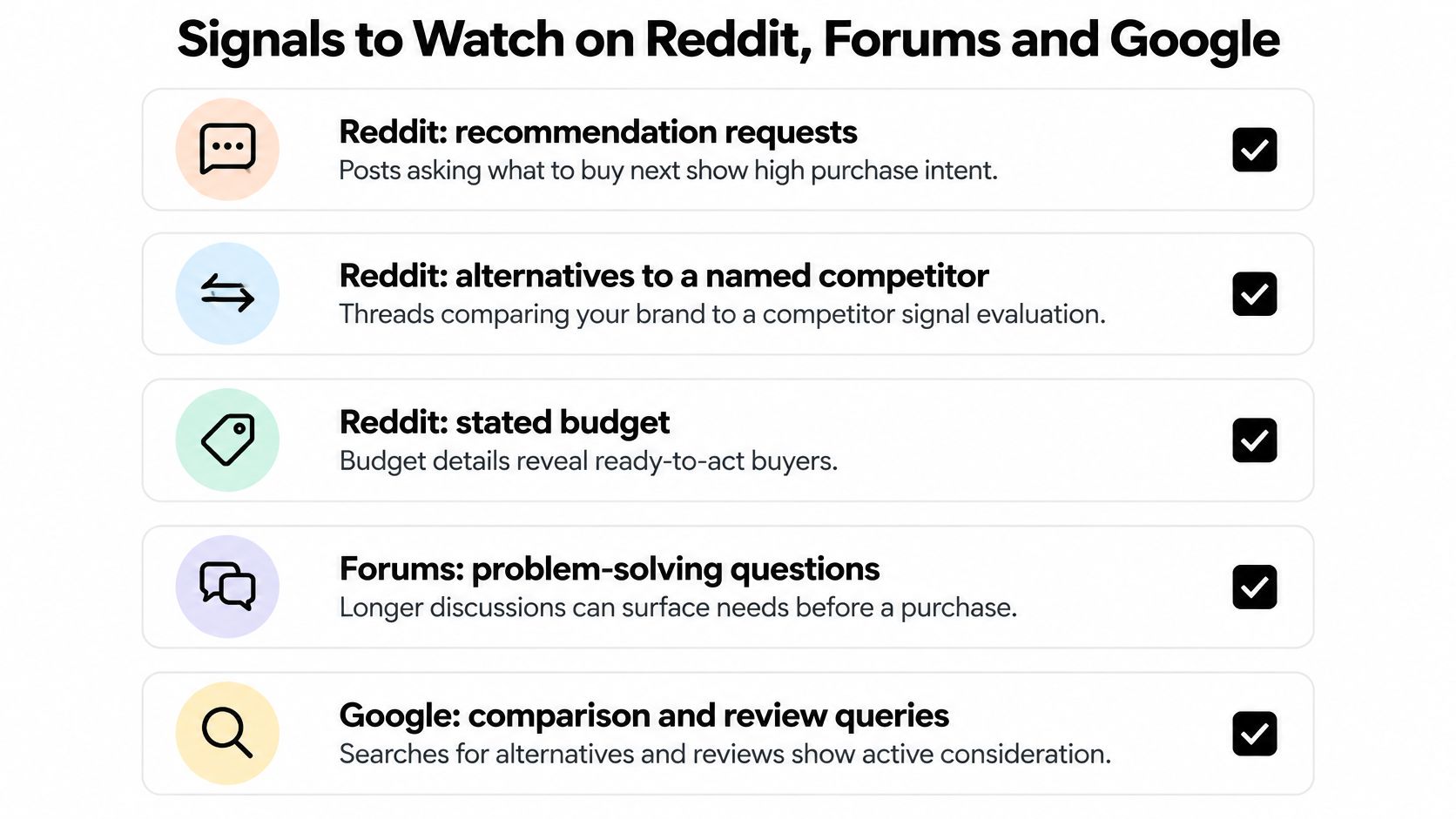
Start with Reddit posts that describe an active buying decision: recommendation requests, alternatives to a named competitor and comparisons with a stated budget. For lead capture, these are stronger starting signals than a passing reference because the author has explained what they're trying to choose.
A relevant buying question can deserve more attention than a feed full of compliments. Read the constraints carefully, though. A buyer who needs a capability you don't offer isn't a qualified opportunity just because they're shopping.
Use these intent cues when reviewing community posts.
Signals to watch by source
Treat these cadences as a starting routine. Use immediate alerts for credible safety concerns, security allegations or rapidly escalating complaints.
| Source | Signal to watch | Check cadence | Why it matters |
|---|---|---|---|
| Reddit threads | Buying questions, alternatives requests and comparison posts | Daily | Reveals explicit purchase intent; check whether the thread also ranks on Google |
| Forums and niche communities | Recurring defect reports and workarounds | Weekly | Can reveal product problems customers haven't reported to support |
| Google results | Brand queries with third-party threads on page one | Weekly | Shows what searchers encounter; inspect whether AI answers cite those pages |
| Review sites | New ratings and public responses | Weekly | Shows the experiences buyers can consult during comparisons |
| News and blogs | Coverage that names you beside competitors | Weekly | Reveals how writers frame your place in the category |
Forum workarounds deserve particular attention. If users explain how to bypass the same problem repeatedly, send the discussion to product support rather than treating it as general negative sentiment.
For Google, record the query as well as the result. A thread appearing for your company name presents a different monitoring task from one appearing for a broad category comparison. Search visibility also isn't proof of AI citation, which requires checking the answer itself.
Verbatim Digital's discussion of community mentions for AI search visibility provides context for examining community content alongside search discovery. Keep the distinction clear: relevant participation is useful, but placing a comment doesn't guarantee an assistant will cite it.
Preserve enough context to act
- Save the full thread: Keep the original post and relevant replies, not just the sentence containing your name.
- Note the date: Distinguish a fresh report from an old discussion resurfacing in search.
- Tag the signal: Use categories such as buying question, defect, comparison or factual error.
- Record the competitor: Preserve the actual alternative being discussed so reviewers understand the choice.
Filtering Relevant Mentions from Noise
Say your product is called Beacon. An alert about a coastal beacon isn't a brand mention, and a sarcastic post praising another failed export isn't necessarily positive feedback. Both errors can survive a simple keyword-and-sentiment filter.
Separate relevance from tone. Academic research on identifying relevant electronic word-of-mouth found that sentiment-based relevance detection performed poorly, supporting a workflow that establishes whether a post matters before labeling its sentiment.
Run the filters in order
- Resolve the entity. Confirm that the name refers to your company or product. Add exclusions for unrelated meanings, but avoid exclusions so broad that they hide genuine comparisons.
- Check relevance. Read for product category, competitor names, purchase language and support problems. Use surrounding discussion and public author context to clarify ambiguity without collecting unnecessary personal information.
- Assess sentiment or stance. Decide whether the author recommends, criticizes, questions or merely quotes a claim. Leave mixed and uncertain cases marked for review.
- Prioritize action. Combine confidence, recurring themes, engagement, author context and unusual activity against your normal baseline. A concrete defect report can outrank enthusiastic but uninformative praise.
Keep the original text beside any automated label. A reviewer should be able to inspect the evidence without reconstructing it from a summary.
Syncly's review of sentiment-analysis accuracy) describes benchmark limitations and recommends treating automated sentiment as a triage layer rather than ground truth. Sarcasm, quoted language, jargon and mixed opinions are good reasons to require human judgment before escalation.
Review standard: Confidence should affect the next action, not disappear behind a positive or negative badge.
Audit what the filters miss
Schedule a monthly review of examples across communities, languages and sentiment classes. Check both precision, whether flagged posts were relevant, and recall, whether relevant posts escaped detection.
Inspect false negatives by manually searching known issue phrases and competitor comparisons. Update keyword rules, record why each change was made and preserve examples for the next review. Missing a high-intent question or an escalating complaint may cost more than reviewing an extra alert.
Tracking Whether AI Answers Cite You
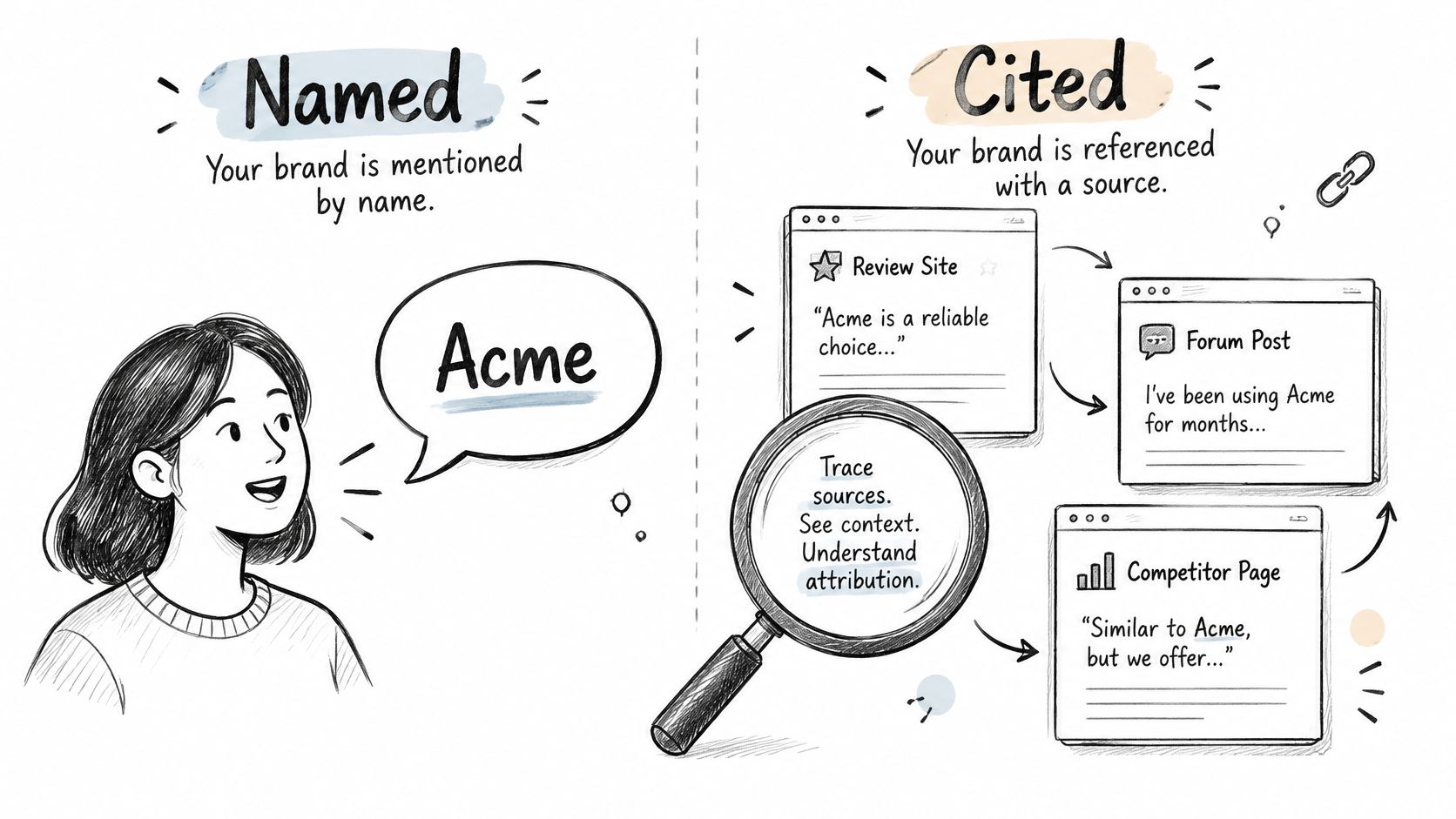
An AI answer might name your product in a shortlist while citing an independent review as evidence. Your brand received a mention, but your website didn't receive a citation. Neither event alone establishes that the answer recommended you.
Keep those distinctions visible when reviewing a response.
Record inclusion and evidence separately
| Field | What to record |
|---|---|
| Mention rate | Share of sampled answers that name your brand |
| Citation rate | Share that cite your domain, with the denominator kept consistent |
| Recommendation rate | Share that explicitly recommend your product |
| Source ownership | Your site, an independent publisher or a competitor |
| Source type | Documentation, review, forum, news or another format |
| Attached claim | The exact capability, limitation or comparison associated with your brand |
Save the engine, country, date, available model version, prompt wording, full answer, mention position and cited URLs. When no source is shown, mark provenance as unknown rather than guessing which page shaped the answer.
Don't call an isolated result a trend. A 2026 paper on repeated AI visibility measurement recommends at least seven runs per prompt per day for brand visibility, eight when source coverage matters, and rolling aggregation over two to four weeks. Treat that as a proposed sampling protocol, not a guarantee of statistical certainty.
AISEOGrow's guide to measure LLM visibility in 2026 offers context for designing a repeatable measurement routine. If manual capacity limits sampling, report the limitation rather than presenting a sparse check as a reliable change.
Use the video as a companion to inspecting answer outputs.
Assign stable gaps to an owner. Incorrect product documentation belongs with content or product; an outdated third-party comparison needs a factual correction request. For Google-specific work, connect the observations to an AI Overview optimization workflow, without assuming a website edit will automatically change an answer.
How to Turn Mentions into Responses
In 2025, roughly three in four consumers said they would switch to a competitor if a brand didn't respond to them on social media, according to Glimpse research for Sprout Social covering 4,044 consumers, reported by Marketing Dive. Silence can leave a genuine question unresolved, but a rushed promotional reply isn't a useful substitute.
Use a response routine that connects monitoring to investigation and follow-up.
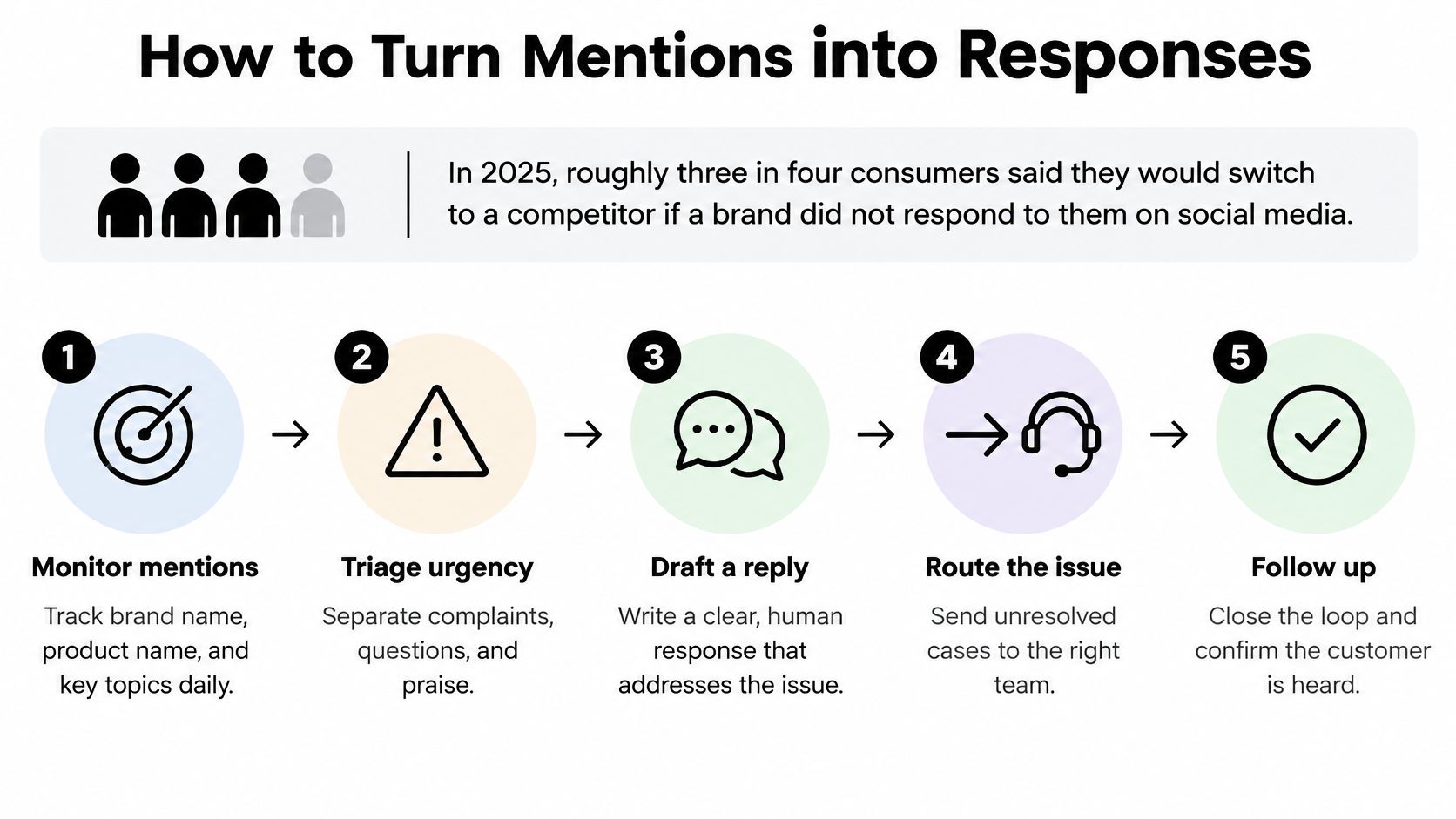
Give each alert a decision and a deadline
The following windows are suggested operating targets, not research findings or promises you must adopt unchanged.
- Route the alert to a named owner. Assign a person, not just a team inbox, because someone needs responsibility for deciding whether to reply, investigate or escalate.
- Read the full thread. Review the replies and any previous brand response so you don't answer a question the community has already resolved.
- Classify the immediate need. Mark it as a question, complaint, recommendation or possible misinformation, while keeping factual disagreement separate from an opinion you dislike.
- Set a response window. Aim for the same day for buying questions, within a day for defect acknowledgments and the next business day for general praise, with urgent safety or security concerns escalated immediately.
- Write a useful, transparent reply. Address the actual question, disclose your affiliation and respect community rules, including restrictions on promotion and links.
- Log the outcome and theme. Record the response, follow-up commitment, resolution status and any observed AI citation so the next reviewer can continue the work.
- Review missed signals monthly. Inspect unanswered threads and late escalations, then adjust terms, source coverage or ownership where the process failed.
Acknowledgment isn't resolution
For a defect report, the first response can acknowledge the issue, explain what information is needed and say when the owner will return. Don't promise a fix before the technical team understands the problem.
Move account details, payment information and other sensitive material to an appropriate private support channel. Keep a useful public update where possible so other readers know whether there's a workaround or confirmed resolution.
For misinformation, correct the specific factual claim with accessible evidence. Don't pressure someone to remove a fair criticism or recast dissatisfaction as dishonesty.
Maintain a shared log with the source URL, owner, due time, action and status. A response that helps the community remains useful after the original exchange, while a defensive reply may leave future readers with the same unanswered question.
Set Up Your First Monitoring Loop This Week
Choose a narrow pilot: the community where buyers compare products and a web source where people discover your company. Assign a named owner and put a brief weekly review on the calendar.
Write down your name variants, product names and a short competitor list. Test the searches against known discussions, remove obvious false matches and create a shared log before enabling more alerts.
Make the pilot easy to review
- Define the action: Decide which findings require support, product investigation or a helpful buying answer.
- Record the handoff: Keep an owner, response window and status beside every actionable mention.
- Preserve the misses: Save relevant posts found manually so you can assess coverage accurately.
For a Reddit-based pilot, our Bazzly Brand Signals feature tracks mentions of your product and competitors over the last 30 days, shows share of voice at the top and labels each mention with sentiment. Finding opportunities, leads and brand signals is free, so you can test discovery before paying for anything more. Comments posted through Bazzly stay out of the Brand Signals feed but still count toward share of voice, with a bar showing how many were placed through Bazzly.
Run the pilot for a month, then review what it caught, what it missed and what your team resolved. Keep useful searches, remove distracting ones and add coverage only where you can identify an unanswered business need.
Bazzly helps small teams find Reddit buying conversations and monitor discussion of their products and competitors. Visit Bazzly to try free opportunity, lead and brand-signal discovery, then assign the relevant findings to an owner with a clear response window.
Written by Bazzly Team
Bazzly builds software that finds buyer conversations on Reddit and posts helpful replies in them (227,592 posts flagged for customers since June 2, 2025). The Bazzly numbers we quote come from our own data, published with the method in our research studies. About us