On this page
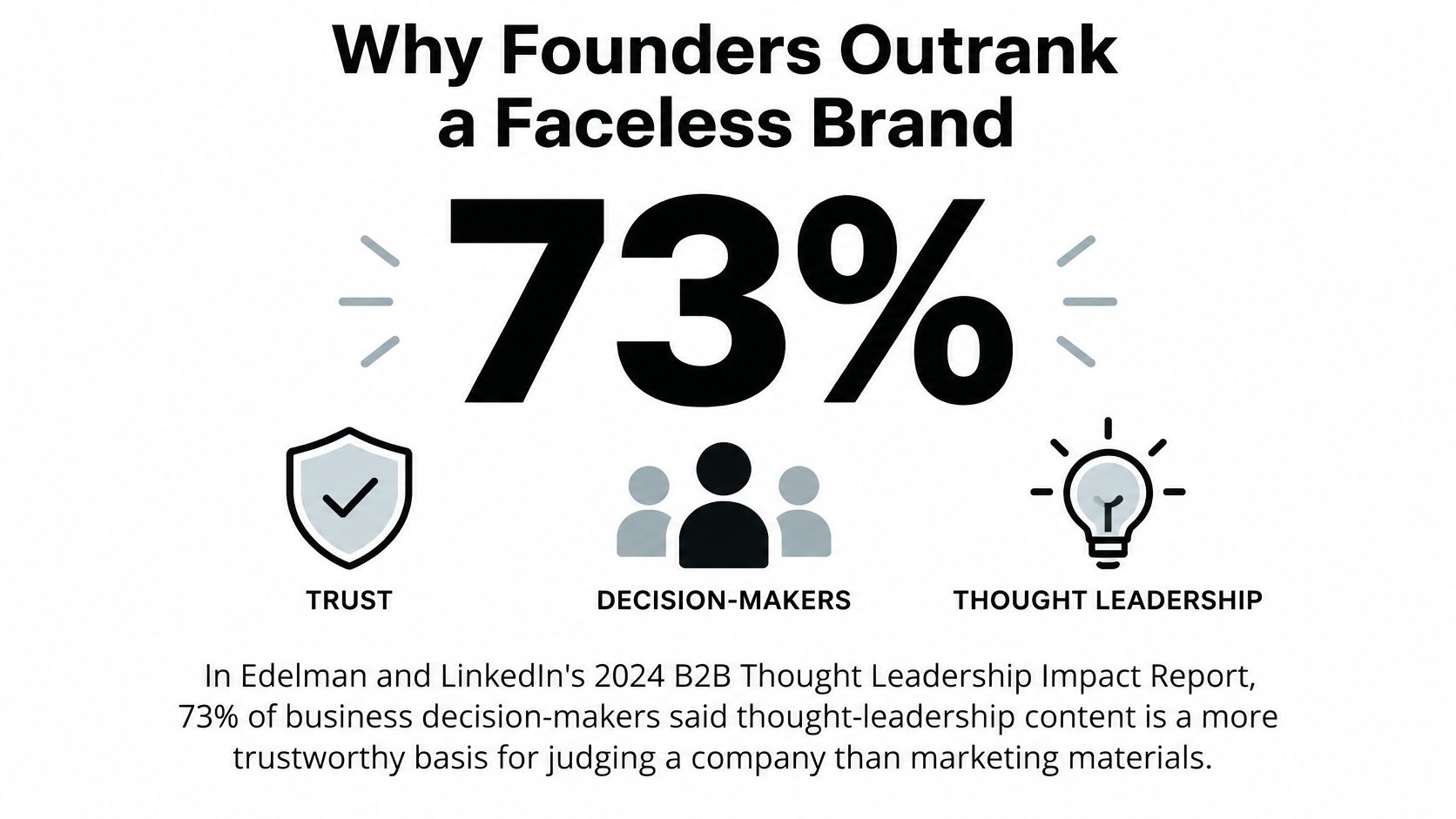
73% of business decision-makers said thought-leadership content is a more trustworthy basis for assessing a company's capabilities than traditional marketing materials, according to Edelman and LinkedIn's 2024 B2B Thought Leadership Impact Report, summarized by Relato. That's a reason to publish useful expertise, not evidence that every founder post creates demand. Your company still needs clear pricing, reliable documentation, and support that works without your personal involvement.
Why Founders Outrank a Faceless Brand
Founder led marketing turns your operating knowledge into public proof of competence. For an early SaaS company, that means explaining a customer problem, showing the reasoning behind a product decision, or challenging conventional advice with evidence you can defend.
A company page can say your product makes onboarding easier. You can explain where onboarding breaks, which workaround helps before someone buys software, and why you chose not to automate a particular step. Buyers can evaluate that reasoning before they agree to a sales call.
Publish evidence, not a personality
A named founder makes a claim accountable. A prospect can inspect your explanation, ask a follow-up question, and notice whether you acknowledge a limitation instead of dodging it.
That doesn't require personal disclosure about your family, finances, or private life. Your useful material is closer to the product: customer language, implementation trade-offs, rejected approaches, and problems you understand firsthand. Remove identifying customer details unless you have permission to publish them.
Operating rule: Publish what helps a buyer judge your competence. Don't publish merely to prove you're active.
Treat the work as a governed experiment with a fixed budget and explicit stop rules. The practical setup needs:
- A weekly hour split that protects useful public answers.
- A daily working block that doesn't become endless browsing.
- Reusable reply and DM skeletons grounded in the buyer's problem.
- A qualified-conversion test with assisted-conversion checks.
- Stall fixes and a delegation rule so weak tactics don't become permanent obligations.
The weekly plan is the working document to put on your calendar this afternoon. A personal brand isn't the deliverable. A repeatable way to earn relevant conversations is.
Weekly Channel Plan for a Solo Founder
| Channel | Weekly time | What to ship | Signal it works | Stop if |
|---|---|---|---|---|
| Community replies | Budget 4 hours | Public answers in two buyer communities | Replies that stay up and profile clicks from the right roles | Removals or hostile replies in that community |
| Original posts and comments | Budget 3 hours | Two posts plus comments on buyer posts | Saves and profile visits from ideal-customer titles | Four posts in a format earn almost no saves |
| Direct messages | Budget 1.5 hours | At most five notes to people who already described the problem | Replies and booked calls | Opt-outs or spam reports |
| Customer-language mining | Budget 2 hours | One lesson from three calls or support threads | A prospect later quotes the lesson | There's no fresh customer wording that week |
| Long-form or changelog | Optional 2 hours | One piece reused into posts | Assisted signups or branded-search lift | It steals the reply block |
These are suggested operating limits, not performance benchmarks. Start with this allocation before hiring anyone, then adjust the budget against qualified opportunities and the time your product needs.
Public answers come first because the buyer has already supplied the context. A detailed question about migrating a workflow gives you something concrete to address. An original post requires you to choose the problem, frame it, and hope the relevant buyer encounters it.
Protect the highest-context work
Choose communities by reading their recent questions, not by their membership counts. Look for buyers describing constraints, comparing tools, asking about migration, or trying to repair a workflow. Pick the communities where you can contribute repeatedly, and ignore the rest.
Read each subreddit's rules before adding it to the plan. If the rules prohibit the kind of product-related reply you intend to write, reject that channel rather than trying to disguise the promotion. A relevant audience doesn't override the community's boundaries.
When the week shrinks, cut the optional essay first. Next, simplify original posts by adapting a useful answer you've already written. Preserve enough customer-language mining to keep the answers grounded, rather than filling the schedule with generic opinions.
A smaller schedule with relevant answers is better than a full calendar built around topics you can't substantiate.
Don't budget around viral posts
RevBoss's founder-led marketing benchmarks report that the top 5% of LinkedIn posts generated 66% of impressions, while founder accounts received about 2.1 times the median impressions of comparable company pages. Those uneven outcomes make averages a poor promise for your next post.
Copying a successful founder's format won't copy their expertise, audience, or relevance. Use saves and buyer-profile visits as early diagnostic signals, then check whether those people become qualified prospects.
For the mechanics of batching drafts without turning planning into another job, PostPulse's guide to weekly content planning for busy founders is a useful companion. Keep the broader organic customer acquisition question attached to the schedule: which buyer action justifies the time?
Tomorrow's daily block is how this allocation becomes work completed, rather than a spreadsheet you keep redesigning.
How to Run the Daily Founder Block
Use a suggested 45-minute block on five weekdays, not a content sprint. It's the protected execution window within the weekly budget, not a replacement for drafting, customer conversations, or reviewing results.
Keep a browser bookmark folder for approved communities, a document of buyer questions, and a spreadsheet for the log. Don't start by opening every social feed.
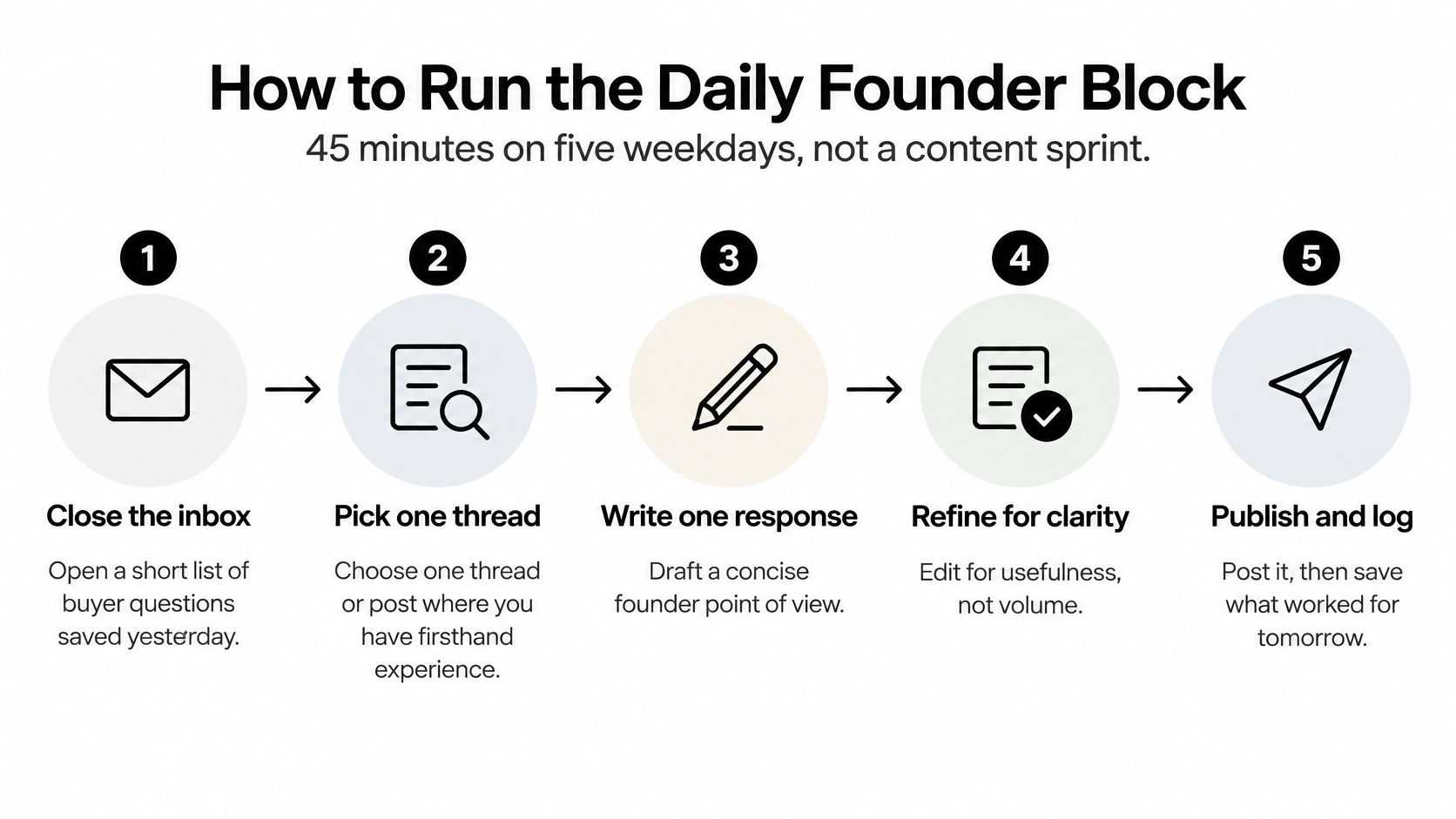
Make the block executable
-
Close the inbox and open yesterday's saved questions. A short queue lets you begin with a buyer problem instead of searching for inspiration; the usual slip is letting notifications choose the morning's topic.
-
Pick a thread where you have firsthand knowledge. Choose a question you can answer with a specific diagnostic, decision, or trade-off; skip anything that would require you to impersonate an expert.
-
Draft the fix in the customer's language. Explain what to check before mentioning software, then disclose your founder role alongside any relevant product mention; the common mistake is opening with a pitch and saving the useful part for later.
-
Publish from your founder account. Use an identity whose relationship to the business is clear, and respect a moderator's removal; don't repost the same pitch from another account or argue that your intentions exempt you from the rules.
-
Record the interaction, not just its engagement. Log the community, thread intent, response type, minutes to reply, and whether the comment remained visible; recording likes without the underlying thread makes the result hard to interpret.
-
Send private notes only where they're welcome. Restrict outreach to people who described the relevant problem publicly, observe the weekly cap, and stop at an opt-out; a public problem statement supplies context, not automatic permission for repeated sales messages.
-
Save an objection for tomorrow. Turn an unanswered concern into the next drafting prompt; don't replace the buyer's wording with a broad topic such as productivity or growth.
Use the timer to constrain scope
A practical way to divide the block is to spend the opening minutes selecting the thread, most of the session writing a useful response, and the remainder logging and handling relevant follow-ups. If the answer needs investigation, save a draft rather than rushing out a confident guess.
Keep customer screenshots, internal numbers, and identifying details out of the draft until you've checked permission and accuracy. If a claim depends on a test, preserve the test's conditions instead of converting a narrow result into a universal promise.
A finished block contains a useful public answer, a complete log entry, and only warranted private follow-ups. On a day with no suitable thread, improving a saved answer or recording why opportunities were rejected is better than manufacturing relevance.
Reply and DM Lines Buyers Can Use
In 2024, 75% of B2B decision-makers said thought leadership led them to research a product or service they hadn't previously considered, according to Edelman and LinkedIn, as summarized by BizGrowthAxel. The practical implication is to make the problem clearer before asking anyone to evaluate your product.
These skeletons are drafting aids, not scripts to paste unchanged. Replace every bracket with something you can substantiate, and delete any sentence that doesn't help the recipient.
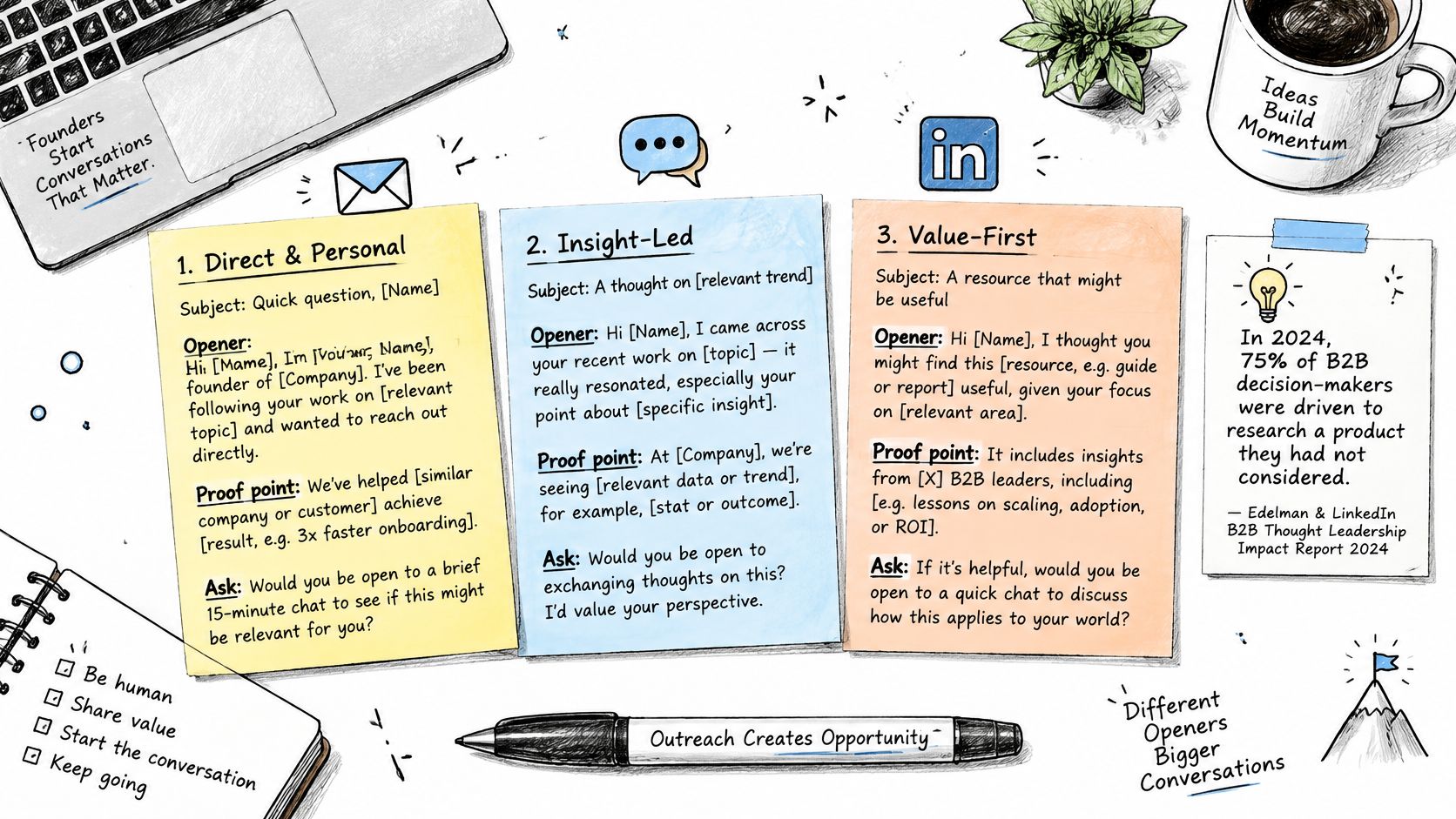
The public answer
Skeleton
You're dealing with [constraint]. Before choosing software, I'd check [diagnostic], try [workaround], and confirm [limitation]. I built [relevant tool] for this use case, so to be clear, I'm the founder.
Bad: Try our tool and book a demo.
Better: If the export fails only on larger files, check whether the request times out before changing the database query.
The better opening gives the reader an action even if they never visit your profile. Mention your product only when it addresses the stated constraint, and don't attach a link unless the rules and context allow it.
The point-of-view post
Skeleton
[Customer's exact sentence, used with permission or safely anonymized.]
Most advice says [conventional claim]. During [specific build or test], we found [bounded observation], so I'd change [decision]. Under what conditions would you take the opposite approach?
Bad: Big news, we just launched!
Better: Our customer couldn't finish onboarding because they didn't know who owned the integration credentials.
Start with an observable problem, then explain your judgment. Don't present a paraphrase as a quotation, and don't imply that a single implementation proves what every team should do.
The permission-based DM
Skeleton
You wrote about [exact problem] in [thread]. My relevant experience is [truthful detail]. Would a short diagnostic checklist help? I can send it if useful.
Bad: Hi! Are you open to a quick demo?
Better: You mentioned that the import succeeds but duplicates appear afterward. Would the duplicate-check sequence help?
Keep the note short and wait for permission before sending material. If you haven't encountered the issue yourself, remove the experience claim rather than inventing a connection.
Disclosure boundary: Say you're the founder when you mention your product. Say you don't know when the question exceeds your experience.
Save these drafts in a shared document and retire language that only works on someone already seeking a demo. For community-specific application, use Reddit lead generation as a relevance exercise, not an excuse to turn every reply into outreach.
How to Measure Demand You Actually Created
Run a four-to-six-week test comparing educational analysis, transparent build-in-public lessons, and customer-problem breakdowns, with reasonably steady distribution and cadence, as recommended in Dipity Studio's founder-led marketing playbook. Its summary of work by Wharton scholars Fujie Jin, Lorin Hitt, and Andy Wu also reports associations between active social presence and stronger Twitter influence and funding outcomes, including higher odds of closing a round, larger amounts raised, and a broader investor pool, not proof that audience growth causes revenue.
Define qualification before publishing. For example, a qualified trial might require the target role, a supported use case, and completion of the product action that demonstrates serious evaluation. Don't broaden that definition to make a popular post look successful.
Separate signals from conclusions
Use distinct landing parameters for each hypothesis and a plain-language source question during signup or onboarding. Allow people to describe their path in their own words rather than forcing every answer into a single-channel dropdown.
| Signal | What to log | Decision it supports | Do not treat it as |
|---|---|---|---|
| Qualified trials | Source field or distinct landing parameter | Which hypothesis to keep | Likes or impressions |
| Assisted path | Relevant touch inside a chosen observation window | Whether a public answer preceded a direct visit | Last-click credit alone |
| Community health | Removals and hostile replies by community | Whether to stay in that community | Raw comment volume |
| Consideration | Branded search and direct visits during the test | Demand you can't click-attribute | Proof of new demand without a matched baseline |
| Private outreach | Replies and calls from people who posted the problem | Whether DMs justify their time | Follower count |
Compare hypotheses after they've received similar publishing opportunities. Keep the landing-page offer reasonably consistent, or you won't know whether the content or the offer explains the difference.
Check assisted paths without claiming causality
A prospect might read an answer, return through branded search, and start a trial later. Record the answer as an assisted touch when the prospect reports it or you have appropriate first-party evidence. Don't add that same signup again to total acquisitions.
For a hypothetical test, you could choose a month-long observation window and extend it if your normal evaluation cycle warrants it. Document the choice before reviewing outcomes, and don't attempt to identify anonymous community readers.
Your community log should include subreddit, thread intent, response type, account used, time to reply, visibility, removals, observable profile clicks, DMs, trials, and paid conversions. Mark unavailable fields as unknown rather than inventing precision.
Compare branded-search and direct-visit changes with a matched baseline, noting launches or other campaigns that could explain them. A staggered rollout across comparable communities can strengthen the comparison, but small samples may still leave the result inconclusive.
Keep a hypothesis only when qualified conversion or assisted pipeline justifies its time relative to the alternatives. Treat removals, deteriorating sentiment, and unqualified traffic as reasons to stop or revise, and use a consistent SaaS marketing ROI calculation that includes founder time.
What to Change When Reach Does Not Convert
Impressions rise, but saves and profile visits from buyers stay flat. Start by checking whether you're repeating a format borrowed from someone with different expertise rather than addressing a problem your buyers recognize.
In HubSpot's 2024 Social Trends Report, 86% of social media marketers said building an active online community was essential to a successful social media strategy. That finding supports investing in participation, not just dropping posts into someone else's discussion space.
Diagnose the failure at the interaction
Use the test log to distinguish weak relevance from a distribution problem. A post with modest reach and qualified conversations needs a different response from a popular post attracting peers who'll never use the product.
- Reach without buyer interest: Replace the borrowed format with a lesson from current customer conversations. Apply the format's pre-agreed stop rule instead of extending it because the impression count looks encouraging.
- Comments removed or flagged as ads: Check whether the opening asks for attention before providing help, then inspect the community rules. Rewrite an otherwise permitted answer as useful guidance, or leave a community that doesn't allow the intended participation.
- DMs treated as spam: Inspect how the recipient entered your list. Restrict notes to relevant public problem statements where private contact is appropriate, and stop contacting anyone who declines.
- Pressure to answer beyond your expertise: Remove unsupported certainty. State the boundary of your knowledge or stay out of the thread.
- A ghostwritten post sounds unlike you: Require a concrete founder-supplied detail and edit the wording aloud. If you can't defend the reasoning in a buyer conversation, don't publish it.
Fix the next step too
Relevant profile visits without trials can point to a different problem: the profile promises one thing while the landing page describes another. Check that your bio, destination page, and signup experience use compatible language about the buyer and the job.
Don't respond to every stall by increasing frequency. Change the failing component, preserve the rest of the test where practical, and record the change so you can interpret the next result.
Before publishing, make these checks explicit:
- Relevant: Does this answer the stated problem?
- Disclosed: Is the commercial relationship clear?
- Substantiated: Can you support the claim?
- Allowed: Does participation fit this community's rules?
- Commercially useful: Which pipeline question could this interaction help answer?
When to Hire, Delegate, or Add Reddit Tooling
Keep the founder's judgment, delegate repeatable labor, and add tooling after a hypothesis earns its place. Hiring someone to produce more of an unproven format makes the experiment more expensive without making the result clearer.
During the initial solo stage, do enough of the work yourself to recognize a good opportunity. You need to distinguish a buyer asking for help from a conversation that merely contains your keywords. That judgment becomes the acceptance standard for anyone who helps later.
Delegate a defined task
Once a pattern produces qualified opportunities, hand off thread sourcing, logging, draft preparation, and scheduling. Retain approval over product claims, disclosure, sensitive disagreements, and promotional replies.
Give a teammate accepted and rejected examples, not just a topic list. Acheloa Wellness, Inc.’s guide to delegate effectively and reclaim your time is useful context for handing over responsibilities without continuing to perform every task yourself.
- Solo stage: Establish the relevance standard and test the message.
- Assisted stage: Delegate administrative work against that standard.
- Small-team stage: Let a teammate draft from the skeletons while you contribute firsthand detail and approve commercial claims.
Add tooling for a demonstrated bottleneck
If Reddit sourcing and reply preparation consume the protected reply budget, Bazzly is an option for finding relevant opportunities and drafting context-aware responses. You can review the draft and post from your own account, preserving founder approval rather than treating automation as editorial judgment.
Start in manual mode for a week to learn what a good opportunity looks like for their product before switching Autopilot on. Use that learning period to document rejection criteria as carefully as acceptance criteria.
Warmed accounts and upvotes don't replace a relevant answer. They also don't make a strict community suitable for promotion, so keep unsuitable communities out of the workflow.
For this week, block the daily sessions, choose your buyer communities, and save the message skeletons. Don't buy distribution until a hypothesis beats the alternatives on qualified conversion or defensible assisted pipeline.
Bazzly helps you find relevant Reddit conversations and draft replies around the problem a buyer described. Visit Bazzly to try a manual, founder-approved workflow, then evaluate whether it saves reply time without weakening relevance, disclosure, or conversion quality.
Written by Bazzly Team
Bazzly builds software that finds buyer conversations on Reddit and posts helpful replies in them (227,592 posts flagged for customers since June 2, 2025). The Bazzly numbers we quote come from our own data, published with the method in our research studies. About us