On this page
- Why Organic Customer Acquisition Compounds
- Which Organic Channels a Small Team Should Fund First
- How Search and Content Keep Producing Customers
- How to Earn Trust in Communities Without Breaking It
- Referrals and Product Use That Bring the Next Customer
- How to Measure Organic Acquisition Across Split Journeys
- Choose One Channel for a 90-Day Test
You and your cofounder pause the ads to protect cash. Signups drop that same week, and suddenly the marketing plan looks less like a system and more like a meter you have to keep feeding. You need a way to win customers that doesn't require buying their attention every time.
Why Organic Customer Acquisition Compounds
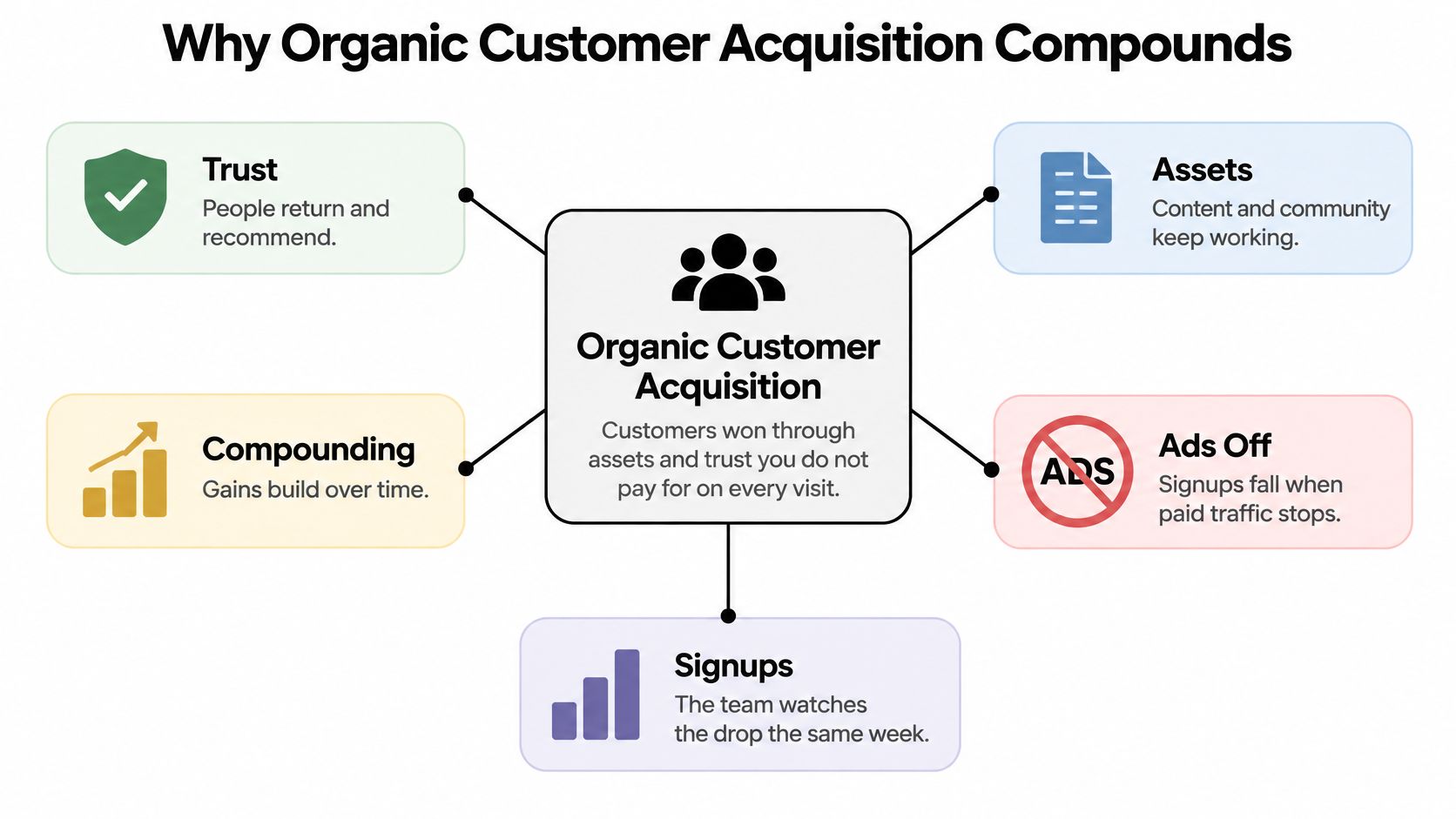
Organic customer acquisition means winning customers through assets and trust you don't pay for on every impression or visit. Those assets include pages that rank, public answers to buying questions, customer recommendations, and product experiences that introduce the next user.
Paid acquisition rents attention. Organic acquisition is closer to planting an orchard: you invest labor before you harvest anything, then maintain what you've planted so it can keep producing.
The distinction isn't free versus expensive. Your founder's time, a writer's invoice, and an engineer's work all cost money. The difference is whether the work can contribute to another customer's decision after you've finished producing it.
What the historical evidence tells you
In its 2019 research, BrightEdge reported that organic search generated 53% of trackable website traffic across industries and 44.6% of website revenue. These are historical benchmarks, not a statement about today's channel mix or a forecast for your business.
They establish a useful pattern: people searching for information also become customers. A founder who answers an important buying question can create something more commercially useful than a post that attracts attention but leaves visitors unsure what to do.
The orchard analogy helps separate the initial investment from the ongoing return.
Practical rule: Build something a qualified buyer will still find useful after you stop actively distributing it.
For the team that paused its ads, that might mean a clear migration guide, a searchable answer about a difficult workflow, or a recommendation from someone who has already solved the same problem.
No strategy guarantees a steady harvest. Rankings change, answers become outdated, and recommendations depend on customer satisfaction. Compounding requires maintenance, not just publishing and walking away.
The operating decision is which kind of asset your small team can produce and maintain well.
Which Organic Channels a Small Team Should Fund First
Organic channels a small team can run
| Channel | Intent it captures | Time to first customers | Cost pattern | Start here when |
|---|---|---|---|---|
| Search and content | People already looking for a solution | After a useful page earns relevant visibility and converts visitors | Front-loaded writing and SEO, then lower marginal cost per visit | The problem is searched and you can maintain a strong page |
| Community participation | People comparing options in public threads | A current conversation can produce interest; searchable threads can contribute later | Mostly contributor time, little media spend | Buyers ask specific questions you can answer honestly |
| Referral programs | Trust transferred by a current customer | After successful users make introductions and those prospects buy | Administration and any reward tied to a qualifying referral | Customers already recommend you without a program |
| Product-led growth | Product use that introduces another user | After activation and a useful invitation flow work | Engineering, onboarding, and support rather than media spend | Users have a natural reason to involve someone else |
A founder can't run all these channels at full strength while also building the product. Choose based on existing buyer behavior, not which channel currently attracts the most marketing discussion.
If strangers already search for the problem, a strong page is a sensible primary asset. If buyers describe their constraints in public discussions, community participation may provide better feedback. If you already have successful users, referrals or an in-product invitation can use relationships you've earned.
Calculate the cost you actually incur
Use this operating definition:
Organic CAC = total content, SEO, distribution, and optimization spend ÷ customers attributed to that work.
Include labor, including founder time valued at a consistent internal rate. Otherwise, a channel can look inexpensive because nobody recorded the work.
A benchmark covering roughly 120 U.S. firms, summarized by Christoph Olivier Consulting, reported average B2B organic CAC of $942, versus $1,907 for inorganic channels. Treat that comparison as directional: attribution methods, included costs, and the businesses being measured affect the result.
The delayed-cost curve explains why an early CAC can look discouraging. You pay to produce a page before it attracts customers, but later customers may arrive through that same page without another production invoice. A search-visible discussion can work similarly, although you don't control whether the platform preserves or promotes it.
Traffic isn't the denominator in CAC. Customers are. Broad posts can consume time and attract visitors without improving acquisition economics.
Make a constrained choice
For a two-person team, fund one primary channel plus at most one light support channel. The support channel should reinforce the primary asset, not become another publishing calendar.
For example, maintain a comparison page as the primary investment and answer relevant community questions when you can help. Don't simultaneously launch a referral program, rebuild onboarding, and start a daily posting schedule.
Use the acquisition checklists from Sprints & Sneakers as a planning resource to turn your chosen approach into assigned work. Keep the checklist narrower than your ambitions: an owner, an asset, a distribution action, and a measurable customer outcome.
The trade-off is explicit. Focus sacrifices reach so a small team can learn whether a channel works.
How Search and Content Keep Producing Customers
A buyer who searches for a specific fix has already done some of the work of defining their problem. Your job isn't to persuade everyone that the category matters. It's to help that buyer evaluate a useful next step.
Say you sell a scheduling tool for service teams. A page about replacing a shared inbox for appointment requests gives you a clearer acquisition opportunity than a collection of general productivity tips.
Build a page around a buying job
-
Collect customer language. Pull problems from sales calls, support tickets, and community threads. For the scheduling tool, record phrases about duplicate replies, missed requests, and uncertainty about who owns an appointment.
-
Keep queries with a clear job. A comparison, implementation question, or category question gives the page a purpose. Drop topics that attract a broad audience but don't connect to a problem your product solves.
-
Answer before introducing the product. Use the opening screen to explain the recommended approach. Then show a workflow example, evidence you can substantiate, limitations, and a relevant next step. A reader should learn whether to change their process even if they don't sign up.
-
Connect the page to relevant places. Add internal links from related pages you already maintain. Seek mentions from people discussing the actual workflow rather than collecting unrelated links. A useful implementation guide is a better reference than a thin promotional page.
-
Refresh instead of duplicating. When the workflow changes, improve the existing answer. Don't publish another shallow post that competes with it and doubles your maintenance burden.
Make the answer worth finding
For the scheduling example, explain when a shared inbox remains sufficient. Show what breaks when several people handle requests, what information must move into the new system, and how a team can avoid losing existing appointments.
Useful limits increase credibility. A buyer should be able to recognize both a good fit and a poor fit.
A page doesn't need to answer every question in the category. It needs to finish the job implied by its headline.
Don't plan a new domain's cash flow around immediate rankings. Narrow B2B or local questions may offer a more accessible opening than broad category terms, but competition and your site's existing visibility still matter.
If you later have distinct use cases with reusable structure, learn what programmatic SEO involves before expanding. A template isn't permission to publish pages with no distinct value.
Search visibility can also extend beyond clicks. Use Kliqo AI's guidance to identify gaps in AI citations, then inspect whether your answer provides clear, attributable information worth referencing. Don't replace substantive writing with formatting tricks.
Evaluate the page through buyer behavior, including branded searches and assisted signups, rather than ranking position alone.
How to Earn Trust in Communities Without Breaking It
Reddit's path-to-purchase research reports that 48% of Americans struggle to determine which online sources or reviews they can trust, while 71% of people who discovered a brand online or offline subsequently researched it on Reddit. That makes community participation a responsibility, not just another distribution tactic.
Treat it as a permissioned reputation channel. You're entering a discussion people use to make decisions, often precisely because they don't want another sales pitch.
Keep the person asking the question at the center of the work.

Set boundaries before replying
- Answer the actual question. Use the poster's constraints, budget concerns, and workflow language. Don't substitute a generic product description.
- Disclose your relationship. If your product is relevant, say you're its founder or employee before readers could mistake your recommendation for an independent endorsement.
- Use only real experience. Explain what you know, distinguish assumptions from facts, and never invent a customer story or pretend to be a satisfied user.
- Respect permission. Read subreddit and moderator rules. Skip promotional participation where it's prohibited, even when the thread looks commercially attractive.
- Handle criticism directly. Acknowledge a missing feature or stronger alternative when it matters to the buyer. Don't turn every comparison into a defense of your product.
The answer must remain useful if the reader never buys. For a shared-inbox question, that could mean explaining an ownership convention and escalation process before mentioning software.
A removed or heavily downranked comment should trigger a review of relevance, disclosure, and permission. Don't automatically repost it or treat removal as merely a failed advertisement.
For a complementary visual resource on Reddit participation:
Choose conversations, not comment targets
Specific problems are more useful signals than general category chatter. In our study of 16,331 posts, 78% of buying-intent Reddit posts described a problem, while 13.6% asked for a tool. Searching only for explicit recommendation requests would miss many relevant conversations.
We also found that 83% of buying-intent Reddit posts had fewer than five comments when we found them. The practical response isn't to flood quiet threads. It's to evaluate an unanswered question carefully and contribute while your answer can still help.
Use a written community-based marketing approach to define acceptable participation before delegating it. If Discord is relevant, Data Hunters Agency's guidance on how to turn Discord joins into conversations provides another planning resource.
Review each chosen community for qualified discussions, later branded searches, and assisted pipeline. Comment volume alone doesn't establish customer value.
Referrals and Product Use That Bring the Next Customer
A referral begins with a relationship you didn't have to create yourself. Someone the prospect knows has already evaluated the problem, used your product, and decided it's worth recommending.
That doesn't eliminate the prospect's need to check fit. It changes the starting point from an unfamiliar claim to a recommendation with context.
A referral-marketing synthesis published by ARSOM reports that referred customers can have 16%–25% higher lifetime value than comparable non-referred customers. That's evidence for the value of trust transfer, not a promised outcome for your program.
Ask after success, not registration
A signup tells you someone was interested. A completed job tells you they have something meaningful to recommend.
For a scheduling product, a useful success moment might be when a team has handled appointment requests without relying on its old shared inbox. Ask then, while the user can explain the benefit in their own words.
Build a small referral process around these decisions:
- Choose a recognizable milestone. Trigger the ask after demonstrated value, not merely account creation.
- Make the introduction specific. Ask whether the customer knows a peer handling the same workflow problem, rather than asking them to promote you generally.
- Keep rewards understandable. A two-sided credit can work if you can administer it reliably. Early access or recognition may suit some products better than cash.
- Track account quality. Compare activation, retention, and expansion for referred customers. An inexpensive signup that immediately leaves isn't a successful acquisition.
Document eligibility, reward fulfillment, and ownership before launching customer referral programs. Confusion about who qualifies can damage the relationship you're trying to build on.
Let collaboration create the invitation
Product-led acquisition works differently. The user introduces another person because doing so helps complete the job.
Consider a shared scheduling workspace. An administrator configures availability, then invites a teammate to manage their own appointments. The teammate arrives to perform useful work, not because the administrator was asked to share a promotional badge.
Design test: If you removed the growth target, would users still need this invitation?
If the answer is no, don't assume an invite button creates a viable loop. A private, single-user utility may be valuable without having any natural sharing mechanism.
Both referrals and product invitations need activated users. They're poor first bets when nobody has successfully used the product yet, because the prerequisite isn't a campaign asset. It's a customer outcome.
Keep the distinction clear: a referral is a personal recommendation; a product invitation enables work; a public community answer helps strangers research. Each deserves its own conversion and retention tracking.
How to Measure Organic Acquisition Across Split Journeys
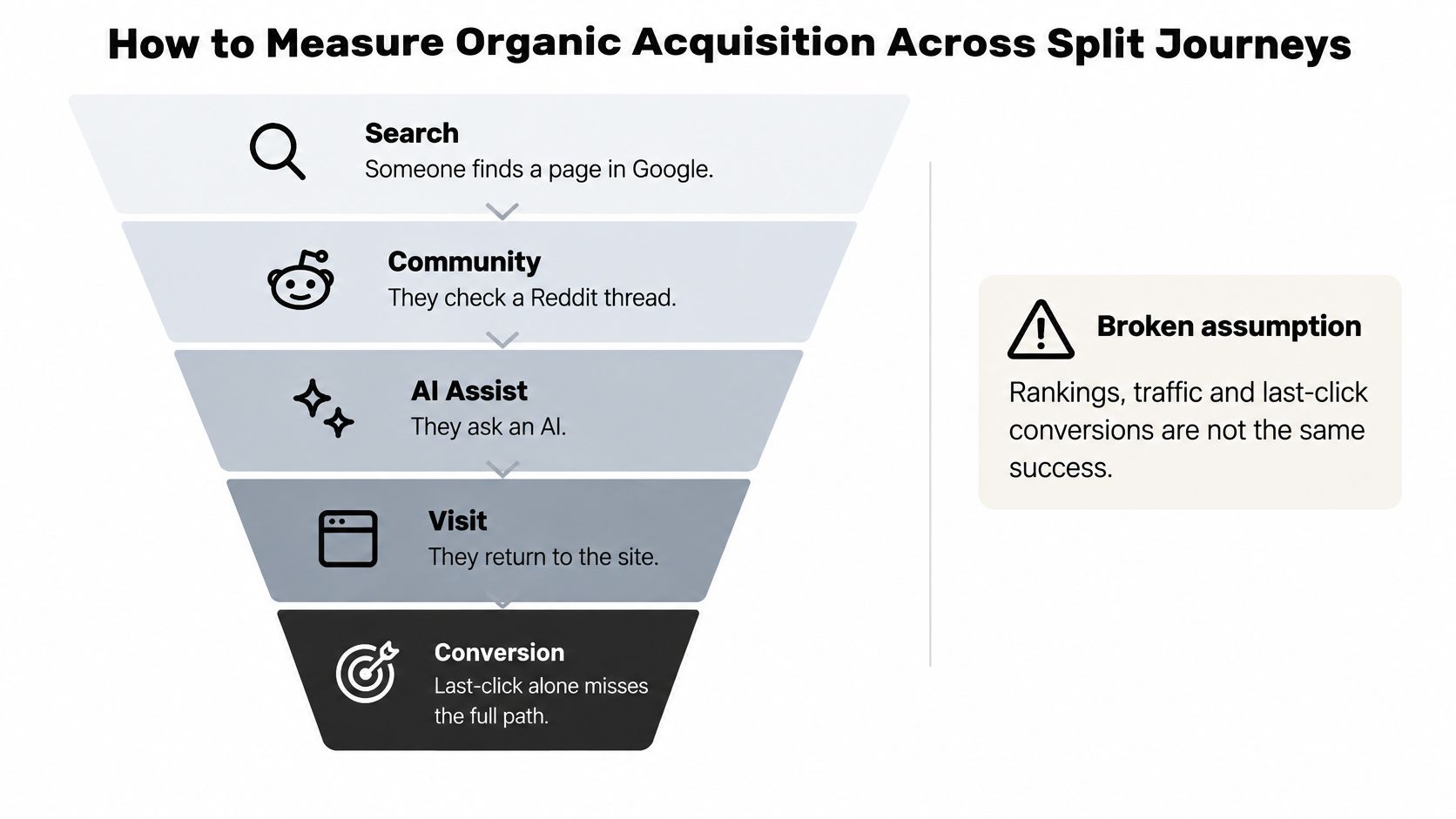
Rankings, traffic, and last-click conversions aren't interchangeable measures of success. A prospect might find your implementation page in Google, check a Reddit discussion, ask an AI assistant about alternatives, and later type your brand name to sign up.
Last-click reporting may label that customer as direct. It doesn't prove that the earlier work contributed nothing.
In its analysis of thousands of queries and top-performing websites from January through August 2025, BrightEdge found that AI-search referrals were growing at double-digit monthly rates but still represented less than 1% of referral traffic, while traditional organic search remained the primary traffic and conversion source.
The budget implication is to monitor AI visibility without replacing search investment. Inspect which independent pages assistants cite, whether those pages describe your category accurately, and whether relevant buyers can verify your claims.
This journey shows why the final visit isn't the whole acquisition story.
Keep a layered spreadsheet
Signals for organic acquisition when the journey splits
| Signal layer | What to track | What it proves | Review every |
|---|---|---|---|
| Discovery | Rankings, branded searches, mentions, AI citations | Whether people have opportunities to find the company without an ad | Monthly |
| Engagement | Qualified replies, demos, email capture | Whether visible content attracts identifiable interest | Weekly |
| Business outcomes | Pipeline, revenue, retention by source, payback | Whether attributed and assisted customers justify the channel's cost | At planned checkpoints and the final test review |
Discovery establishes visibility, not causation. Engagement helps you judge fit, but a demo isn't revenue. Business outcomes need costs and sufficient follow-up before you can make an economic judgment.
Use Google Search Console for search queries and page performance, website analytics for tagged visits and conversion events, and your CRM or spreadsheet for customer outcomes. Add an open-text signup question asking how the buyer first heard about you, and preserve that answer alongside the recorded acquisition source.
Don't force conflicting evidence into a single certain answer. A tagged visit, a customer-reported recommendation, and a later direct conversion can all belong to the same journey.
Test contribution rather than claiming perfect attribution
For a proposed 90-day experiment, review outcomes at days 30, 60, and 90. Record both the original production cost and subsequent maintenance so later returns don't appear artificially free.
Ship a focused page or contribute useful answers in selected communities, then compare branded searches and qualified signups with a prior matched period. Annotate other changes, including promotions, launches, and pricing updates.
This isn't laboratory proof. It is a practical check against mistaking unrelated movement for success.
A full multi-touch analytics suite can wait until a channel shows credible assisted revenue. The useful decision is whether your work brings customers who activate and stay, not whether you can assign every interaction an exact share of credit.
Choose One Channel for a 90-Day Test
Make the commitment before starting another marketing project. Choose the row that matches behavior you can already observe: people searching the problem, buyers asking questions publicly, or existing users getting results.
Run the test in four moves.
-
Name the channel and asset. Write a concrete scope, such as a comparison page for a known buying question or a defined set of relevant community conversations. State who the intended buyer is and what action would demonstrate interest.
-
Cap weekly time. Put research, production, participation, and measurement on the calendar. Give the test a limit so it can't consume the product roadmap.
-
Log the complete evidence. Record discovery, engagement, and customer outcomes, including time spent. Don't add another primary channel before the review date just because the early work feels slow.
-
Decide at day 90. Continue when assisted pipeline or retained customers justify the work. If they don't, distinguish weak execution from poor channel fit before switching rows. For search, useful progress may support a longer investment, but continued funding still needs an explicit reason.
If Reddit is your primary channel
Learn the pattern manually for a week before introducing automation. Read the surrounding discussions, inspect moderator expectations, and identify which problem descriptions match what you solve.
Bazzly can optionally help scan chosen subreddits, score posts for fit, and draft context-aware replies that you review and post from your own account. The founder remains responsible for accuracy, disclosure, and whether participation is permitted.
The end-of-test question isn't whether you published enough. It's whether the evidence supports spending another cycle on this channel rather than on a better alternative.
Write the commitment into your working document today: one primary channel, one defined asset, one 90-day review. Give it an owner and a decision date before creating the next task.
Bazzly helps founders find relevant Reddit conversations and prepare replies grounded in what the person asked. If community participation is your chosen organic acquisition test, visit Bazzly to explore opportunities in your selected subreddits and review the fit before you respond.
Written by Bazzly Team
Bazzly builds software that finds buyer conversations on Reddit and posts helpful replies in them (227,592 posts flagged for customers since June 2, 2025). The Bazzly numbers we quote come from our own data, published with the method in our research studies. About us