10 B2B Digital Marketing Strategies That Work
Every B2B company doesn't need every channel at once. That popular advice creates scattered execution, weak follow-up, and dashboards full of activity that sales can't explain. The better approach matches the growth engine to buyer intent, deal value, channel speed, available expertise, and sales capacity.
The ten b2b digital marketing strategies below follow the buyer journey and the operating model behind it. Community participation and SEO can create or capture demand. Content, partnerships, and webinars build trust. ABM, LinkedIn outreach, email, paid media, and proof assets help move qualified accounts toward a decision. Each strategy includes when it fits, where it fails, how to start, and which signals deserve attention.
B2B marketing now operates across a broader set of touchpoints. McKinsey survey data summarized in 2024 found that B2B marketing organizations managed an average of 10.2 channels, approximately twice the number managed in 2016. That doesn't mean a lean team should copy the whole ecosystem.
Choose one primary strategy, one supporting strategy, and a measurement baseline before expanding. Define the audience, the problem you solve, the next action you want from a buyer, and the pipeline event that will prove the channel deserves more time. Then connect every supporting activity to that path.
Table of Contents
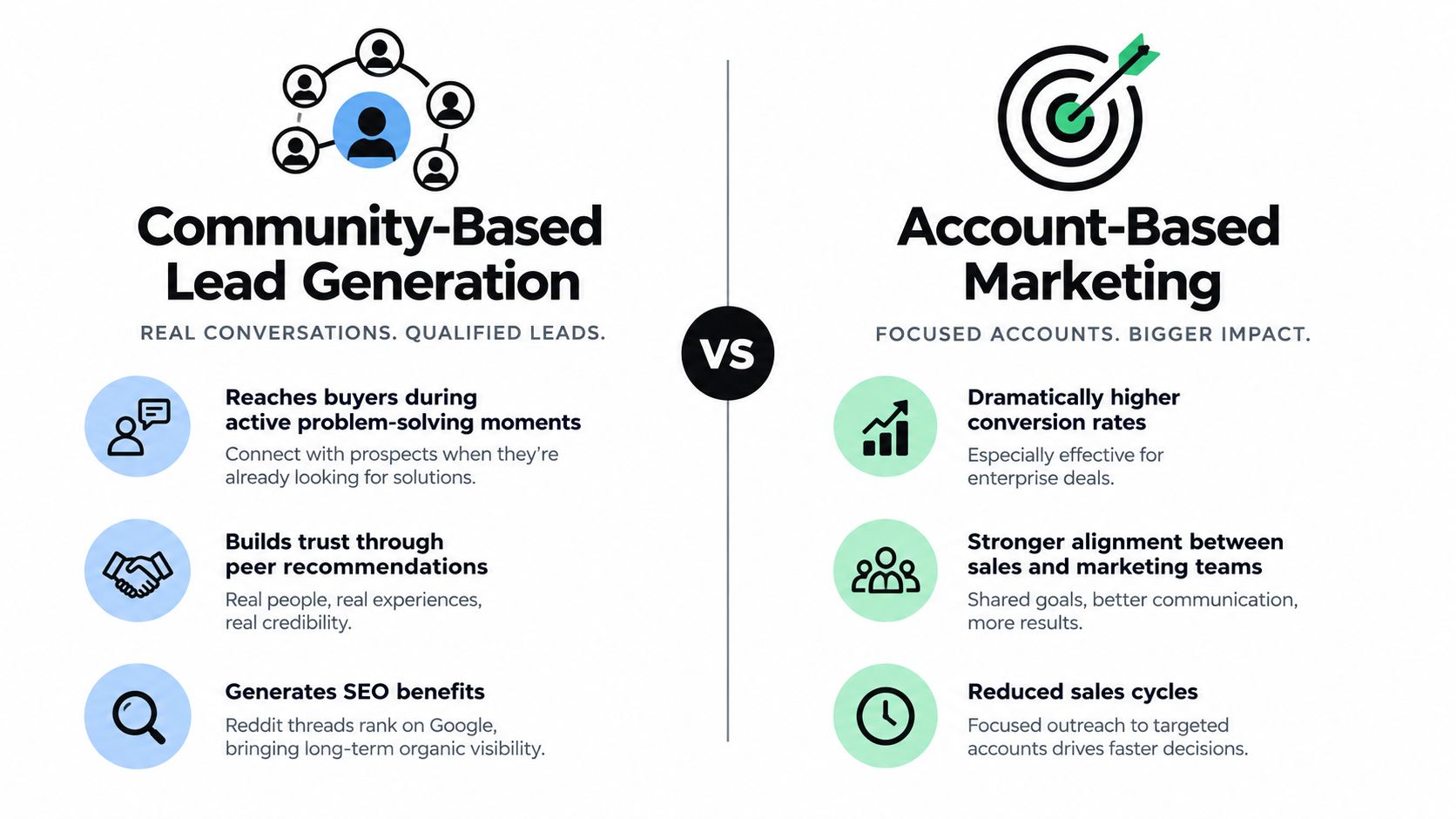
- 1. Community-Based Lead Generation With Reddit and Niche Forums
- 2. Account-Based Marketing
- 3. Content Marketing and Thought Leadership
- 4. LinkedIn Sales Navigator and Outreach
- 5. SEO-Driven Organic Search Strategy
- 6. Email Marketing and Nurture Sequences
- 7. Paid Advertising With Google Ads, LinkedIn Ads, and Retargeting
- 8. Webinars and Virtual Events
- 9. Influencer and Partnership Marketing
- 10. Customer Testimonials and Case Studies
- B2B Digital Marketing: 10-Strategy Comparison
- Build a Portfolio, Not a Channel Checklist
1. Community-Based Lead Generation With Reddit and Niche Forums
Community marketing works when buyers already discuss the problem you solve in public. A founder searching for a reporting tool, a developer comparing deployment options, or an operator asking how to fix a workflow may reveal more useful intent in one thread than in a broad demographic audience.
Reddit and niche forums reward relevance, not polished brand language. A useful reply explains the trade-off, gives a practical next step, and mentions a product only when it fits. Bazzly's community-based marketing guide is relevant for teams that want to identify these conversations and respond consistently without treating every thread as an advertisement.
When it fits and how to start
Use this strategy when your buyers ask specific questions in identifiable communities and your team understands the language of those communities. It's a poor fit when the audience rarely posts publicly, the product requires private procurement before anyone can evaluate it, or your team can't provide helpful answers.
Start by listing communities organized around the buyer's problem, not only around your product category. Read discussions before participating. Look for recurring questions, objections, comparison requests, and posts where someone has already described a buying trigger. Build response guidelines that prohibit unsupported claims, aggressive links, and copy-pasted replies.
A practical workflow can include:
- Intent classification: Separate educational questions from requests for recommendations or urgent troubleshooting.
- Context review: Read the surrounding discussion so the reply answers the actual conversation.
- Human approval: Require review for sensitive topics, competitor comparisons, and direct outreach.
- Attribution: Record the community, thread, problem category, response, visit, signup, and qualified conversation.
Practical rule: Solve the public problem first. Your product mention should feel like an optional continuation, not the purpose of the reply.
Measure qualified thread engagement, assisted visits, branded search, signups, and sales-accepted conversations. Last-click reporting will understate the value of a trusted community interaction, especially when a prospect later converts through search or email.
2. Account-Based Marketing
ABM earns its place when a small group of accounts can materially affect revenue. It is a poor fit for low-value, self-serve sales where broad demand generation matters more than coordinated account attention. The operating question is practical: which companies deserve focused effort, and what evidence could move each one toward a conversation?
Begin with account quality. Build a focused list using commercial value, fit, and buying potential. Research public hiring activity, product launches, leadership changes, technology choices, and category-specific challenges. Connect each signal to a stakeholder, a relevant message, and a clear next step.
The buying committee determines the work. A cloud security vendor may need separate messages for a security leader, finance stakeholder, and technical evaluator at the same company. Each person needs a different reason to continue, whether that means risk reduction, financial justification, or proof that implementation will work.
Set up the account record before launching outreach. Add the business model, likely pain points, current solution, relevant triggers, known stakeholders, and evidence still missing. Marketing and sales should agree on account stages and the action that moves an account from awareness to evaluation.
ABM becomes more useful when channels support the same account journey:
- SEO and content: Answer category and problem questions stakeholders may search independently.
- Reddit and forums: Capture practitioner language, objections, and signs of an active problem.
- LinkedIn and email: Turn account-specific observations into relevant outreach rather than generic product pitches.
- Proof assets: Give each stakeholder evidence that resembles the account's situation.
The trade-off is coordination cost. Personalization improves relevance but consumes research and review time. Broad automation creates more activity, yet weakens trust when messages ignore context. Automate research, routing, and first drafts. Keep positioning, claims, and final account decisions with the team.
Measure qualified pipeline, account progression, opportunity quality, and closed revenue. Compare coordinated activity with standard outreach, including whether SEO, community visits, email, and sales touches contribute to the same opportunity. For additional context on ABM in SaaS and product-led growth, see this account-based marketing guide.
3. Content Marketing and Thought Leadership

Content should give buyers a useful answer before they agree to a sales conversation. It also gives sales a reason to continue an exchange without sending another product brochure. Strong B2B content explains a real decision, shows how to assess the options, and makes the company's point of view recognizable.
Start with buyer questions, not a publishing calendar. Interview customers, salespeople, support staff, and implementation specialists. Record the language they use for the problem, the alternatives they considered, and the risks that delay a purchase. Those interviews provide the raw material for content across the buyer journey.
At the awareness stage, explain the operational issue without forcing a product pitch. SEO can bring in people researching that problem, while relevant Reddit and forum discussions reveal the language and objections practitioners use. At consideration, publish comparisons of approaches, constraints, implementation paths, and risks. Email nurture can distribute these assets to subscribers who have shown interest. At decision, offer a relevant next step, such as an assessment, consultation, or product walkthrough, and support the choice with case studies or sales enablement material.
A detailed guide comparing two implementation paths may attract fewer readers than a broad article about “digital transformation,” yet create more relevant conversations. That trade-off affects planning. High-quality B2B content requires subject-matter access, editorial judgment, and distribution. Low-effort publishing creates volume without authority.
Build each substantial piece for reuse. A strong article can become an email, social post, webinar discussion, or sales asset. Keep one owner responsible for the core argument, then adapt the format for each channel rather than copying the article everywhere.
Thought leadership needs evidence and a specific author perspective. Broad executive observations could come from any company. Connect each opinion to the buyer's work and explain what experience supports it.
Measure qualified organic visits, returning visitors, email subscriptions, content-assisted opportunities, and sales usage. Direct leads are only part of the picture, so combine analytics with self-reported attribution and CRM notes. Review which topics attract the right audience, assist later opportunities, and help sales progress active conversations.
4. LinkedIn Sales Navigator and Outreach
LinkedIn works best as a conversation channel for buyers who are professionally identifiable and likely to evaluate a solution with other stakeholders. Sales Navigator helps teams filter people by role, company, industry, and account characteristics, but targeting cannot compensate for an irrelevant message. Use it for consultative sales, services, enterprise software, recruiting, and offers with a clear business use case. Choose another primary channel when the audience is difficult to identify by role or the recipient has little influence over the purchase.
Start with a small account set connected to a defined problem. For ABM programs, coordinate the target account, buying role, trigger, and desired next action with sales before anyone sends a message. Review responsibilities, company changes, published posts, hiring needs, and likely priorities. A short note should explain why the contact is relevant now, not announce a product and request a meeting.
A practical sequence can combine several touchpoints without turning into a script:
- LinkedIn engagement: Respond to a relevant post with a specific observation or useful resource.
- Connection request: State the context briefly and avoid a complete sales pitch.
- Email support: Continue the same business topic by email only when there is a legitimate reason and appropriate contact information.
- Follow-up value: Offer a comparison, diagnostic question, or practical insight instead of repeating the meeting request.
- Sales feedback: Record which messages produce qualified conversations and which attract poor-fit replies.
Use SEO content, email assets, and Reddit or niche-community research to improve relevance. A search article can answer the problem raised in outreach, while email can continue an opted-in conversation after a useful exchange. Community discussions may reveal the language buyers use, but they should inform research rather than become unsolicited promotion.
The operating trade-off is personalization versus throughput. Automation can organize tasks and draft variants, while human approval should cover sensitive company details, competitor references, and unverified assumptions. Track positive reply rate, qualified conversation rate, meetings accepted by sales, opportunity creation, and conversion by message theme. Connection growth matters only when it leads to relevant discussions. This LinkedIn lead generation campaign guide provides a related framework, while this B2B outreach guide offers additional execution context.
5. SEO-Driven Organic Search Strategy
SEO earns its place when B2B buyers search for a problem, category, vendor type, or solution comparison before speaking with sales. Results take longer than paid advertising, yet a useful page can keep attracting qualified visitors after its initial publishing work. That slower payoff makes SEO a poor fit for urgent pipeline gaps and a strong fit for teams building durable demand capture.
Start with the buyer journey, not a keyword spreadsheet. Educational pages should explain the problem in the language buyers use. Consideration pages should compare approaches, vendors, and implementation choices. Decision pages need product detail, relevant proof, pricing context where appropriate, and a clear next action.
A practical rollout begins with one problem area and a connected page set:
- Technical foundation: Make priority pages accessible, indexable, fast, and easy to interpret.
- Topic coverage: Publish a central guide, then add focused pages for related questions and objections.
- Internal links: Move readers from education to solution pages, proof assets, and conversion paths.
- On-page clarity: Match the title, examples, structure, and call to action to search intent.
- Authority development: Earn relevant references through original research, partnerships, expert contributions, and genuinely distinct content.
Use the SEO recommendations guide to prioritize page-level fixes. The ultimate SEO checklist for B2B companies can help teams review technical and content fundamentals before expanding the program.
SEO works best as part of an operating system. Reddit and niche forums can reveal the wording behind recurring problems, while ABM can identify which accounts deserve custom pages or proof. Email can distribute a useful article to opted-in contacts, and sales can use the same page to answer a live objection. Keep community research focused on buyer language, not unsolicited promotion.
Review qualified organic sessions, engaged visits, conversion paths, assisted opportunities, and pipeline quality. Compare performance by intent and account fit, then improve pages that attract relevant visitors but fail to create a next step. Growth in rankings matters only when searchers become credible conversations or opportunities.
6. Email Marketing and Nurture Sequences
Email earns its place after a prospect gives permission to continue the conversation. It gives a B2B team a direct channel for education, onboarding, event follow-up, sales support, and customer expansion. The team controls the audience relationship more than it does on social platforms, but that control brings responsibility: every message must have a clear reason to exist.
Build journeys around buyer decisions, not around a fixed number of emails. A guide download may indicate early research, while a product comparison, pricing visit, reply, or demo request signals stronger intent. Use role, problem, content interest, account fit, product activity, and stated buying stage to determine the next message.
A practical starting model:
- Education path: Explain the problem, share an applicable resource, address a common objection, then offer a relevant conversation.
- Evaluation path: Provide comparisons, implementation details, proof, and a clear route to speak with sales.
- Trial or onboarding path: Help the user reach a useful product outcome, identify friction, and connect activity with timely assistance.
- Customer path: Support adoption, introduce relevant capabilities, and invite expansion only when usage or needs justify it.
Set entry and exit rules before writing the sequence. Each contact should enter for a known reason, receive one primary action per message, and leave when they reply, book time, become a customer, or stop engaging. Route high-intent actions to sales with enough context to guide the conversation, without flooding the team with every open and click.
Email works best as part of the wider buyer journey. A Reddit discussion can reveal the language for an educational email. An SEO page can collect opted-in subscribers, then the nurture sequence can help them apply what they found. ABM can create account-specific content and alert sales when several people from the same account show interest.
Measure qualified replies, meeting quality, progression between journey stages, activation, retention, expansion, and reactivation. Review performance by segment and entry point, then adjust timing, subject, offer, or routing. For broader B2B channel context, consult the B2B marketing statistics summary, but keep email decisions grounded in your own audience behavior and pipeline evidence.
7. Paid Advertising With Google Ads, LinkedIn Ads, and Retargeting
Paid media is useful when the buyer journey has a clear next action. Search ads can capture active purchase intent, LinkedIn can reach defined professional audiences, and retargeting can bring known visitors back to a relevant decision point. Each channel also creates a recurring cost. Stop the campaign, and the traffic usually stops with it.
Choose the commercial job before choosing the platform. A high-intent search campaign suits buyers already naming a problem or solution. LinkedIn fits account reach and category education, where prospects may need more context before they convert. Retargeting supports either route when the message reflects what the visitor previously viewed.
Build around the buying decision
Connect the ad promise, landing page, and conversion event. An ad offering a comparison should lead to a comparison, not a generic homepage. A campaign aimed at a defined account group should use account-relevant proof and a follow-up path that sales can understand.
Set the operating rules before launch:
- Conversion definition: Choose a signup, qualified form, booked conversation, or another commercial event that matches the buyer stage.
- Audience exclusions: Remove existing customers, poor-fit segments, and people who completed the intended action.
- Message variants: Test different problems and proof points, rather than only changing wording or design.
- Landing page review: Check relevance, clarity, friction, trust signals, and the next action.
- Pipeline connection: Return lead and account status to the reporting system so spend can be judged against progression, not clicks alone.
Use the wider journey to improve paid performance. Community discussions can expose the language buyers use. SEO pages can answer early questions and give retargeting audiences a useful next step. Email can continue an opted-in conversation, while ABM can coordinate account-specific ads, content, and sales follow-up. Sales calls and search queries also reveal which objections the campaign needs to address.
Paid advertising cannot repair unclear positioning. It can show that an offer is failing, but extra traffic will not make an unfamiliar message persuasive. Start with a narrow test, check lead quality and pipeline movement, then increase spend only when the landing page, audience, and follow-up process work together.
Adobe's 2025 B2B survey found that 34% of organizations used generative AI for copy creation, 30% for creative content, and only 38% had deployed working AI solutions for marketing or customer experience. The report separates pilots and informal tests from operational deployment. Use the Adobe B2B digital trends report as context, while measuring paid workflows by qualified pipeline, conversion quality, and time saved, not AI usage.
8. Webinars and Virtual Events
A webinar earns its place when buyers need explanation, confidence, or direct access to expertise before choosing a solution. The format suits technical products, complex services, implementation-heavy purchases, and problems that benefit from live questions.
Start with a recurring customer problem, then define the decision the session should support. A broad topic may increase registrations while attracting weaker intent. A narrow session may draw fewer people but produce sharper questions and better sales conversations. Choose that trade-off deliberately.
Design the session around a buyer decision
Give attendees a useful outcome. They might learn how to compare workflows, assess an approach, avoid an implementation mistake, or build an internal business case. Include a product demonstration only when it clarifies that decision. A feature tour can reduce attention before buyers understand the problem.
Plan distribution and follow-up as one operating flow:
- Early-stage discovery: Publish an SEO page that answers the event question and captures search demand. Participate in relevant Reddit and forum discussions by contributing useful answers, rather than posting invitations in unrelated threads.
- Consideration: Use segmented email invitations that explain why the session fits each contact's role or buying stage. Speakers and partners can share practical excerpts on LinkedIn before and after the event.
- Account progression: Invite priority accounts through ABM, then connect attendance, questions, and follow-up activity to account records. Sales should use the buyer's stated problem as the basis for the next conversation.
A recording is an asset, not a nurture program. Send attendees a concise summary, the recording, a related resource, and one clear next action. Give registrants who missed the event a different follow-up message. Route high-intent questions to sales promptly, while continuing education for contacts who are still researching.
Measure registrations from qualified accounts, attendance quality, questions asked, follow-up replies, meetings accepted, and opportunities created. Review both reach and progression. A smaller event can outperform a larger one when it creates serious conversations with accounts that fit the target customer profile.
9. Influencer and Partnership Marketing
Partnership marketing works when a trusted person or company already has access to the buyers you need. Audience size matters less than problem fit, credibility, and the absence of a direct conflict. Complementary software vendors, consultants, implementation firms, specialist communities, educators, agencies, and industry publications can all play that role.
Start with the buyer's stage and the partner's position in the buying process. A workflow automation company might work with an integration provider or operations consultancy because each addresses a different part of the same customer problem. Use an expert contribution or practical guide for early discovery, a joint webinar or integration tutorial during evaluation, and partner referrals when a buyer is close to a decision.
Run one bounded test before creating a formal program. Choose a specific audience, problem, and asset. A generic co-branded announcement creates promotional work without giving buyers a reason to respond. A useful guide, implementation example, or problem-focused session gives both audiences a clear reason to participate.
Set the operating rules before launch:
- Audience definition: Identify overlapping customers, roles, industries, and use cases.
- Offer ownership: Assign creation, hosting, follow-up, and qualified-lead handling.
- Message control: Keep claims accurate and let each partner use its own voice.
- Attribution: Use distinct landing pages, campaign tags, referral fields, or partner codes.
- Review process: Judge lead quality, account fit, and progression, not traffic alone.
Connect the test to the rest of the buyer journey. A co-created guide can earn search visibility and enter an email sequence. A partner webinar can trigger ABM follow-up for priority accounts. An expert explanation can become a sales asset, a Reddit contribution, or a useful answer in a niche forum. Those channels should support the same problem and offer, rather than publish disconnected messages.
Partnerships can reduce acquisition friction while adding dependency. A partner may change priorities, promote a competing product, or attract an audience that rarely buys. Track qualified referrals, assisted opportunities, partner-sourced pipeline, conversion quality, and retention. Reward partners for customer fit and progression, then expand only when the test produces repeatable results.
10. Customer Testimonials and Case Studies
Proof assets help buyers answer a practical question: “Will this work for a company like mine?” Testimonials offer a quick confidence signal. Case studies explain the context behind it, including the original problem, decision process, implementation, obstacles, and outcome.
A weak case study says a customer was happy. A useful one shows what changed, why the customer chose the solution, and which conditions made the result possible. Give similar buyers enough detail to recognize the pattern without making unsupported claims or exposing confidential information.
Turn customer evidence into a reusable system
Customer interviews should produce specific details. Ask what the team tried before, why the problem became urgent, who joined the decision, what nearly stopped the purchase, and how the customer defines success. Get permission for every claim you plan to publish, including metrics, timeframes, logos, names, and video.
Match each proof asset to the buyer's uncertainty:
- Early stage: Add a brief customer observation to educational content, search-driven articles, or a relevant Reddit or niche-forum response.
- Consideration: Place a relevant case study beside comparison and solution pages, then direct engaged readers into an email sequence.
- Decision: Give sales a detailed story that matches the prospect's industry, use case, or account profile. ABM campaigns can feature the same evidence for priority accounts.
- Post-sale: Use proof to reinforce adoption and show customers what successful usage looks like.
Don't force every story into a revenue-growth narrative. Operational improvements, reduced manual work, faster response, easier collaboration, or clearer reporting may be more credible and more relevant to the buyer. The story should reflect the customer's actual value, not the marketing team's preferred headline.
Repurpose carefully. A long case study can become a short testimonial, sales slide, email, webinar segment, or paid ad. Each version must preserve the approved meaning and retain the detail that makes the evidence credible. Review performance by proof-assisted conversions, sales usage, page engagement, qualified conversations, and win-rate patterns where reliable data exists. Proof rarely creates demand alone. It makes demand easier to trust after a buyer encounters your content, search result, community response, or outreach.
A clear proof sentence might read: “After replacing manual reporting with the solution, the operations team responded faster and gave sales a clearer view of active accounts.”
B2B Digital Marketing: 10-Strategy Comparison
| Strategy | Implementation Complexity 🔄 | Resource Requirements ⚡ | Expected Outcomes ⭐ | Ideal Use Cases 💡 | Key Advantages 📊 |
|---|---|---|---|---|---|
| Community-Based Lead Generation (Reddit & Niche Forums) | 🔄 Medium–High, requires authentic participation & moderation | ⚡ Low $ but high time; automation reduces effort | ⭐⭐⭐ High-intent leads, trust-building, SEO lift | 💡 Solo founders, early-stage SaaS, niche B2B communities | 📊 Authentic engagement, low ad spend, compounding organic traffic |
| Account-Based Marketing (ABM) | 🔄 High, account research, personalization, sales alignment | ⚡ High, CRM, intent data, dedicated reps | ⭐⭐⭐⭐ Very high conversion & revenue impact per account | 💡 Enterprise & mid-market deals with high LTV | 📊 Precision targeting, clear ROI attribution, tighter sales-marketing alignment |
| Content Marketing & Thought Leadership | 🔄 Medium, editorial process and subject-matter expertise | ⚡ Medium–High time/budget for quality content | ⭐⭐⭐⭐ Compounding organic traffic and credibility (long-term) | 💡 Brands building authority, long sales cycles, education-heavy buyers | 📊 Sustainable traffic, supports full funnel, reusable assets |
| LinkedIn Sales Navigator & Outreach | 🔄 Medium, targeted search + personalized outreach cadence | ⚡ Medium, subscription + SDR/time investment | ⭐⭐⭐ Warm, research-backed outreach with good response rates | 💡 Targeted B2B prospecting, land-and-expand strategies | 📊 Direct access to decision-makers, integrates with sales workflows |
| SEO-Driven Organic Search Strategy | 🔄 Medium–High, technical SEO + content and link building | ⚡ Medium–High, SEO expertise and ongoing effort | ⭐⭐⭐⭐ Consistent high-intent traffic; long-term CAC reduction | 💡 Products with clear buyer search intent; scaling organic acquisition | 📊 Compounding visibility, lower CAC over time, supports brand authority |
| Email Marketing & Nurture Sequences | 🔄 Low–Medium, setup sequences, segmentation, automation | ⚡ Low–Medium, platform costs and content creation | ⭐⭐⭐⭐ Very high ROI; effective at conversion and retention | 💡 Lead nurturing, onboarding, retention and upsell motions | 📊 Owned channel, measurable attribution, highly scalable |
| Paid Advertising (Google, LinkedIn, Retargeting) | 🔄 Medium, campaign setup, targeting, continuous optimization | ⚡ High, ongoing ad spend and specialist skills | ⭐⭐⭐ Immediate visibility and scalable lead volume | 💡 Fast demand generation, testing PMF, time-sensitive goals | 📊 Rapid results, granular targeting, clear conversion metrics |
| Webinars & Virtual Events | 🔄 Medium–High, content, production, and promotion effort | ⚡ Medium, platform, hosts, promotion budget | ⭐⭐⭐ High-quality, engaged leads; strong demo/education channel | 💡 Complex products, product demos, training and thought leadership | 📊 Interactive education, strong lead qualification, repurposable content |
| Influencer & Partnership Marketing | 🔄 Medium, partner discovery, agreements, co-creation | ⚡ Low–Medium, variable costs or revenue share | ⭐⭐⭐ Access to engaged third-party audiences and credibility | 💡 Complementary products, co-marketing, affiliate programs | 📊 Accelerates credibility, expands reach with lower upfront spend |
| Customer Testimonials & Case Studies | 🔄 Low–Medium, customer coordination and production | ⚡ Low, interviews to high if producing video assets | ⭐⭐⭐⭐ Strong trust signal; boosts late-funnel conversion | 💡 Late-stage prospects, sales enablement, proof-of-value needs | 📊 Highest credibility source, objection handling, repurposable across channels |
Build a Portfolio, Not a Channel Checklist
The right B2B digital marketing strategy isn't a collection of disconnected tactics. It's a portfolio built around how buyers discover a problem, evaluate alternatives, involve other stakeholders, and decide whether the risk of change is acceptable.
Start with the buying motion. If prospects actively search for a defined problem, choose one demand-capture channel, such as SEO or high-intent paid search. If they discuss the problem in communities, build around relevant Reddit and niche forum participation. If the market consists of a known set of valuable accounts, ABM and carefully researched LinkedIn outreach may be more appropriate. If buyers need education before they can evaluate the product, invest in content, webinars, and proof.
Then add one trust-building asset. That might be a practical guide, a comparison page, a webinar, a partner resource, or a customer case study. The asset should answer the question that blocks the next stage. A community interaction can lead to an educational article. An SEO visitor can encounter a case study. A webinar attendee can enter a useful email sequence. An ABM contact can receive proof that matches the account's industry and problem.
Finally, add one conversion system. Email nurture, sales follow-up, a product-led signup path, a consultation request, or an account handoff can provide that system. Without it, demand-generation activities create attention that no one develops. Marketing and sales need shared definitions for a qualified conversation, sales acceptance, opportunity creation, and customer conversion.
A practical 90-day sequence looks like this:
- First, establish the baseline: Define the ideal customer profile, priority problems, source tracking, conversion events, and the pipeline fields required for channel analysis.
- Next, launch one focused test: Choose a narrow audience and offer. Use one primary channel and one supporting asset. Keep the message consistent across the landing page, follow-up, and sales handoff.
- Then, inspect qualified outcomes: Review conversations, account fit, sales acceptance, opportunity quality, time to follow-up, and assisted influence. Don't treat clicks, impressions, or raw registrations as the final verdict.
- Finally, scale or replace: Expand the activity only when the team can explain why it produced useful pipeline. If it didn't, change the audience, offer, message, or channel rather than adding more tactics.
Measurement needs to reflect distributed buying journeys. A 2025 B2B buyer research synthesis notes that review sites are the most frequently consulted source for 34% of buyers, while research is the longest stage for 45%. Those figures reinforce a practical point: the channel that creates trust may not receive the final conversion credit.
Use several signals together. Track assisted conversions, repeat visits, branded-search movement, self-reported attribution, sales-cycle velocity, qualified thread engagement, and pipeline quality. Small teams can use CRM fields, campaign parameters, call notes, and periodic customer surveys without pretending that one dashboard proves causality. Compare cohorts where possible, use audience or geographic holdouts when practical, and write down the decision rule before reviewing the result.
AI can support this operating model, but it shouldn't replace it. A benchmark based on more than 60 senior B2B marketing and sales leaders reported that 88% considered AI part of their marketing strategy, while only 21% felt very confident they were using it effectively. The same AI readiness report reported that 72% used AI in at least one workflow, fewer than half had defined a success metric, and organizations reporting strong marketing and sales alignment also reported 20% higher satisfaction with AI outcomes.
For a lean team, that means using AI in controlled workflows such as intent classification, research, response drafting, lead routing, and prioritization. Keep human approval for high-risk outbound messages. Log prompts and versions, filter prohibited claims, check for duplicate content, and evaluate drafts against representative buyer questions. Judge the system by qualified conversations created, sales acceptance, time saved, and downstream conversion, not by how often the team opens the tool.
Bazzly can fit one part of this portfolio for founders and small B2B teams that want to monitor relevant Reddit conversations, draft context-aware replies, and support prospect follow-up. It shouldn't replace SEO, email, proof, or sales capacity. It can serve as a community demand-capture layer that feeds a broader measurement and conversion system.
Choose the channel where buyer intent is easiest to observe, create one asset that removes a major trust barrier, and connect both to a conversion path your team can realistically manage. Review the evidence after the initial test, keep what creates qualified pipeline, and replace what only creates noise.
Bazzly monitors relevant Reddit conversations, identifies high-intent threads, and helps founders and small teams draft and publish context-aware replies or follow up with promising prospects. If Reddit belongs in your B2B digital marketing portfolio, visit Bazzly to explore a more repeatable way to turn community conversations into qualified traffic and leads.


