B2B Digital Marketing Solutions: A Complete Guide
92% of B2B buyers ultimately purchase from a preferred “Day One List” created before the formal buying journey begins. Effective B2B digital marketing solutions therefore need to make a company visible before sales contact, then connect search, content, communities, paid media, and timely follow-up into one intent-aware system.
That finding changes the job for a small marketing team. You're not just trying to generate a form submission. You're trying to become one of the vendors a buying committee already recognizes when a problem becomes urgent.
Table of Contents
- The Reality of Modern B2B Buying
- Exploring Core Digital Ecosystems
- Software versus Managed Services
- Adapting Tools to a Compressed Cycle
- Building a Unified Acquisition System
- Moving Beyond Clicks to Real Growth
The Reality of Modern B2B Buying
A prospect rarely arrives at a B2B website with a blank slate. They've searched for the problem, read comparisons, asked peers for recommendations, checked community discussions, and formed an early opinion about which vendors deserve attention. Sales may enter the conversation later, but the shortlist often takes shape first.
A Google and Bain study of 1,208 people involved in U.S. business purchasing found that 92% ultimately purchased from an initial preferred “Day One List” created before the formal purchasing journey began. Search was the most frequently used research resource, with 56% of buyers using it at least weekly. The evidence is summarized in Marketing Dive's analysis of the modern B2B buying landscape.

Visibility comes before conversion
Consider a small SaaS company selling workflow software to operations teams. Its sales team might have a strong demo and a capable outbound process, but those assets matter only after the company earns consideration. If a buyer searches for an operational problem and finds competitors instead, the sales team is starting from behind.
The same study found an average of 17 stakeholders involved in a B2B purchase, with approximately 40 touchpoints per buyer and more than 670 potential opportunities to influence the decision. Those numbers don't mean a small team should create hundreds of campaigns. They show why one landing page and one sales sequence can't carry the entire buying experience.
Practical rule: Build answers for the questions buyers ask before they're willing to speak with you.
That means publishing useful educational content, earning third-party validation, participating in relevant communities, and making product information easy to evaluate without a meeting. Paid campaigns can accelerate reach, while search optimization gives useful answers a longer shelf life. For teams developing paid acquisition, a resource on a creative engine for B2B Facebook ads can help clarify how creative production fits into a broader demand system.
The practical consequence is uncomfortable but useful: lead generation is downstream from preference formation. A visitor who already trusts your expertise converts differently from someone who encountered a generic advertisement with no supporting proof. Small companies should allocate effort to both direct response and early-stage visibility, because buyers may decide who belongs on the shortlist before they ever submit a form.
Exploring Core Digital Ecosystems
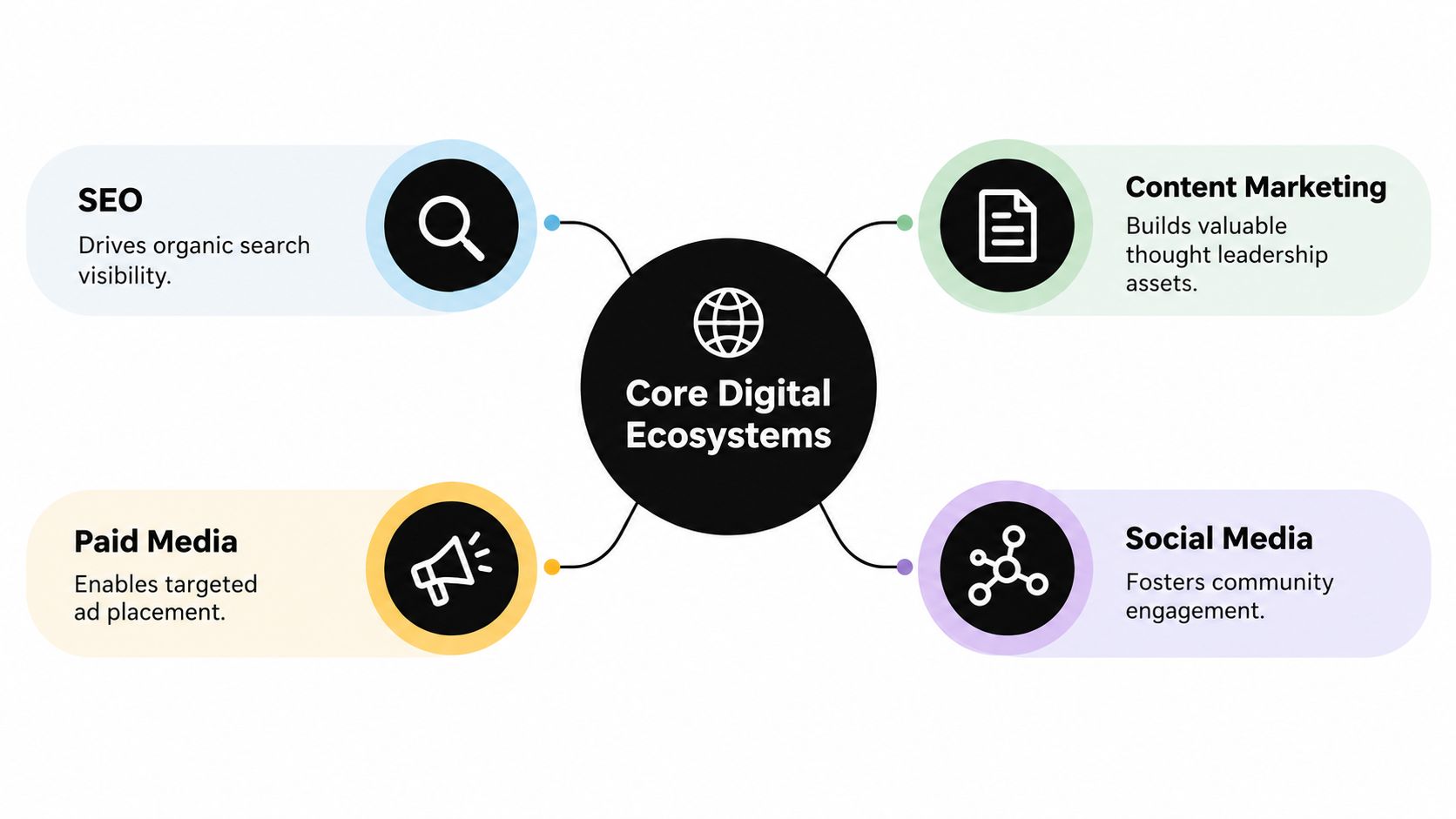
B2B digital marketing solutions work best as connected parts of an acquisition system. Search creates discoverability, content supplies evidence and education, paid media provides controlled distribution, and communities expose the language buyers use when they need help. Each channel answers a different question, so treating them as interchangeable creates gaps.
McKinsey research covering more than 3,800 B2B customers and sellers across 13 countries found that buyers used an average of 10 or more interaction channels during the purchasing journey. E-commerce ranked as the most effective channel at 35%, followed by in-person interactions at 26% and video at 12%, as summarized in this overview of B2B buyer journey research.
Four channels, four jobs
SEO captures existing demand. It helps your company appear when someone searches for a problem, category, comparison, or implementation question. The strongest B2B SEO programs don't chase broad visibility alone. They map pages to specific intent, such as evaluating alternatives, understanding integration requirements, or validating whether a product fits a particular workflow.
Content marketing builds confidence. A useful article may attract an early researcher, while a comparison page, product guide, webinar, or implementation checklist helps a later-stage evaluator. Content should give buyers material they can share internally, not just persuade the original visitor.
Paid media buys controlled attention. Search ads can capture urgent category demand. LinkedIn and other professional platforms can target roles or accounts. Retargeting can return a prospect to a relevant proof point, but it won't repair weak positioning or an unclear offer.
Community engagement reveals context. Reddit, industry forums, peer groups, and social conversations contain the language people use when they describe constraints in their own words. A thoughtful response can build trust, while an obvious sales pitch can damage it. Community activity also creates material for content briefs, objection handling, and product messaging.
A coordinated program gives each channel a defined role. Search can discover demand, a community discussion can provide credibility, a guide can answer implementation concerns, and a focused offer can create the next measurable action. The B2B digital marketing strategies guide is useful for comparing these activities as parts of a strategy rather than isolated campaigns.
For a small team, coordination doesn't mean publishing everywhere. It means choosing a narrow audience, reusing strong ideas across formats, and recording which interactions indicate real intent. A single customer question can become a search page, a short video, a community contribution, and a sales enablement asset. That operating model stretches limited headcount without turning the brand into a content factory.
Software versus Managed Services
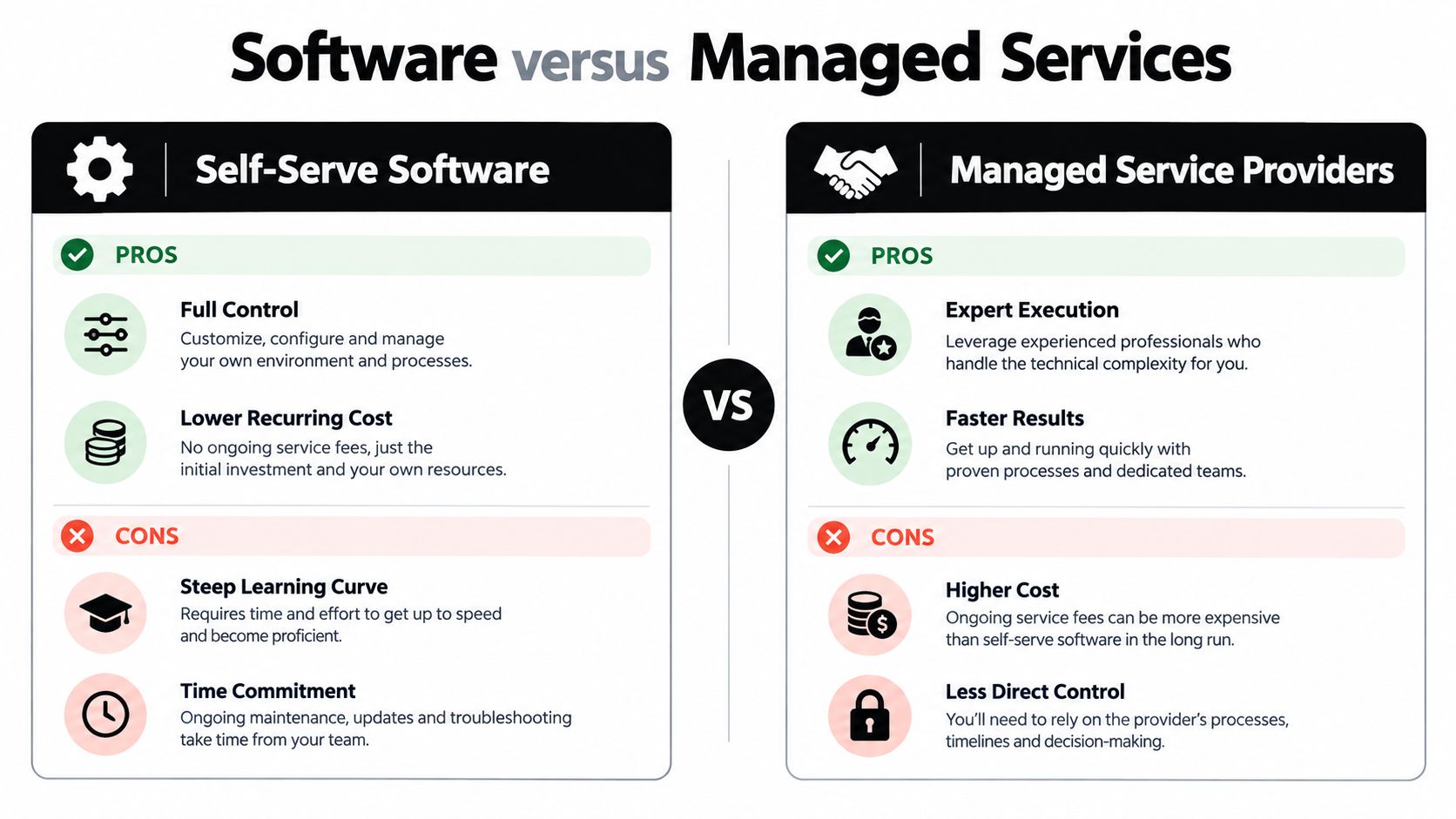
The software-versus-service decision isn't really about which option is superior. It's about where your team can reliably create advantages. Self-serve software offers control and repeatability, while a managed service can remove execution work that your team doesn't have the time or expertise to perform.
When software fits
Self-managed tools make sense when someone on the team can own the workflow. That person needs to define the audience, maintain tracking, interpret results, write or approve messaging, and act on signals. Tools such as Google Search Console, HubSpot, Ahrefs, LinkedIn Campaign Manager, and a CRM can provide useful building blocks, but buying access doesn't create a functioning system.
Software tends to work well when:
- The process is repeatable: Your team knows what counts as a qualified account and can execute the workflow consistently.
- Control matters: You need direct access to targeting, content, budgets, or customer data.
- Learning is strategic: The team wants to build internal capability rather than outsource every decision.
- The channel is already validated: You're improving a working motion, not trying to discover one from scratch.
The trade-off is operational load. Every platform adds configuration, QA, reporting, and maintenance. A small team can end up managing dashboards instead of improving the offer.
When managed help fits
Managed services make more sense when the constraint is execution capacity or specialist knowledge. An experienced partner can accelerate research, campaign setup, creative production, technical SEO, or community operations. You still need to provide product context and approve positioning, but the partner carries more of the recurring work.
Managed services tend to fit when:
- The cost of delay is high: A launch or market opportunity needs focused execution.
- The skill is difficult to hire: Your team needs expertise that isn't required every day.
- The workflow is labor-intensive: Monitoring, content production, testing, or reporting would overwhelm internal staff.
- You need accountability: A defined scope and reporting cadence create ownership beyond a collection of subscriptions.
The risk is dependency. A provider may produce activity without building useful learning into your company, and an external team can misunderstand nuanced product claims. Contracts should define deliverables, access, approval rights, data ownership, and the metrics that matter to the business.
A hybrid model often suits early-stage companies. Keep positioning, customer insight, and final judgment in-house. Use software for shared visibility and automation, then bring in managed support for specialized or repetitive work. The right question isn't “Which tool should we buy?” It's “Which part of this system can our team operate well every week?”
Adapting Tools to a Compressed Cycle
B2B systems built around slow, linear nurture sequences can miss buyers who are already comparing vendors. A 2025 Google study of 2,063 U.S. senior B2B buyers found that 84% said AI tools accelerated their purchasing process, while most buyers completed the journey within 12 weeks. The findings are available in the Google and National Research Group buyer journey study.
The response isn't to automate every interaction. It's to reduce the time between a meaningful signal and a relevant next step.
Start with an intent model
Define signals that distinguish active evaluation from casual attention. Problem-specific searches, comparison-page visits, pricing-page activity, repeat sessions, and company-fit attributes should carry more weight than a generic impression or an isolated social interaction.
Write the model in plain language before choosing software. For example, a high-intent account might show category research, return to a product page, match your target company profile, and engage with implementation content. A lower-intent visitor might receive education and retargeting instead of immediate sales outreach.
Connect the signal sources
Capture intent from the places buyers already research:
- Search behavior: Group queries by problem, category, comparison, and solution readiness.
- Community language: Record recurring objections, requirements, and words buyers use to describe the problem.
- Website behavior: Track meaningful page visits, return sessions, content downloads, and product interactions.
- Campaign response: Separate exposure from actions that indicate evaluation.
A CRM or customer data layer should combine these events with firmographic information and account history. Without that connection, the team sees disconnected activity and treats every conversion as equally valuable.
Trigger the next action
High-scoring accounts should route to a human or a personalized workflow within minutes or hours, not sit in a queue until the next campaign review. The next action might be a customized email, a relevant comparison guide, a sales notification, or an invitation to ask a specific product question.
Automation should remove waiting, not remove judgment.
Measure time-to-first-response, marketing-qualified-account-to-opportunity conversion, sales-cycle duration, and pipeline generated by intent tier. Lead volume can rise while commercial quality falls, so the system needs feedback from sales. When an account advances, stalls, or disqualifies, update the model. That loop keeps the technology aligned with how buyers behave instead of turning automation into a faster way to send irrelevant messages.
Building a Unified Acquisition System
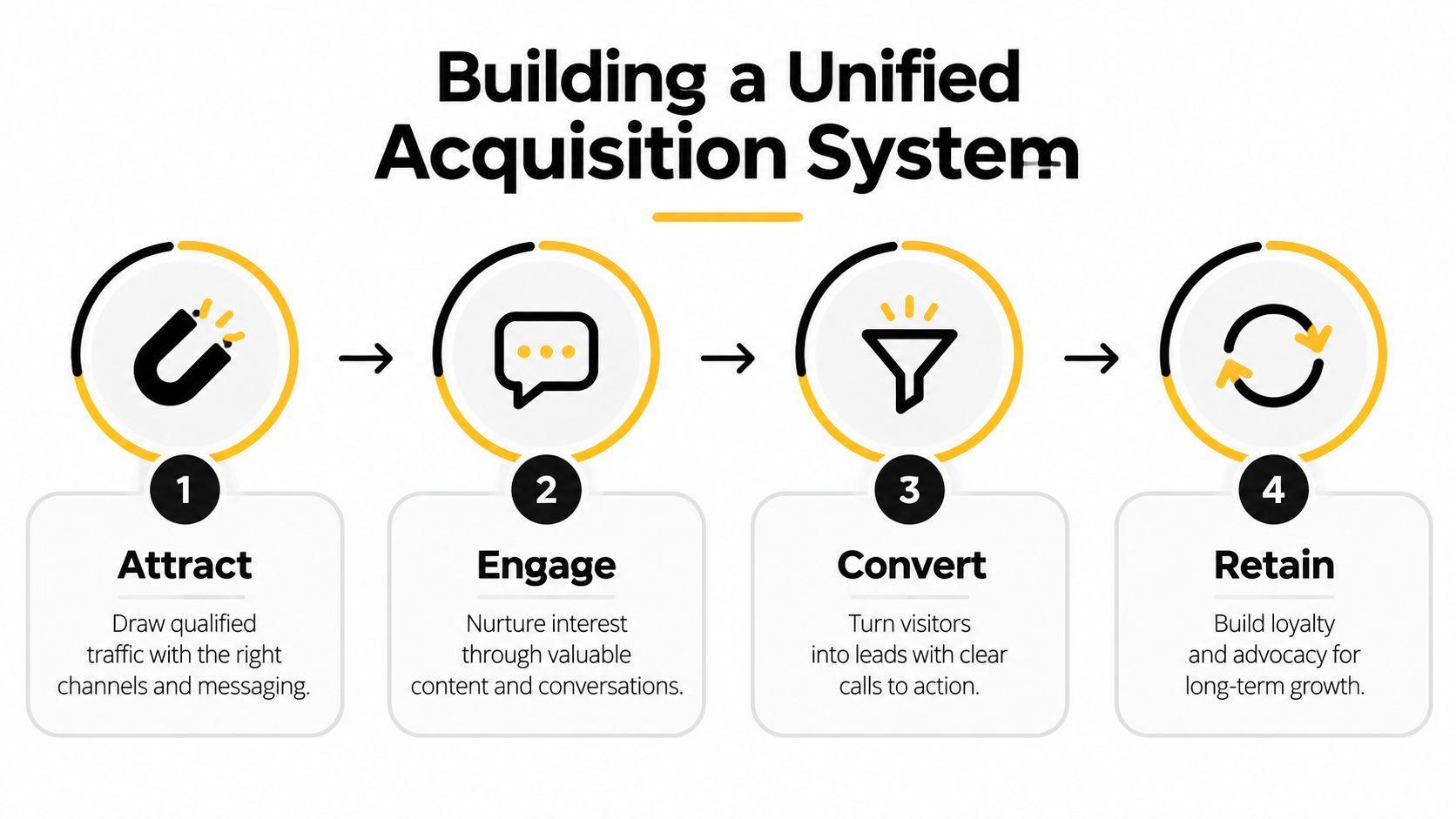
A unified acquisition system has one defining property: every channel contributes information to the next decision. Search identifies questions, community engagement adds context, content handles objections, paid media distributes proven messages, and conversion paths make the next step easy.
Attract and engage with the same message
Start with a problem your target account already recognizes. Publish a search-oriented explanation, participate where buyers discuss that problem, and use paid media to distribute the strongest evidence. The wording doesn't need to be identical in every channel, but the promise and point of view should remain consistent.
Community engagement deserves particular care. The Social Search perspective on pipeline building provides useful context for treating social conversations as part of acquisition rather than as a vanity engagement channel. A response should answer the question first, disclose relevance where appropriate, and avoid forcing a demo into a discussion that doesn't call for one.
Test the conversion path
Don't assume every prospect should land on your website. A native form can preserve ad context and reduce the steps required to submit information, while a landing page gives you more room to educate, qualify, and handle a complex offer.
A 2025 benchmark summarized from Metadata data found that LinkedIn lead-generation campaigns using native forms averaged $193 per lead, compared with $346 per lead when traffic went to traditional landing pages. The benchmark is reported in this analysis of LinkedIn advertising data.
Run the comparison as an economic test, not a form-completion contest:
| Path | Useful starting point | What to evaluate |
|---|---|---|
| Native form | Narrow, high-intent targeting and a simple offer | Qualified-account rate and opportunity conversion |
| Landing page | Complex offers that need proof or education | Engagement quality and pipeline contribution |
| Follow-up | Both paths connected to the CRM | Response time, duplicate records, and revenue attribution |
Use the same audience definition, offer value, attribution window, and budget controls. Add server-side conversion tracking and CRM deduplication so repeated submissions don't inflate results.
For community-led acquisition, Bazzly monitors relevant Reddit conversations, identifies high-intent threads, drafts context-aware replies, and supports publishing through automation or a browser extension. It belongs in the engagement layer, alongside clear review rules and human oversight. The broader B2B customer acquisition strategy framework helps connect that activity to conversion and retention rather than treating Reddit as a disconnected experiment.
Moving Beyond Clicks to Real Growth
Clicks and form fills are easy to report, but they don't tell you whether a buyer trusts the company, whether the account fits, or whether sales can create an opportunity. A stronger measurement system connects visibility to qualified conversations and pipeline movement.
Google reported in May 2025 that AI Overviews had reached more than 1.5 billion monthly users across over 200 countries and territories. Independent analysis cited alongside that development reported click-through rates of 8% when AI Overviews appeared, compared with 15% for traditional results, as discussed in Google's overview of AI and marketing.
That shift makes last-click attribution less complete. A buyer might encounter your brand in an AI-generated answer, read a Reddit discussion, search your company directly, and later convert through a branded page. The final visit matters, but it doesn't explain what created confidence earlier.
Track influence, not just traffic
Add measures that reflect how demand forms:
- Assisted awareness: Record branded search movement, direct traffic patterns, and repeat visits after major content or community activity.
- Qualified conversations: Review whether discussions produce replies, questions, demos, or account research from the right audience.
- Channel contribution: Use unique landing paths, CRM source fields, and cohort analysis to compare audiences without pretending attribution is perfect.
- Pipeline velocity: Track time from first meaningful signal to opportunity, conversion by intent tier, and pipeline generated by channel.
Tools such as LinkedIn analytics tools can help organize channel-level observations, but dashboards aren't a strategy. Your team still needs clear definitions for a qualified account, a meaningful conversation, and a commercially useful action.
The practical test for any B2B digital marketing solution is simple: does it help the right buyer recognize your company, understand the offer, and move forward with less friction? If it only produces more activity, it belongs in an experiment until the data proves that it contributes to SaaS marketing ROI.
Bazzly helps founders and small teams turn relevant Reddit conversations into an organized acquisition workflow by monitoring discussions, drafting context-aware replies, and supporting personalized outreach. Visit Bazzly to see how community intent can fit into a broader B2B digital marketing system without adding another full-time channel manager.


