On this page
In a study of 16,331 Reddit posts, 78% of buying-intent posts described a problem, while 13.6% asked for a tool. That distinction matters: buyers often explain what's going wrong before they name the kind of product they need. Founders don't need a bigger pile of startup marketing tools. They need a small stack that finds real opportunities, captures what happens next, and gives them a result quickly enough to decide whether to keep investing.
The market makes focus harder. MarTech's overview of the 2025 landscape counts 15,384 solutions across 49 categories, so tool choice is less about finding something that can do the job than avoiding extra setup, cost, and upkeep. The picks below are organized around time-to-first-result: Bazzly for Reddit conversations, HubSpot for contact records, Ahrefs and Semrush for search research, Buffer and Canva for social publishing and creative, Mailchimp for email, PostHog and Mixpanel for product behavior, and Zapier to connect the pieces.
Start with one acquisition channel and one way to measure what happens after a lead arrives. Then build a marketing stack around customer acquisition by adding only the tools that remove a clear bottleneck.
1. Bazzly
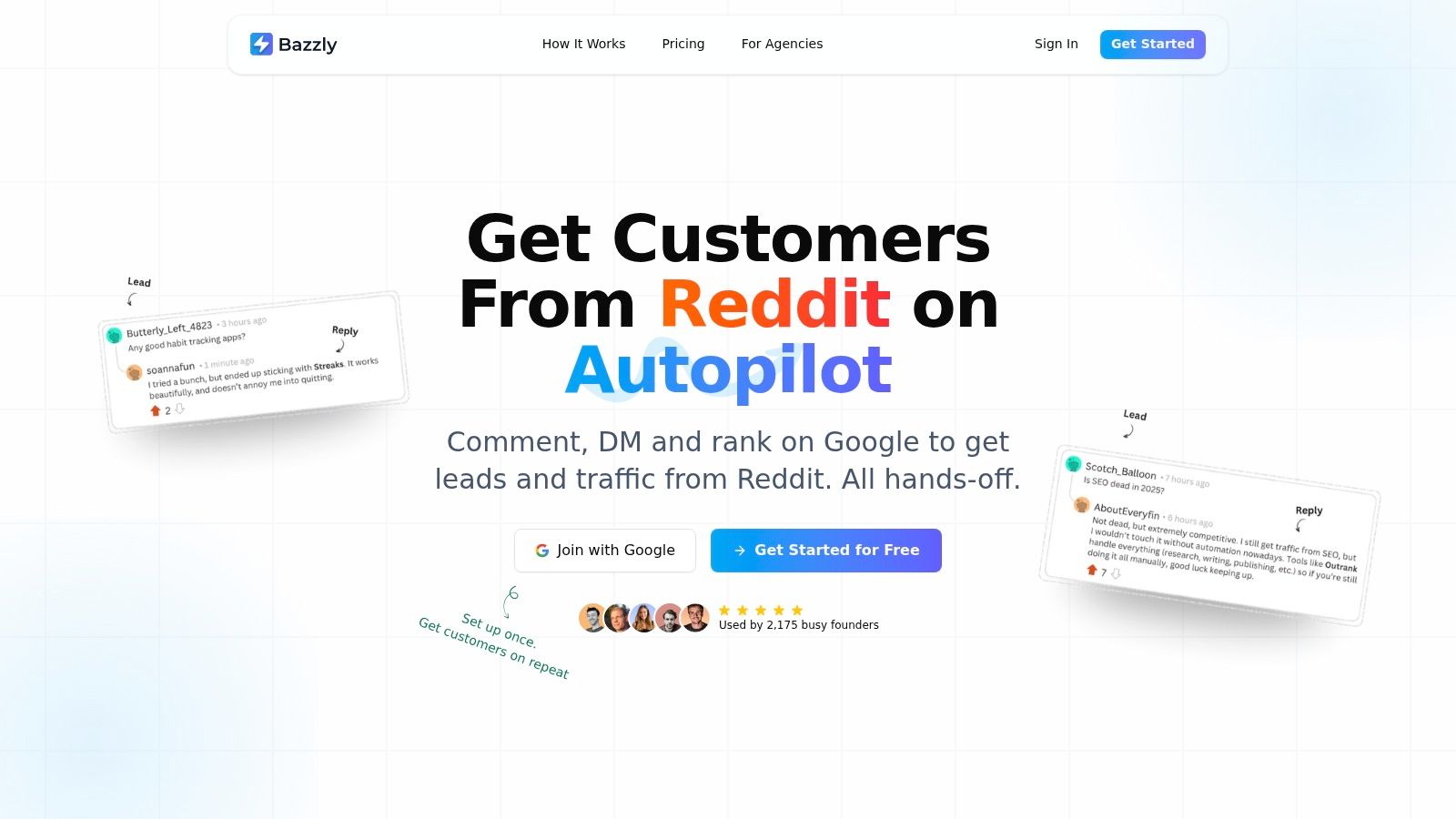
Reddit can hold useful buying conversations, but searching threads manually is a poor use of a founder's day. Bazzly monitors selected subreddits around the clock, scores new posts for relevance and buying intent, and finds older discussions that already rank on Google or appear in AI answers. It drafts context-aware replies so you can review and post through the free Chrome extension, or choose posting through Bazzly's warmed-up accounts.
You can also track leads, brand and competitor mentions, and sentiment. The platform includes API and MCP access, but it has no native Slack or CRM integration, so plan how you'll record useful conversations and conversions. Its All in One plan costs $199 per month per project, includes 170 credits, and has a 7-day free trial; additional credits cost $1 each. Finding opportunities, leads, and brand signals is free, but posting and optional upvotes use credits.
Start in review mode
Autopilot can find, draft, post, and upvote at a pace and relevance threshold you control. Still, automation can't make a low-value reply useful, or override subreddit rules. Start by reviewing opportunities yourself, tune your relevance criteria, and only automate when you know what a good fit looks like. A removed warmed-account comment is generally refunded within 48 hours, subject to the stated subreddit-policy exceptions.
Practical rule: Treat Reddit replies as helpful participation, not ads. Track the thread, the problem, the action taken, and any later signup or sales conversation in a founder-owned evidence log.
2. HubSpot
A new lead is only useful if you can find the contact and remember why they raised their hand. HubSpot gives early-stage teams a free CRM entry point, with contact records alongside tools for email, forms, landing pages, and lead capture. That makes it a sensible first home for leads when a spreadsheet has started to become a source of missed follow-ups.
The trade-off is breadth. HubSpot can support a growing team across marketing, sales, service, content, and analytics, but that range can take time to understand. Advanced automation and growing contact volumes can also change the cost calculation, while some free features have limits.
Keep the first workflow small
Begin with one form and one follow-up process. Make sure every new lead has a source, a clear next step, and an owner, even if that owner is you. Don't build branching campaigns before you know which message earns a reply.
HubSpot fits best when your biggest pain is scattered contact information. If you're still figuring out how to attract prospects, a CRM won't create demand by itself. Use it to keep acquisition efforts accountable, then add more automation only when the manual process becomes repetitive.
3. Ahrefs
SEO research can surface content opportunities, but it won't write or distribute the content for you. Ahrefs helps founders research keywords and competitors, inspect backlinks, audit a site, track rankings, and explore content opportunities. Some site-owner tools are available free, which gives a small team a way to start checking technical and search basics before committing to broader research features.
The first result is usually an answer to a specific question: which competitor page earns links, which search topic fits your product, or which site issue needs attention? That's useful if someone on the team can turn the answer into a page or a fix. It's a poor fit if the research will sit in a dashboard because nobody has time to publish.
Use research to make a decision
Pick one product-relevant topic, compare the pages already ranking for it, and decide whether your team can produce a more useful answer. Paid plans may be a substantial expense for a bootstrapped startup, and meaningful use requires both time and SEO knowledge.
Ahrefs is a research layer, not a content engine. If you need an all-in-one publishing workflow, this won't supply it. Choose it when search is a deliberate acquisition channel and you'll use its findings to make specific editorial or technical changes.
4. Buffer
A social calendar doesn't need to become a full marketing suite. Buffer focuses on planning and scheduling posts across connected social channels, with post ideas and an AI assistant. Its free plan supports up to three channels, while paid pricing is per channel, so a solo founder can begin with a narrow publishing routine rather than paying for a larger suite upfront.
The limit is also the appeal. Buffer helps you publish consistently, but it isn't a CRM and won't manage the full customer journey. Analytics and team collaboration vary by plan, and channel-by-channel costs can add up as your publishing footprint grows.
Make each post earn its slot
Use a small queue of useful posts drawn from customer questions, product updates, and existing content. Review automated drafts before they go live, especially when a post makes a claim about what your product can do. For a closer look at the category, see AI social media tools.
If you're comparing publishing tools, consider this comparison of social media tools tested for 30 days. Buffer is a good fit when scheduling is the bottleneck. It's not the right pick if you need deeper customer records, complex campaign reporting, or a tool that connects every marketing channel.
5. Canva
When a founder needs a campaign graphic today, a reusable template can beat a design process that takes days to organize. Canva offers templates and visual assets for social posts, presentations, ads, web content, and video. A free plan makes it easy to start, and paid plans add brand kits, reusable templates, collaboration features, and plan-dependent AI allowances.
The time-to-first-result is short: adapt a template, apply your colors and logo, and publish. The catch is sameness. If you use a template without changing its layout, copy, and visual choices, your creative can look like every other post built from the same starting point.
Build a reusable system
Create a small set of brand-consistent layouts for recurring needs, such as feature announcements, customer quotes, and event reminders. Reuse the system, but change the visual hierarchy and content to suit each message. That gives you speed without making every campaign look identical.
Canva won't replace a specialist design workflow for complex creative work. It's a practical choice when the alternative is having no visual asset at all, or spending too much time on routine graphics.
6. Mailchimp
Mailchimp gives founders a direct way to collect email signups, send campaigns, and manage an audience. Mailchimp includes an email campaign builder, templates, segmentation, signup forms, and automation on eligible plans. It can support a newsletter or customer sequence while you're building a repeatable relationship with people who've already shown interest.
The main trade-off is that pricing and send limits depend on audience size and plan. As your list grows, the cost may grow with it, so check how your current plan handles contacts, sending, and the workflows you plan to run. Advanced lifecycle messaging may call for a closer comparison of automation capabilities and limits.
A list you can reach is valuable only if the people on it asked to hear from you and can still receive your messages.
Keep signup sources clear, send content that matches what subscribers expected, and remove invalid addresses rather than repeatedly mailing them. This guide to improving deliverability through list verification is a useful companion when you're maintaining list quality.
7. PostHog
PostHog helps answer the question a campaign dashboard can't: what did the visitor do after arriving? PostHog combines product and web analytics with session replay, feature flags, experiments, surveys, and other product tools. For a product-led startup, that can connect acquisition activity to what users experience inside the app.
You'll need to put thought into implementation. Define events around meaningful actions, such as completing onboarding or reaching a product milestone, rather than recording activity without a question in mind. PostHog offers generous monthly free allowances across several products, but usage is governed by separate product limits and costs can rise beyond them.
Choose events before dashboards
Start with the steps between signup and first value. If users abandon a step, session replay can help you inspect the journey, while analytics can show whether the behavior happens broadly or in a particular cohort. That makes PostHog useful when marketing and product work together.
The range can be more than a marketing-only team needs, and technical setup takes time. Pick it when you can instrument the product and act on what you learn, not just because a broad toolset looks extensive.
8. Mixpanel
If you're trying to find where new users abandon onboarding, Mixpanel is built for behavioral analysis rather than campaign execution. Mixpanel focuses on funnels, retention, user flows, cohorts, and saved reports. Depending on the plan, it also offers session replay and experimentation, with a product analytics MCP server available across plans.
Its free plan can support meaningful early-stage analysis, and unlimited seats on listed plans can make it easier for people across a team to inspect reports. But analytics only works when the team agrees on what events mean. If one person tracks “activated” as a completed signup and another uses a product action, their reports won't answer the same question.
Separate measurement from execution
Use Mixpanel to investigate user behavior and campaign cohorts, not to send the campaign or manage customer records. It doesn't replace a CRM. A startup growth tools guide can help you think through how analytics fits alongside acquisition and product tools.
Event volume can increase costs beyond free usage, so instrument the actions that support a decision. If you need broad product analytics and can maintain clean event definitions, Mixpanel is a focused option. If your primary need is simple web traffic reporting, it may be more than you need.
9. Zapier
Zapier connects apps that don't talk to each other, and that is the whole reason it earns a slot in a small stack. Zapier runs trigger-and-action workflows called Zaps: a form submission lands in a CRM, a teammate gets pinged when a lead arrives, a new row creates an invoice. No custom code, no waiting on an engineering sprint.
Time-to-first-result is short. One Zap built from a template produces a working handoff in under an hour, which is faster than most integration projects a solo founder can manage alone. The cost arrives later. Every plan runs on a monthly task allowance, and each action inside a multi-step Zap counts separately, so a five-step workflow burns five tasks per run. Test on the free tier, then budget for a paid plan once real activity flows through rather than assuming the allowance holds as volume grows.
Automate a process you already trust
Write down what should happen when an event occurs, then automate the simplest reliable version of it. Build with real data instead of sample records, confirm each step passes the right field, and check the task history after the first few runs.
Silent failures are the main risk. A Zap that stops firing throws no error you will see. Lead routing just goes quiet, and you discover it days later when a prospect follows up. Add a filter or a fallback notification to any workflow touching revenue, and revisit the longest Zaps every quarter, because upstream API changes break automations you never touched.
Zapier is the right call when two specialist tools have no native connection and the data passing between them is simple. It won't repair inconsistent field formats, decide who owns a lead, or replace an integration your main tools already ship. For a related example of automation choices, see automating replies on X, and keep a human review step wherever an automated response could affect trust.
10. Semrush
Semrush brings SEO and digital visibility research into a broader platform. Semrush supports keyword and competitor research, site audits, rank tracking, and content planning. That breadth can help a team that treats organic search as a core channel and wants to research and measure content within one toolkit.
The trade-off is the same one that often comes with a broad platform: the interface and feature set can be daunting if you only need occasional keyword checks. Paid plans may also be a sizeable commitment for a very early-stage startup. Compare the data and plan limits with alternatives before making it a standing expense.
Choose it for a search program
Use Semrush when you have a consistent process for deciding what to publish, checking how your site performs, and responding to what you learn. It's less compelling if nobody owns SEO or if research doesn't lead to production. In that case, start with a narrower task and adopt a broader toolkit only when your workflow needs it.
10 startup marketing tools at a glance
Read this table by time to first result, not by feature count. Bazzly, Buffer and Mailchimp can return something usable within a day, because setup is an account, a channel and a first post or send. PostHog and Mixpanel stay quiet until someone instruments events properly, and Ahrefs and Semrush pay off only once a person owns the publishing schedule.
| Category | Free entry point | Best for | Main limitation |
|---|---|---|---|
| Bazzly, Reddit lead generation | Free Chrome extension for posting; paid platform has a 7-day trial | Finding Reddit conversations and turning them into leads | $199/month per project; activity uses credits |
| HubSpot, CRM and marketing | Free CRM and foundational tools | Managing contacts, campaigns, and lead capture together | Advanced automation can become costly |
| Ahrefs, SEO research | Free tools for some site-owner tasks | Keyword, competitor, and backlink research | Paid plans can be costly and require SEO knowledge |
| Buffer, Social publishing | Free plan for up to three channels | Scheduling social posts across channels | Analytics and collaboration vary by plan |
| Canva, Design and creative assets | Free plan | Creating campaign graphics and other marketing assets | Advanced features depend on the plan |
| Mailchimp, Email marketing | Trial for eligible users | Newsletters, audience management, and email campaigns | Pricing and send limits depend on audience size and plan |
| PostHog, Product analytics | Generous free allowances across products | Connecting acquisition activity with product engagement | Setup takes technical effort; costs can rise with usage |
| Mixpanel, Product analytics | Free plan | Analyzing funnels, retention, and user behavior | Requires consistent event instrumentation |
| Zapier, Workflow automation | Free plan for basic automations | Connecting apps and automating repetitive tasks | Free plan is limited to 100 tasks per month |
| Semrush, SEO and visibility research | Limited free account; paid plans unlock full data | SEO research, competitor analysis, and content planning | Broad feature set and paid plans may be daunting or costly |
Assembling Your Stack Without Tool Bloat
A lean stack should reflect how your business wins customers, not how many subscriptions you can connect. Pick one acquisition channel, one analytics layer, one email tool, and Zapier only where a direct integration is missing or a repeated manual handoff is causing trouble. For example, a SaaS founder might test Reddit conversations for acquisition, use PostHog or Mixpanel to inspect what new users do, and use Mailchimp for an email relationship. HubSpot can hold contact records if lead follow-up is getting lost.
Don't install every tool in this list. A small team can lose more time configuring dashboards and fixing automations than it saves, especially when nobody owns the workflow. Gartner reports that organizations used only 49% of their marketing technology capabilities on average in 2025, up from 33% in 2023, in its marketing technology survey data snapshots. The practical lesson is to judge tools by what your team uses in practice, not by how many features a plan advertises.
Before adding a subscription, define one outcome it must improve. Record the source of each lead, the conversation or campaign that prompted action, and whether that lead became a qualified opportunity, activated user, or customer. Attribution won't always be complete, but an evidence log is better than treating clicks, post volume, or activity as revenue. If you can't describe how a tool will change a decision or remove a recurring task, wait.
Keep the weekly operating rhythm small: review new opportunities, check whether leads received follow-up, inspect one meaningful product or campaign signal, and fix failed handoffs. That's a stack a solo founder can run in under five hours a week if the workflows stay focused and the number of tools stays modest. Add automation after a process works manually, not as a way to hide uncertainty about the message or channel.
For a Reddit-led acquisition test, Bazzly is built as a Reddit marketing automation tool for SaaS and product teams. Finding opportunities, leads, and brand signals is free; the All in One plan includes full autopilot mode, warmed-up accounts, smart upvotes, unlimited leads and opportunities, 170 credits refreshed monthly, and a 7-day free trial. Try it as one channel-specific experiment, log what conversations lead to qualified interest, and compare the result with the time and spend before committing budget elsewhere.
Bazzly helps founders monitor relevant Reddit discussions, find opportunities and brand signals, and draft replies without spending hours searching manually. If Reddit is a channel you want to test in a lean marketing stack, visit Bazzly and try the workflow before adding more tools.
Written by Bazzly Team
Bazzly builds software that finds buyer conversations on Reddit and posts helpful replies in them (227,592 posts flagged for customers since June 2, 2025). The Bazzly numbers we quote come from our own data, published with the method in our research studies. About us