
On this page
Ask ten marketers for the best time to post on Reddit and you'll get a confident answer about Tuesday mornings. That advice solves the least important part of the problem. A scheduled post rarely dies because of its hour. It dies because a moderator removed it, because AutoModerator ate it on arrival, or because the tool reported success that never happened and nobody checked again.
A Reddit post scheduler is an access-controlled publishing system with a verification gap. Handle the access and skip the verification and you end up with a queue that looks green while your links sit in a removed pile. The pipeline has five stations, each with its own way of dropping an item, and knowing which one failed is the difference between a fix and a guess.
Judge a scheduler by the removals it prevented, not the posts it pushed out.
How a Reddit Post Scheduler Works Behind the Queue
The mental model that causes trouble is the clock. People picture a scheduler as a timer: choose Tuesday at 9, the post appears. A real scheduler behaves more like a sorting room. Items arrive, get checked, wait in line, leave through one door, and a clerk confirms that they left.
Discover opens the line. A scanner watches the subreddits attached to a project and catches new posts within minutes of publication, which is the scan Bazzly runs around the clock across the communities you choose. Stale subreddit lists are the quiet killer here, since a community you stopped watching three weeks ago never feeds the queue at all.
Approve is where a person or a relevance threshold decides which drafts deserve a send. Then Queue: an approved item waits with no scheduled time until a slot is booked. Publish pushes it through an authenticated account at the booked moment. Verify is the step everyone skips, and the only one that tells you the truth.
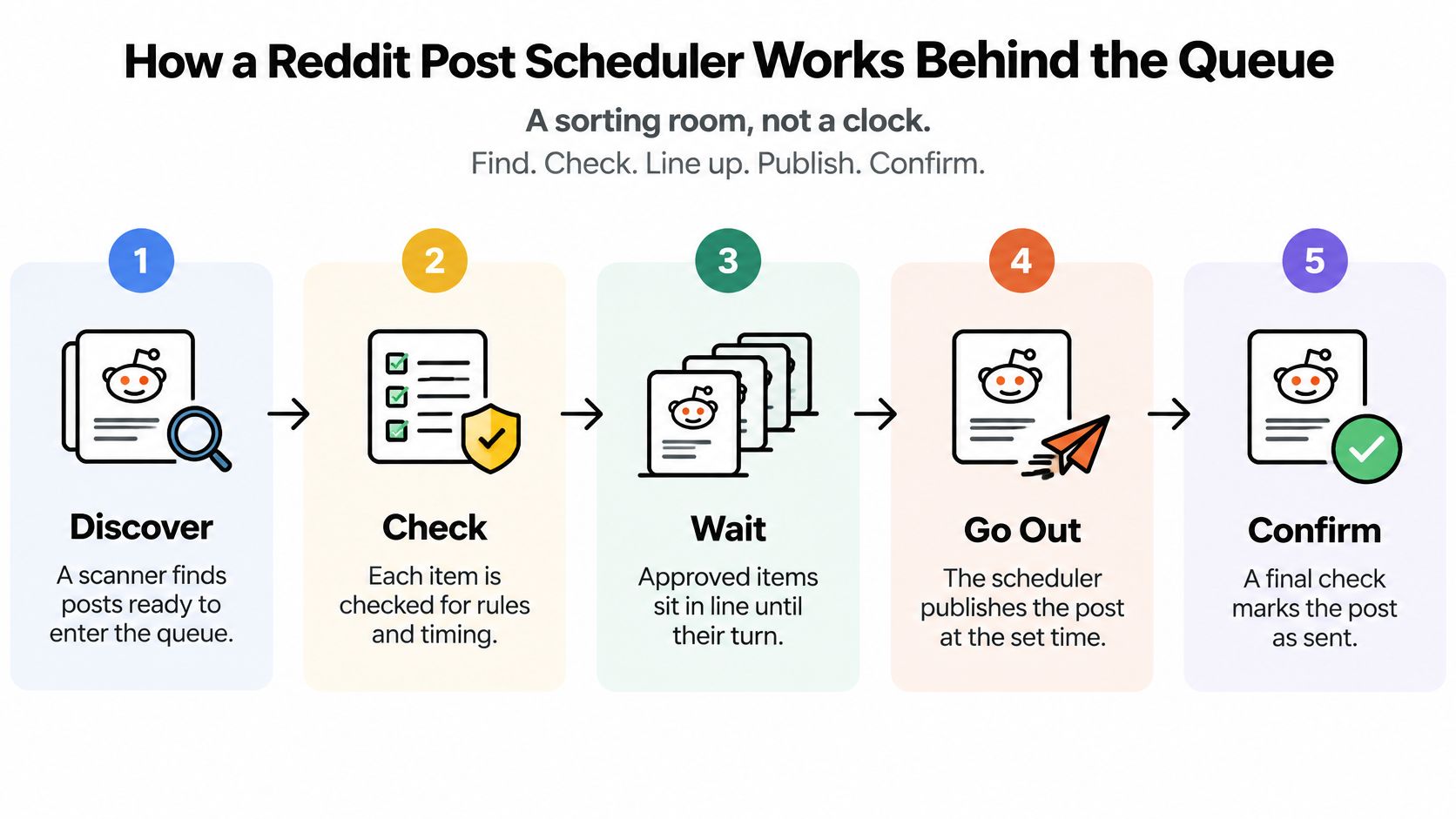
| Stage | What Happens | Where It Fails |
|---|---|---|
| Discover | Scanner watches chosen subreddits for new posts | Missed posts when the subreddit list is stale |
| Approve | A person or relevance threshold approves each draft | Off-topic drafts get approved |
| Queue | Item waits with no scheduled time until a slot is booked | Items are forgotten in the queue |
| Publish | Post or comment goes live at the booked time | Removed by AutoModerator or moderators |
| Verify | Scheduler checks whether the item is still visible | Silent removals go unnoticed |
Two systems look identical on a dashboard and behave nothing alike: a delayed API call and a durable queue. The delayed call fires once and forgets. The durable queue writes the job down first, publishes exactly once, and reconciles the resulting post ID afterward.
When a post disappears, don't start with the calendar. Find the row above where it failed, then fix that station.
Reddit API Limits That Cap How Often You Can Schedule
Publishing to Reddit runs on a metered pipe. Posts go through the Data API, and Reddit's Data API rate limit documentation sets free-access usage at 100 queries per minute per OAuth client ID, averaged across a 10-minute window so short bursts get smoothed rather than granted as extra allowance.
Do the arithmetic and the ceiling appears: 100 queries a minute works out to 6,000 queries per hour sustained. That sounds generous until you price the workload. A scheduler polling a few dozen communities every minute, rechecking posting eligibility and publishing queued items spends that budget faster than a dashboard suggests, and the same budget has to cover re-checks on everything already live. OAuth authentication is required, and unauthenticated traffic may be blocked outright.
The API reports its own meter. Rate-limit response headers carry approximate usage, remaining quota and reset time on every response, which makes them the cheapest instrumentation a scheduler gets. Read them on each call, delay jobs when remaining quota drops, and treat HTTP 429 as an instruction to reschedule rather than a reason to retry harder.
| Limit | Value | What It Means for Scheduling |
|---|---|---|
| Free Data API queries | 100 per minute per OAuth client ID | Caps how often a scheduler can poll |
| Averaging window | 10 minutes | Short bursts get smoothed, not treated as extra allowance |
| Sustained equivalent | 6,000 queries per hour | Upper bound for steady polling |
| Authentication | OAuth required | Unauthenticated traffic may be blocked |
| Throttling response | HTTP 429 | Scheduler must back off and reschedule the job |
These limits are not permanent. Reddit's Data API terms let the platform impose request and app-user limits, require app review, and suspend applications that exceed or attempt to circumvent rate limits. A polling plan built on last year's assumptions deserves an annual review, if not a quarterly one.
The practical response is unglamorous. Poll the communities that matter most at high frequency and everything else less often, spread publishing across the day instead of batching it into one hour, and keep a hard cap on concurrent jobs per account so a burst can't spend the whole window. Hold back enough quota to keep auditing posts that already went live. A scheduler that publishes on time but can't afford to confirm its own output is optimizing the wrong number.
Subreddit Rules and the Safe Posting Procedure
Here's the failure that costs the most and gets discussed the least. The API accepts your post, returns an ID, your dashboard turns green, and the thread carries on without you because a moderator removed the comment ninety seconds after it landed. Communities write their own rules on self-promotion, links, flair, account age, karma and post format, and API access grants you none of that permission, as post.buzz's guide to scheduling Reddit posts points out. Published is a status, not an outcome.
Classify each subreddit before you queue anything
Every community you plan to touch gets one of four labels. Bazzly classifies subreddit self-promotion strictness as strict, moderate, lenient or unknown, and that label decides the approval path rather than the copy.
| Strictness | What It Signals | Scheduling Approach |
|---|---|---|
| Strict | Self-promotion heavily restricted | Manual posting or human review only |
| Moderate | Promotion allowed within limits | Approval required before queueing |
| Lenient | Promotion tolerated | Scheduling acceptable after a rule check |
| Unknown | Rules not yet classified | Manual review before any queued post |
Run one preflight pass before anything enters the queue: read the current rules, confirm the posting account clears the age and karma thresholds, check whether the rules changed in the last month, and send anything unclassified to a human. A subreddit rules checker shortens that loop, though it doesn't replace reading the sidebar yourself.
The posting procedure that survives contact with moderators
- Draft against the thread, not a template. The thread sets the context, the vocabulary and the length. A reply that reads like it could sit under any post gets reported as low effort, and the reports are what moderators act on.
- Put strict and unknown communities in manual mode. In manual mode, nothing is posted until you queue it yourself. That pause is the point, because it puts a human between the draft and the removal.
- Queue first, book time second. An approved item stays in the queue with no scheduled time until a slot is booked, so nothing can fire while you're still editing. Own-account comments are capped at 3 per rolling 24 hours and 1 per subreddit, which keeps a single account from looking like a broadcast tower.
- Expect different clocks per task type. Warmed-account comments usually publish within a few hours, while a custom task on a post at least a week old in a subreddit new to the account usually takes three to five days. Plan the calendar around the slow case, not the fast one.
- Verify visibility, not status. Open the live thread and look for your comment with a logged-out browser if you have doubts. Record every removal with its subreddit and its probable rule, because that log is the only data that tells you which communities to drop.
The slips are consistent: skipping the rule check because the community "looks fine", batching every post into one hour, and treating a published status as proof of visibility. When posting from your own account through the Chrome extension, the usual rules still apply, and no guideline-following tool exempts you from a subreddit's spam filter.
The measure that matters: a good week is one where nothing got removed, not one where twelve posts went out.
Why Comment Timing Beats Post Timing
Search for the best time to post on Reddit and you'll get a table of hours. The table misses how activity shifts through the day. A study of Reddit activity and comment timing found posting activity drops sharply around users' sleep periods, reaching a nadir 4.75 hours after bedtime at 87% below daytime levels, then returning to baseline 10.25 hours after bedtime.
There is no universal good hour, only an hour that matches the audience you're trying to reach. The same source documents a preregistered 2026 analysis of 236,000 comments across nine subreddits which found early comments still gain an advantage, while timing mainly changes the chance of gaining traction rather than the typical outcome.
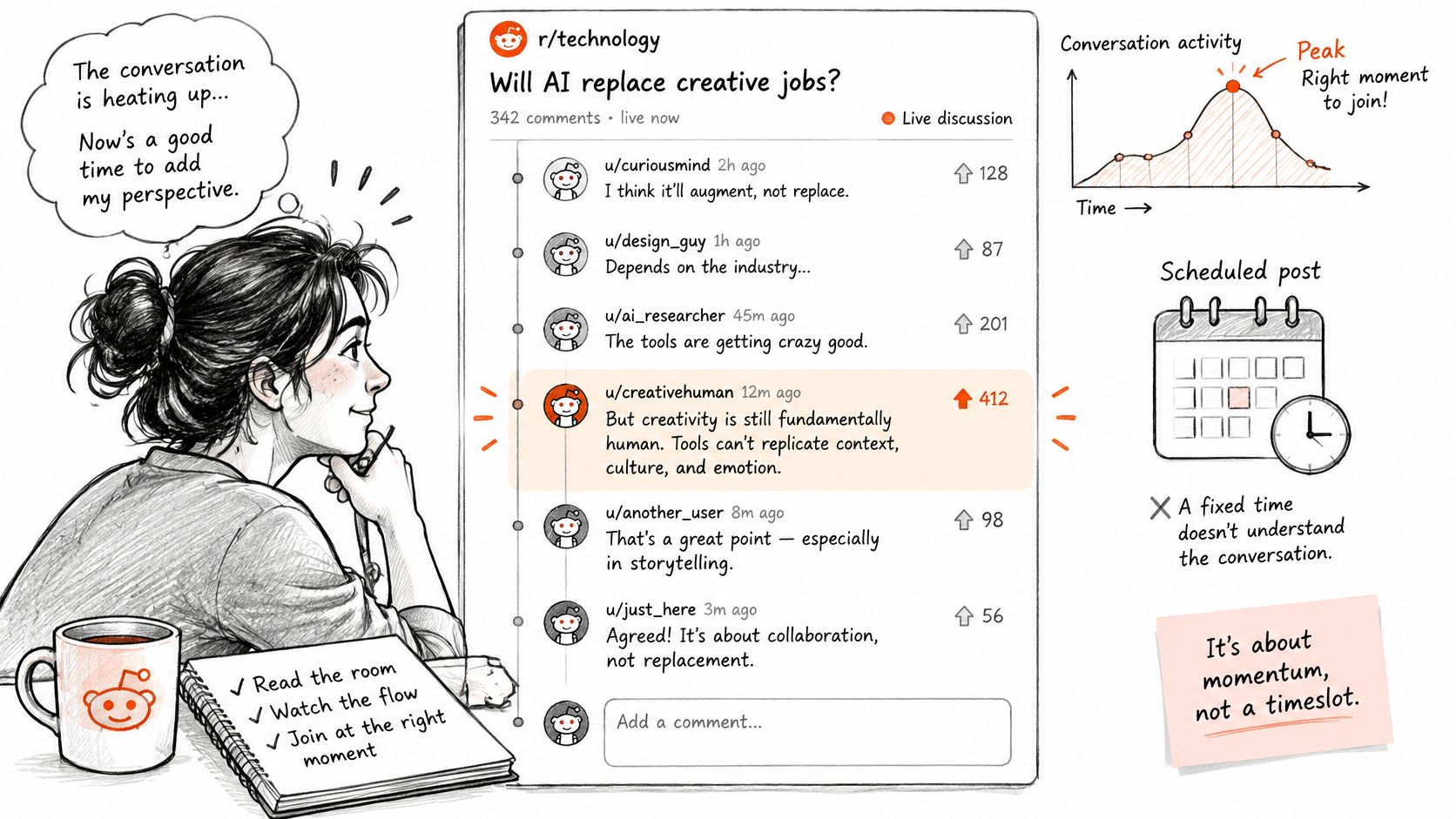
That's the whole argument in one sentence: an early, useful reply to a buying-intent thread usually outperforms a polished promotional post queued for a perfect hour. The thread's first two hours decide whether anyone reads your contribution at all.
Work through four checks in order. Is the thread fresh enough to still be climbing? Is the audience awake in its own time zone? Do the subreddit's rules allow the reply at all? If all three pass, send something specific and send it now. The trade-off is real, because rushed replies break rules and get removed, so keep the speed for threads where you already know the community. For a slower task, such as a comment on a search-ranking thread or a post at least a week old in a subreddit new to the posting account, the three-to-five-day turnaround is normal and worth planning around. If you want hour-level guidance anyway, a best time to post on Reddit calculator gives you a starting point, then adjust it against the responses you see.
Speed wins the thread. A rushed reply that breaks a rule loses the community.
What to Check in a Reddit Post Scheduler
Most tool comparisons benchmark the calendar view and the number of connected networks. Those checks say nothing about the two ways a Reddit schedule fails: silence from a moderator, and a queue that exceeds its quota. Compare tools against the five stations instead.
- Discovery coverage: does the tool watch exactly the subreddits you set, and does it flag a stale list? Reddit's developer platform documentation describes listing pagination with cursors and page sizes up to 100 results per request, so a fast scanner can cover ground. The question is whether yours remembers where it stopped.
- Approval gate: drafts should pass a human or a relevance threshold, and strict or unknown communities should default to manual. If the tool can publish the instant a draft exists, it's a posting button, not a scheduler.
- Queue persistence: jobs should survive a restart with a planned time, so a forgotten item is visible rather than lost. Reply Queue shows each comment as Queued, Posted, Removed or Cancelled, with a link to the live comment, which turns an invisible outcome into a readable one.
- Behaviour when throttled: ask how the tool handles a rejected request. It should reschedule the job, retry transient failures with exponential backoff and jitter, and stop dead on a permanent authorization error instead of looping.
- Verification window: does it recheck after publishing, and for how long? Removing a comment an hour later is common, and a scheduler that checks once has checked nothing.
- Rule context at drafting time: a thread lookup that returns the post, up to 10 existing comments and the subreddit's rules without spending credits helps you write something native. It supports your judgement rather than replacing it.
If the queue is one piece of a wider content calendar, this guide on how to halve your social media posting time is worth reading before you bolt Reddit onto five other networks.
Ask any vendor two questions: what happens when a moderator removes my comment, and what happens when I hit the API ceiling. The answers separate a scheduler from a publishing button.
Measure Results and Start With One Subreddit
Start narrower than feels necessary. Pick one subreddit, classify its self-promotion strictness, read the current rules, and queue a single approved item. Run it through every step yourself: draft, review, schedule or post, then check whether it is still live over the following days. A small first run shows where the process breaks while the cost of a mistake is still one comment in one community.
Then measure survival before output. Track the share of queued items still live after a week, removals by subreddit, time from approval to publication, qualified conversations per community, and downstream signups or replies. Impressions and post counts flatter you while the removals pile up. Before committing weeks to a community, a subreddit stats lookup helps you judge whether its activity and rules are worth the risk.
A review rhythm that tells you when to expand
Published status isn't proof. Removals arrive later, and moderators act at their own pace. Bazzly keeps checking posted comments for weeks after they are posted, which is how a removal landing on day four still shows up in your numbers. Set a rhythm you will keep.
- Weekly: scan the queue for anything that has gone missing, and log the subreddit and probable cause for each removal.
- Monthly: review which subreddits produced conversations that turned into replies or signups, and drop the ones that produced neither.
- Immediately: move any subreddit with repeated removals to manual mode, and leave it there until you understand the rule you broke.
Expand only after the first subreddit has stayed live for a month and produced relevant conversations. Strict and unknown communities stay manual indefinitely; one credibility hit inside a tight community costs more than a dozen scheduled comments buys back.
A scheduler earns its place by what it keeps alive.
Bazzly scans the subreddits you choose around the clock, scores each new post for fit and buying intent, then drafts a context-aware reply. You can publish from your own account through the Chrome extension or have it posted from a warmed-up account with a booked time in the queue. The parts that matter here are built in: strictness classification for the subreddits it covers (strict, moderate, lenient or unknown), manual mode for the risky ones, and a Reply Queue that keeps checking whether each comment is still live. Visit Bazzly and run one subreddit through the whole pipeline on the seven-day free trial before you scale.
Written by Bazzly Team
Bazzly builds software that finds buyer conversations on Reddit and posts helpful replies in them (227,592 posts flagged for customers since June 2, 2025). The Bazzly numbers we quote come from our own data, published with the method in our research studies. About us