Online Community Marketing for SaaS Founders
You launch a SaaS product, join the communities where your buyers already ask questions, and discover that nobody is waiting for another branded Discord server. Your new community dashboard stays empty while relevant conversations happen elsewhere, often in threads you aren't monitoring. Meanwhile, a founder who answers one specific problem in the right forum can create more qualified interest than a week of polished social posts.
That's the operational reality of online community marketing. It isn't mainly about collecting members. It's about finding existing demand, contributing useful answers, and building a measurement system that connects conversations to pipeline even when the buyer later returns through search, a direct visit, or a private message.
Table of Contents
- The Reality of Community-Driven Growth
- Why Online Communities Drive SaaS Revenue
- Targeting High-Intent Threads on Reddit
- Scaling Community Engagement Without Burnout
- Measuring ROI in Messy Discovery Environments
- Implementing an Automated Reddit Workflow
- Building Long-Term Community Authority
The Reality of Community-Driven Growth
The classic community plan is simple. Open a Discord server, write a welcome message, invite early users, and wait for activity. The dashboard looks official, but the strategy depends on people discovering an empty room and deciding to create its culture for you. That rarely happens without a clear reason to participate and someone responsible for keeping the conversation useful.
A founder I've watched through this stage usually starts with good intentions. They publish product updates, ask members for feedback, and schedule occasional events. The problem isn't effort. The problem is location. Prospective customers are already discussing their pain in established subreddits, forums, comment sections, and private groups. A new destination adds friction when the buyer is actively looking for an answer somewhere else.
Active community acquisition reverses the sequence. Instead of building an audience before understanding demand, you identify conversations where people describe a problem your product can solve. You answer the question first, explain the trade-offs, and introduce your product only when it fits the context. The community remains the primary audience, while your product becomes one relevant option rather than the subject of a pitch.
Build around a reason to return
A useful community has a repeatable promise. It might help members troubleshoot a workflow, compare tools, share implementation details, or make decisions with less uncertainty. If you're creating a branded space, define that promise before choosing the platform.
Practical guidance on audience definition, participation rituals, and useful member contributions is available in these proven community building tips for writers. The same principle applies to SaaS communities: people return for reliable value, not because a company created a channel.
Intercept demand before creating demand
Existing conversations offer clues that a blank community cannot. Repeated questions reveal language for landing pages. Objections show where onboarding fails. Comparisons expose the alternatives buyers already consider. Helpful replies can therefore support acquisition, positioning, and product research at the same time.
Practical rule: Treat every community reply as a public product demonstration. Show how you think, not just what you sell.
This approach is more demanding than scheduling posts. You need monitoring, qualification, careful writing, and follow-up. But it gives a small team a better starting point than trying to manufacture attention from zero.
Why Online Communities Drive SaaS Revenue
A prospect can read a Reddit recommendation, compare several experiences, and arrive at a product page without ever posting or clicking a branded ad. Online communities have become commercial channels because buyers use them to reduce uncertainty before they speak with sales.
One industry roundup reports that 60% of businesses own a branded online community, while 76% of internet users participate in an online community and approximately 27.3% of customers use online communities during internet buying decisions (Social.plus community statistics). These figures point to a practical acquisition problem: community influence often happens before attribution systems register intent.
For SaaS, a silent reader may be comparing tools, checking implementation advice, or testing whether other users trust a vendor. Your team therefore needs to measure community exposure and assisted conversions, not only clicks, sign-ups, or visible replies.
Awareness extends beyond active participation. Roughly 7 in 10 internet users who have not recently visited community sites still know these platforms, with awareness rising to 77% among Millennials and Gen Z. Community activity can also connect with over 30% of an organization's revenue in some reported cases. These figures are not a forecast for every SaaS company, but they support treating community as a commercial channel worth investigating rather than as a branding exercise.
From broadcast to continuous feedback
Online research communities made this work more structured. They use private, selected groups that interact over days, weeks, or months instead of responding to one isolated survey. The history of online research communities describes how the format became an accepted research and engagement method, giving brands a way to observe changing attitudes, test messages, and build rapport over time.
For a SaaS founder, that feedback can sharpen acquisition decisions. Discussions reveal how buyers describe the category, which problems they prioritize, and what concerns block adoption. Those observations can improve product messaging before the team commits more budget to paid acquisition.
Automation helps resource-constrained teams monitor recurring questions and identify promising conversations, but it cannot replace judgment. A useful operating model combines alerts, intent scoring, human review, and careful replies. Automating publication too aggressively can make recommendations look scripted and damage trust.
A community strategy also needs a home base for evidence. A SaaS community-building strategy can connect conversations with broader content, onboarding, and retention work. The channel is only one part of the system. Consistent review, useful documentation, and disciplined attribution determine whether community activity becomes commercial intelligence.
Targeting High-Intent Threads on Reddit
Reddit behaves like a forum, but buyers often use it like a search engine. They describe a problem in plain language, ask for alternatives, and evaluate replies from people who appear to have direct experience. A useful overview of what Reddit is used for today helps explain why context and peer discussion matter more than polished brand publishing.
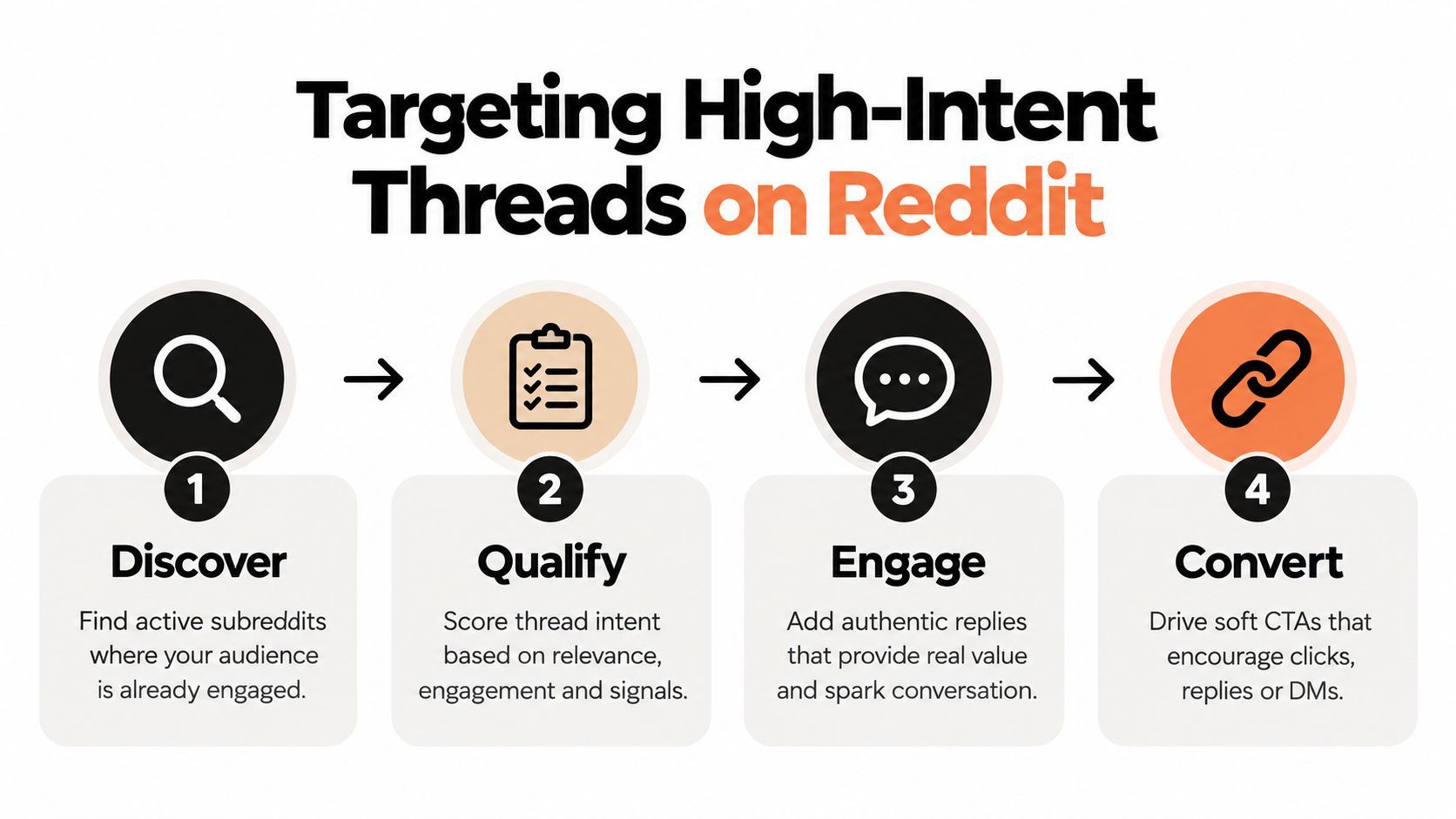
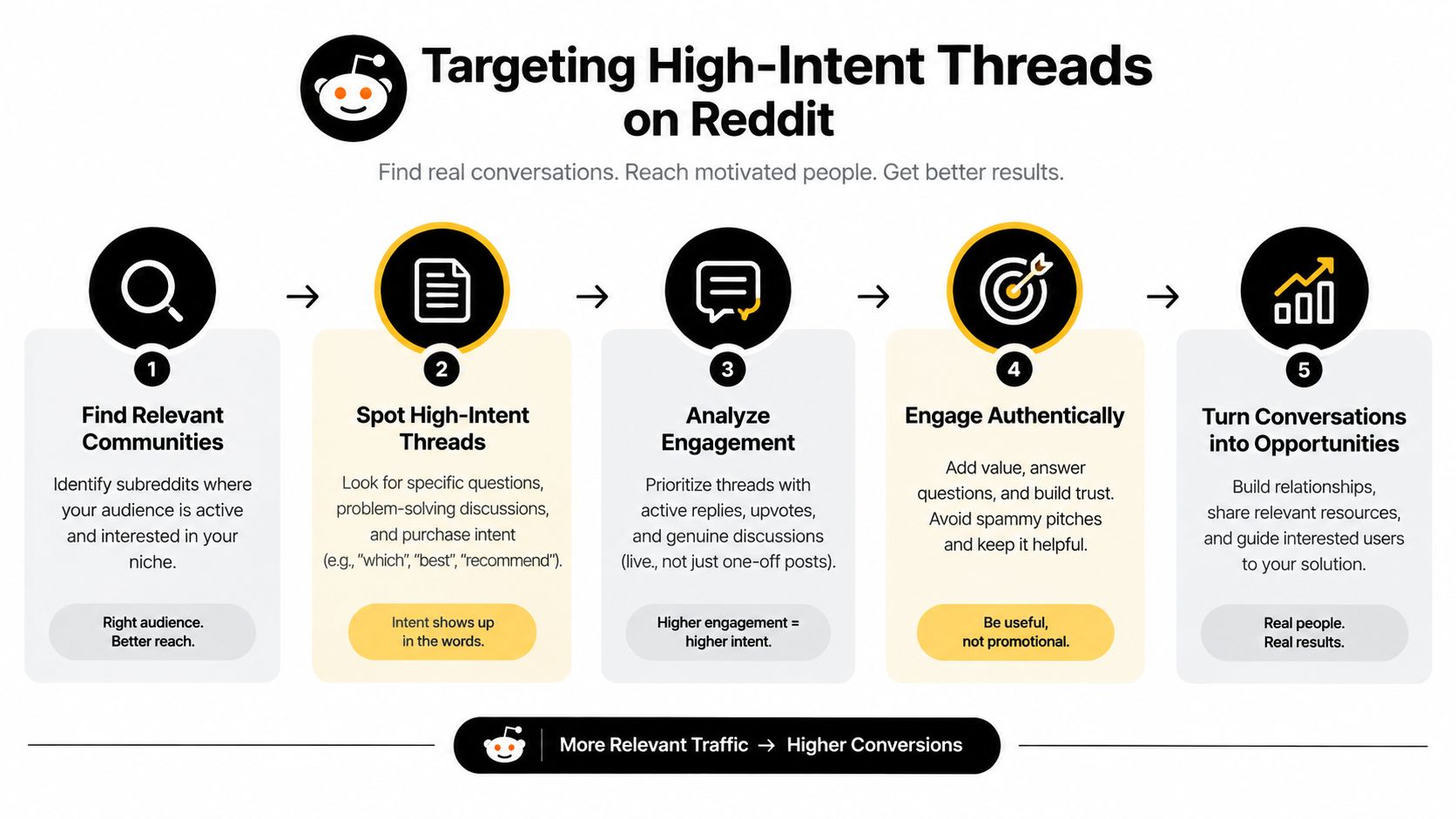
Start by separating intent from topical relevance. A thread about project management may attract your audience, but a question asking how to replace a specific workflow signals a much clearer opportunity. Look for language such as “how do I,” “what should I use,” “alternative,” “switching from,” or “has anyone tried.” Then check whether the community permits recommendations and whether existing replies answer the question adequately.
A practical qualification sequence
-
Find the conversation. Monitor subreddits, recurring questions, competitor references, and problem language. Keyword research should include the wording people use when they describe the pain, not only the category term. This Reddit keyword research guide can help structure that discovery work.
-
Score the intent. Give priority to questions with a clear problem, a defined use case, and an opening for a practical answer. A vague complaint may be interesting research, but it doesn't always justify outreach.
-
Answer the question independently. Explain the decision criteria, mention limitations, and provide steps the reader can use even if they never visit your site. A reply that starts with a product link looks like advertising. A reply that solves part of the problem earns the right to mention a relevant tool.
-
Use a soft conversion path. If the product fits, explain exactly where it helps and link to the most relevant page, not the homepage. In some cases, invite a reply or private message rather than pushing a signup immediately.
-
Track the thread as an asset. Record the URL, problem, subreddit, reply date, product context, and later visits or signups. The thread may continue attracting readers after the original discussion ends.
Why structure beats applause
A large-scale analysis of 248,000 Reddit posts found that engagement is a weak predictor of downstream AI and search visibility. The most cited posts often had fewer than 20 upvotes and fewer than 20 comments, and over half of cited Reddit content came from Q&A threads (Semrush Reddit AI search visibility study). That changes the optimisation target. A concise, answerable question can outperform a high-volume promotional discussion.
A separate audit found that each e-fold increase in post score raised retrieval odds by 24.1% in large communities and 16.4% in smaller communities, reported as OR 1.241 and OR 1.164 respectively (arXiv Reddit generative search audit). The practical lesson is to contribute early with relevant information, not to chase empty engagement. Early visibility can support later retrieval, but community members still decide whether the answer deserves attention.
Scaling Community Engagement Without Burnout
The biggest constraint in community marketing is usually time. A founder can't monitor every subreddit, read every thread, draft every response, answer every message, and still ship product. The answer isn't to automate the entire relationship. It's to automate the repetitive decisions while keeping judgment and accountability with a human.
A useful division is discovery, drafting, publishing, and escalation. Software can watch for relevant language, group opportunities, and prepare a response that follows your tone rules. A person should decide whether the thread is relevant, whether the community welcomes commercial references, and whether the draft sounds like a real contribution.

Automate the workload, not the trust
The wrong workflow publishes the same product pitch across several communities. It may save time initially, but it also ignores local norms, repeats language, and makes the account look transactional. Automation should reduce monitoring overhead, not remove context.
Good candidates for automation include:
- Opportunity detection: Find new posts that contain problem language, comparison terms, or requests for recommendations.
- Prioritisation: Sort threads by fit, urgency, answerability, and community rules.
- Draft preparation: Suggest a response that starts with the user's question and includes relevant caveats.
- Record keeping: Store thread URLs, drafts, decisions, and outcomes in a shared workflow.
- Escalation: Flag sensitive questions, complaints, security topics, or conversations requiring product expertise.
Keep publishing under review until your team understands failure modes. AI can produce fluent text that misses a community's culture, invents a product capability, or answers a different question from the one asked. A human approval step costs less than repairing credibility after a careless reply.
The scalable unit isn't the post. It's the decision process that determines which posts deserve a response.
Selective focus matters as much as automation. Choose communities where your buyers already ask answerable questions, define a small set of product use cases, and create response rules for each. A narrow system that produces useful contributions is more durable than broad coverage that creates noise.
Measuring ROI in Messy Discovery Environments
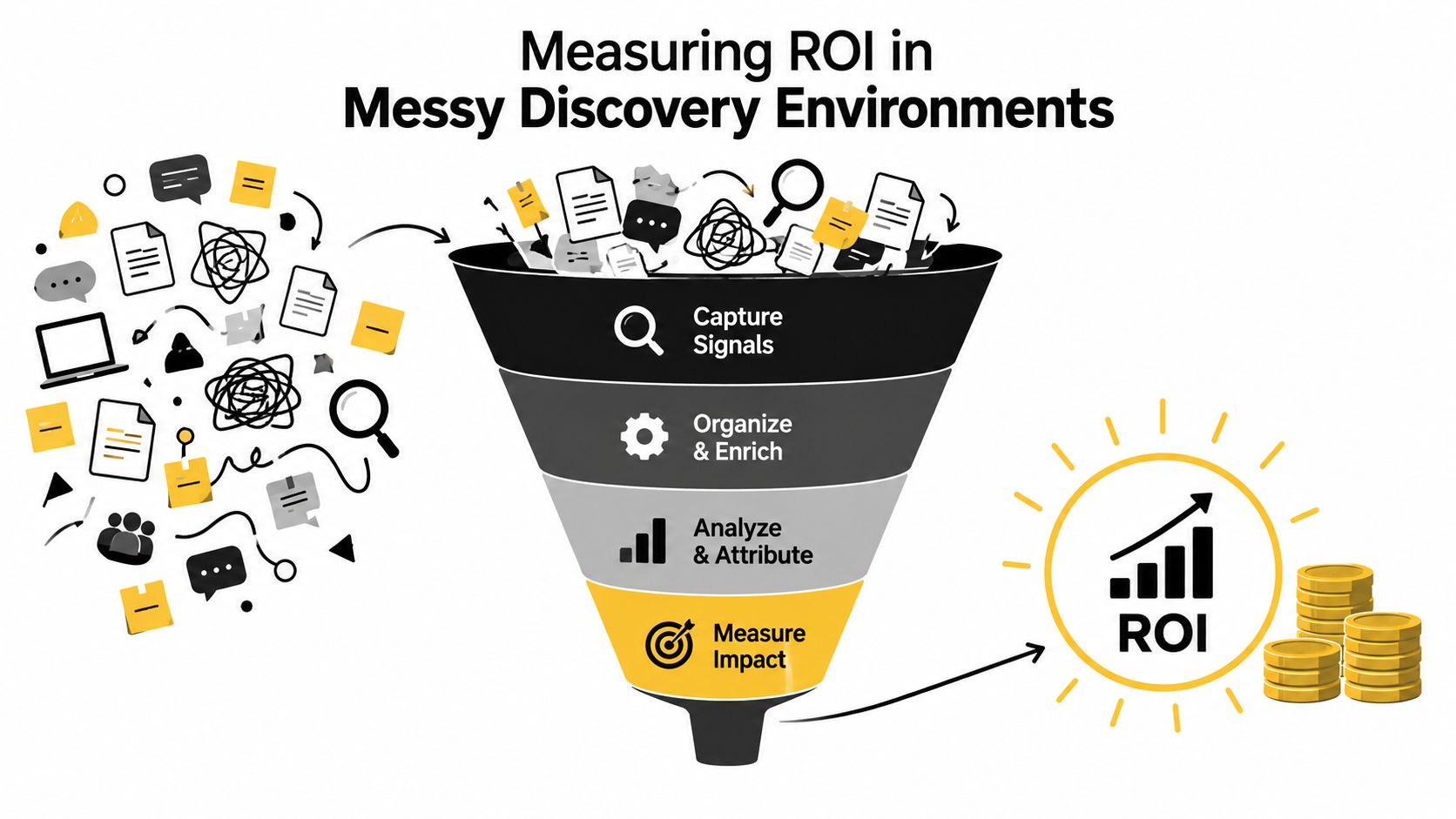
Community attribution breaks because discovery rarely follows a straight line. A prospect may read a Reddit answer, discuss it in a private message, search for your brand later, and sign up through a direct visit. Last-click analytics will usually credit the final visit while ignoring the conversation that created the original interest.
You need a measurement system that separates exposure, intent, and commercial outcome. Don't treat upvotes or comment volume as revenue. Treat them as activity signals that help explain why some conversations deserve follow-up.
A workable attribution ledger
Create one record for every meaningful opportunity. It should be simple enough to maintain and detailed enough to connect a public conversation with later customer activity.
| Field | What to capture |
|---|---|
| Conversation | Thread URL, subreddit, topic, and date |
| Intent | Problem type, use case, and buying signal |
| Contribution | Reply, resource, product mention, or private follow-up |
| Identity signal | Referral tag, self-reported source, or CRM note |
| Outcome | Visit, signup, qualified conversation, opportunity, or customer |
| Confidence | Directly observed, self-reported, or inferred |
Use distinct landing pages or campaign parameters when the context allows it, but don't assume every buyer will click immediately. Add a “How did you hear about us?” field during signup, and make the answer specific enough to distinguish Reddit, a private recommendation, a search result, and a community referral. Ask sales and support teams to record community mentions in the CRM when prospects volunteer them.
Measure influence without pretending to have perfect proof
A useful report connects three layers:
- Activity: relevant threads found, approved replies, meaningful responses, and follow-up conversations.
- Intent: product-page visits, demo requests, direct questions, trial starts, and self-reported discovery.
- Revenue: qualified pipeline, converted accounts, expansion, and retention signals associated with community-sourced or community-influenced contacts.
The SaaS marketing ROI framework can help place these signals alongside other channels. The key is consistency. Use the same definitions each reporting period, label confidence, and avoid claiming that every later branded search came from one comment.
Attribution is useful when it improves decisions, not when it creates false certainty.
Review the ledger for patterns. Which problem statements produce qualified conversations? Which communities create discussion but no commercial movement? Which replies generate direct questions rather than passive clicks? Those answers tell you where to spend scarce attention.
Implementing an Automated Reddit Workflow
A reliable Reddit workflow begins with boundaries, not software. Write down the problems you can solve, the communities where your audience discusses them, the claims you can support, and the situations where you won't mention the product. This prevents an automation tool from turning a broad audience definition into indiscriminate outreach.
Step 1, define the opportunity set
List the exact use cases that indicate a strong fit. Include alternative phrases, common objections, competitor comparisons, and questions that signal urgency. Then identify relevant subreddits and review their rules, posting norms, and tolerance for commercial participation.
Don't optimise for the largest audience automatically. A smaller community with clear questions and strong topical fit may produce better conversations than a broad subreddit where your answer disappears among unrelated posts.
Step 2, create a response policy
Set rules for tone, length, disclosure, and linking. Require drafts to answer the question before mentioning the product. Ban unsupported claims, invented customer results, false personal experience, and unnecessary urgency.
Give the system examples of acceptable and unacceptable replies. Include a rule for uncertainty. If the product doesn't support a requested workflow, the answer should say so and offer a useful alternative.
Step 3, monitor and qualify
Use a monitoring workflow to surface new threads that match your intent language. Review each opportunity against four questions:
- Does the person have a problem your product addresses?
- Can you provide useful information without forcing a pitch?
- Does the community permit this type of response?
- Is the question specific enough to justify an answer?
Reject opportunities that fail these checks. A smaller queue improves review quality and reduces repetitive posting.
Step 4, draft and publish carefully
Have AI prepare a context-aware draft, then edit it for accuracy and local language. Add a product reference only when it clarifies the solution. Link to a page that answers the specific question, and disclose your connection when community rules or common sense require it.
Bazzly is one option for founders who want Reddit monitoring, high-intent thread identification, AI-assisted comment drafting, configurable outreach, and either automated posting or review through a browser workflow. Whatever tool you choose, keep approval controls, account safety, and community compliance ahead of publishing volume.
Step 5, follow up and review
Track replies, questions, profile visits, referral activity, CRM records, and self-reported discovery. A private message can be useful when a prospect asks for help, but unsolicited DMs can feel invasive and may violate community expectations. Send only when the person has created a clear opening, and make the message helpful without assuming a purchase.
Review outcomes on a regular cadence. Remove prompts that produce generic drafts, refine the use cases that generate qualified interest, and pause communities where your participation isn't adding value.
Building Long-Term Community Authority
Automation can help you notice opportunities, but authority comes from the quality of your accumulated contributions. Buyers remember the account that explains a difficult trade-off, admits when a tool isn't suitable, and returns with a useful answer after the initial discussion. They don't reward a stream of interchangeable product mentions.
Use community conversations as a longitudinal feedback engine. Capture recurring objections, phrases customers use, implementation failures, and requests that don't fit your current roadmap. Feed those observations into product messaging, documentation, onboarding, and prioritisation. The community then improves the business even when no individual thread produces a measurable click.
Public communities also reward restraint. A founder who contributes consistently across a focused set of topics can become recognisable without turning every interaction into a campaign. Depth compounds more reliably than virality because each useful answer strengthens the next conversation and gives future buyers evidence of competence.
The operating model is straightforward: automate discovery, assist with drafting, review for relevance, measure commercial influence, and keep humans responsible for trust. Start with a narrow use case and a small group of communities. Once the workflow produces consistently helpful replies, expand carefully rather than flooding every related discussion.
Bazzly monitors Reddit conversations, identifies high-intent threads, and helps founders draft and manage context-aware replies without spending the day searching manually. If you want to turn relevant community questions into a repeatable acquisition workflow, visit Bazzly and set up your first campaign.


