On this page
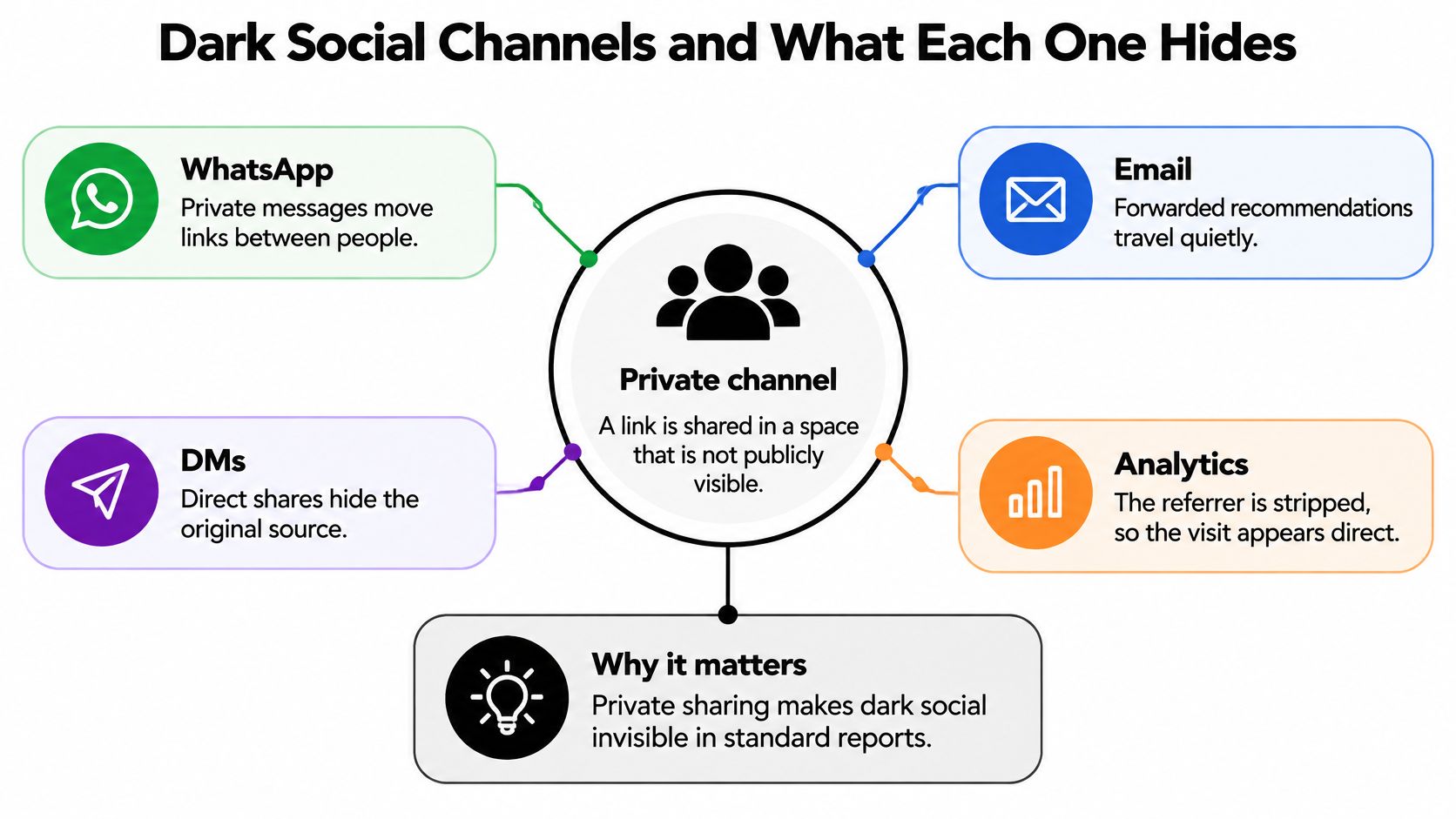
Private channels carry a large share of content sharing, but analytics often cannot show where those recommendations travel. A link sent in a direct message, WhatsApp, or Messenger may lead to a visit that appears as direct traffic, leaving the original influence out of view.
Where Your Best Referrals Actually Go
Say a founder posts a useful answer in a Reddit discussion. Someone forwards it to a colleague in Slack, who later visits the product website. The founder sees a rise in direct traffic, but no clear connection to the original thread.
Dark social is sharing through private or hard-to-measure channels such as group chats, texts, email, copied links, and forums. The term describes a visibility problem, not something suspicious. A recommendation can be perfectly ordinary while leaving little evidence of its route.
A missing trail isn't a missing influence
The problem predates today's messaging habits. In its 2016 analysis of participating publishers' and marketers' websites, RadiumOne found that 84% of site-originated sharing happened through private channels, compared with 7% through Facebook, as reported by The Drum. That's historical context, not a current census of internet sharing.
RadiumOne's sharing-data report also reported that users who shared content were 9 times more likely to purchase than users who didn't. That association doesn't prove sharing caused the purchase. People who share may already be evaluating a solution or seeking approval from someone else.
The useful distinction: An unknown traffic source isn't evidence that marketing had no influence. It also isn't permission to claim credit.
For a small team, dark social marketing means making useful material easy to pass along, then collecting enough evidence to make sensible decisions. That includes community replies, permission-based conversations, and a review routine that separates recorded activity from plausible explanations. The aim is honest measurement and deliberate outreach, not perfect tracking.
Dark Social Channels and What Each One Hides
When someone follows a link, their browser may pass a referrer, information identifying the page they came from. Messaging apps and other environments don't always pass that information. Without a referrer or recognized campaign parameters, analytics may classify the visit as direct.
Think of a recommendation passed across a dinner table. You receive the suggestion, but the business doesn't receive a receipt showing who recommended it. A digital click can have the same missing context, even though the website records the visit.
Referrer loss and tracking fixes by channel
In a controlled SparkToro experiment involving 1,113 visits across 16 pages, referral information was absent for all tested visits from TikTok, Slack, Discord, WhatsApp, and Mastodon; losses were 75% for Facebook Messenger and 30% for Instagram direct messages, according to Wunderland Media's account of the experiment.
| Channel | Referrer lost | What analytics shows | Tracking fix |
|---|---|---|---|
| TikTok | 100% in the test | Direct | Tagged link in bio and supported clickable placements |
| Slack | 100% in the test | Direct | Tagged short link plus survey question |
| Discord | 100% in the test | Direct | Tagged link in server posts |
| 100% in the test | Direct | Tagged link and sign-up survey | |
| Mastodon | 100% in the test | Direct | Tagged link in post |
| Facebook Messenger | 75% in the test | Mostly direct | Tagged link and survey |
| Instagram direct messages | 30% in the test | Partly direct | Tagged link in replies |
| Email, SMS and copied links | Not measured in this test | Direct when referral information is missing | Tagged links and survey |
These results describe the experiment, not permanent loss rates for every app configuration. They also show why dark social isn't limited to private spaces: a public platform can send visits without usable referral information.
Keep the campaign label attached
For a Reddit-led program, the vulnerable moment may come after discovery. A reader copies your product link into Slack, and their colleague arrives without any visible Reddit connection.
Use campaign parameters such as utm_source, utm_medium, and utm_campaign on links you control. Give profiles and important threads distinct campaign labels, shorten the completed URLs if needed, and verify that redirects preserve the parameters.
Before publishing, check:
- The link: Does the destination retain its campaign parameters after the redirect?
- The page: Can a colleague understand the offer without reading the Reddit discussion?
- The customer question: Will new customers have a chance to explain where they encountered the recommendation?
Don't rename all direct traffic as dark social. Direct visits can also come from bookmarks, typed addresses, and other missing-source situations.
How to Measure Dark Social Without Overclaiming
Most attribution confusion begins when teams merge different questions:
- Where did the click happen? This concerns the recorded route to your website.
- What influenced the buyer? This concerns the content, people, and conversations that shaped the decision.
- Which channel deserves credit? This is a reporting decision based on your attribution rules.
A tagged Reddit link can travel through a private message. Its campaign label survives, but that doesn't establish where the final click happened. High confidence in the label isn't high confidence in the whole journey.
Evidence types and how much weight each deserves
| Evidence | What it proves | How to capture it | Confidence |
|---|---|---|---|
| Observed referral | Click arrived with a tagged source label, not necessarily from that immediate platform | Dedicated short link per profile or thread | High for the recorded label |
| Self-reported influence | Buyer names a source they remember | Single-choice sign-up field asking where they heard about you, with an other option | Medium |
| Branded-search lift | Branded demand increased after activity, without proving its cause | Weekly branded-search trend | Medium-low, directional |
| Inferred influence | A plausible connection exists, but remains unproven | As a proposed test, pause activity in a chosen subreddit for two weeks and compare | Low, test before claiming |
These confidence labels are practical reporting judgments, not statistical confidence intervals. A survey response can reveal an influential conversation, but memory is imperfect. A branded-search increase may coincide with Reddit activity while also reflecting a newsletter, product announcement, or unrelated recommendation.
For the reporting foundations, SleekPost's guide to social analytics for small business teams is a useful companion. Keep public conversation monitoring separate from traffic attribution, too: social listening helps you understand what people discuss, not inspect their private messages.
Give credit without counting revenue twice
Credit the strongest relevant evidence first, while retaining other evidence as supporting context. If a customer arrives through a tagged link and names Reddit in a survey, that's a richer account of the same customer, not separate revenue.
Record the observation as a fact. Record the explanation as a hypothesis until you can support it.
A posting pause can help test a hypothesis, but it isn't automatically a clean experiment. Existing threads remain visible, audiences overlap, and buying decisions may take longer than the pause. Note those limits before interpreting the comparison.
In a weekly review, examine tagged sessions, sign-ups, survey answers, and branded searches side by side. Put unexplained direct spikes in a questions column. Don't distribute that traffic across channels merely to make the dashboard look complete.
Reddit Replies and AMAs That Get Passed Along
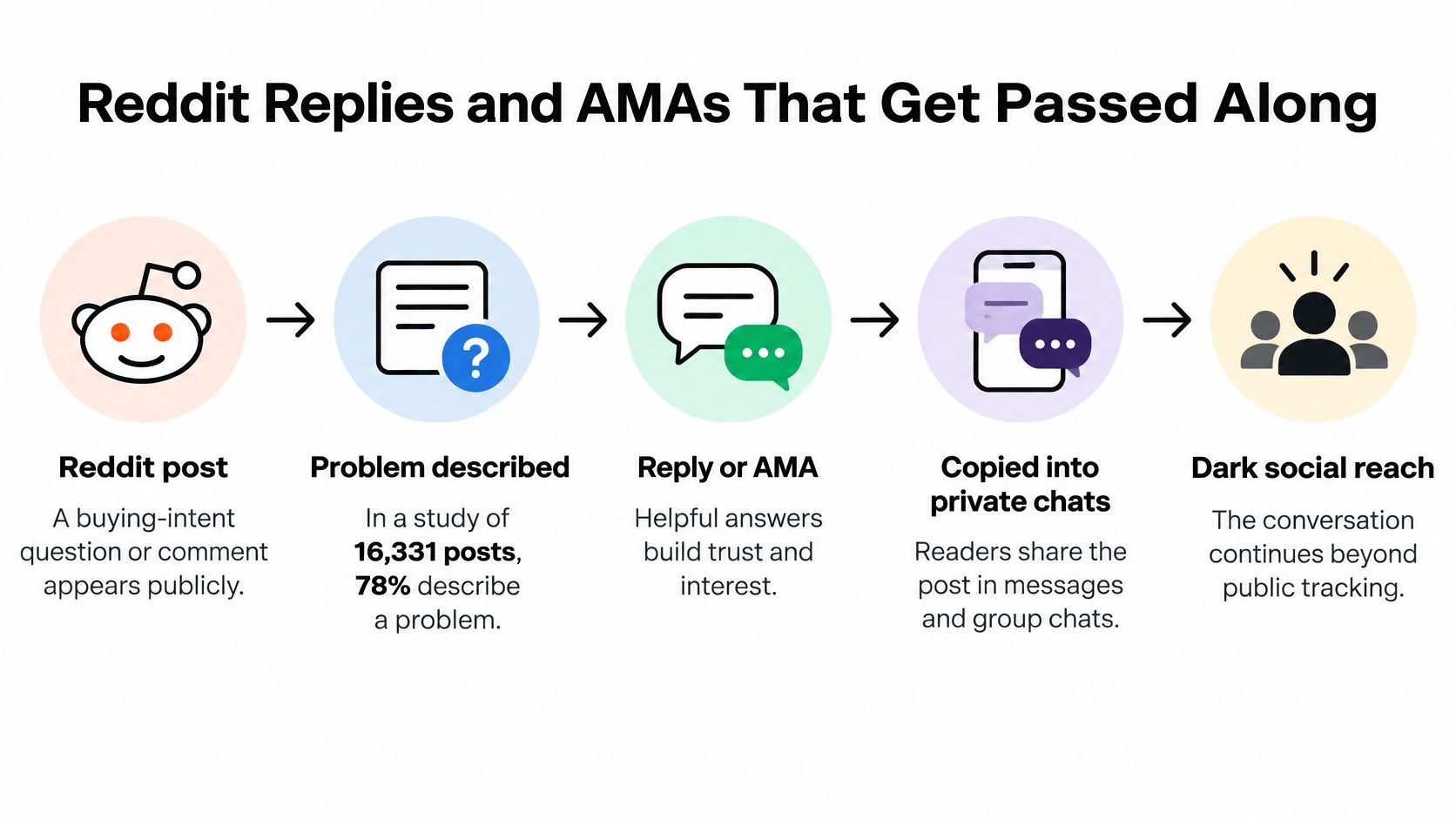
In our study of 16,331 buying-intent Reddit posts, 78% described a problem, while 13.6% asked for a tool. Separately, 83% of buying-intent posts had fewer than five comments when we found them. Those observations suggest a useful starting point: look for unresolved problems, not just explicit requests for product recommendations.
An early answer can be easy to notice when a discussion is still quiet. But timing alone doesn't make it worth forwarding. The answer needs to help someone explain the problem or make a decision.
Write replies people can reuse
Say a founder asks how to identify which onboarding emails confuse new users. A useful reply explains how to compare support questions with the relevant email, distinguish delivery problems from unclear instructions, and test a revision. It doesn't open with a product pitch.
Build the reply around these choices:
- Answer the stated problem first. Give the reader something they can do without becoming a customer.
- Name a limit. Explain when your suggestion won't work or what information is missing.
- Disclose your affiliation. Say plainly if you build or work for a relevant product.
- Respect link restrictions. In strict communities, keep promotional links out of the initial reply. Don't use later comments to evade the rules.
A practical forum marketing strategy starts with the community's purpose. Write so a reader can paste your answer into a team discussion without having to explain away a sales pitch.
Run an AMA around a real question
An Ask Me Anything, or AMA, works best when the topic is something members already want to understand.
- Choose a welcoming community. Read its rules and ask moderators whether your proposed format is appropriate.
- Announce a specific topic and availability window. A focused operational question gives members more to work with than a general founder introduction.
- Prioritize useful answers. Address questions that help the community, including awkward ones. Use honest numbers only when you can substantiate them.
- Publish a reusable summary. Include a tagged resource link only where moderators permit it.
- Follow up with relevant commenters. Continue publicly unless someone invites a private discussion.
Promotional wording, attempts to suppress criticism, and launch announcements disguised as AMAs can undermine the exchange. Correct inaccuracies openly rather than hiding uncomfortable questions.
For a proposed first-week review, look for substantive follow-up questions, any save signals available to you, and tagged visits. Treat forwarding as unknown unless someone reports it. A helpful comment doesn't become a proven private referral because it received attention.
Turning Private Shares Into Tracked Conversations
Public content helps someone discover an answer. Private forwarding lets them ask a trusted person whether that answer fits their situation. That's a useful model for dark social marketing, but you shouldn't assume every forwarded link represents an endorsement or an imminent purchase.
A GlobalWebIndex and We Are Social survey of more than 3,000 adults in the United States and Britain found that 63% preferred private channels for sharing content and recommendations, compared with 54% for open social platforms and 51% for offline word of mouth, as reported by The Drum. This measures sharing preferences, not conversion rates.

Make the next exchange useful
-
Write a self-contained public answer. State the problem and who the advice fits near the beginning. Someone receiving a pasted excerpt should understand its purpose.
-
Attach a tagged destination that stands alone, where links are welcome. Explain the use case, limitations, and next action on the page rather than relying on the original thread.
-
Offer a private follow-up when appropriate. A qualifying question identifies a concrete need, such as a workflow constraint or implementation requirement. Ask permission before moving to DMs, and respect community rules.
-
Ask a focused question about their situation. For example, ask which part of their current process requires manual work. Don't send a discovery questionnaire before helping.
-
Log the conversation and its source. Record the public thread, the stated need, permission to follow up, and the outcome in a shared sheet. Avoid copying unnecessary personal details.
As conversations accumulate, you can categorize recurring needs before deciding what content to improve. Cyndra's guide to AI-driven customer behavior analysis offers a useful starting point for thinking about those patterns. Automation should help organize evidence, not turn guesses about a person's intent into facts.
Don't confuse access with permission
A mention of a problem in passing isn't an invitation to receive a sales message. Neither is a public profile. Identify yourself, explain why you're responding, and make it easy to decline.
A better signal than message volume: The prospect answers a relevant question and asks what to do next.
If you formalize referrals later, keep the expectations explicit. A clear approach to customer referral programs can support recommendations without treating every private conversation as a sales channel you own.
A Small Team Playbook for the First Week
Use a two-channel rule: focus on the subreddit where prospective buyers already discuss their problems and the permitted channel where you can respond personally. That might mean public replies followed by invited DMs. It doesn't mean joining every community or opening a branded group before anyone wants one.
Read the rules before choosing where to participate. Our internal analysis found that 59% of the 1,905 subreddits checked were strict about self-promotion, and 80% of those strict subreddits had over one million members. A large audience isn't automatically an accessible audience.
Set up a manageable working system
Use this as a proposed first-week setup, not a performance benchmark:
-
Create your link register. Make a tagged short link for each Reddit profile and product destination you intend to use. Record the destination, campaign label, placement, and owner so teammates don't create conflicting labels.
-
Add a sign-up attribution question with an other, please specify option. Keep the wording neutral. If the answer doesn't fit the listed choices, let the customer explain rather than forcing a misleading category.
-
Choose a small shortlist of subreddits. Read their self-promotion, direct-message, and AMA rules. Record whether links are permitted and whether moderator approval is required.
-
Book a review for the end of the week. Assign someone to bring the evidence, and someone to challenge unsupported interpretations. Write down the decision each review should produce.
Keep a simple working sheet with columns for the discussion, buyer problem, response owner, follow-up permission, campaign label, and outcome. Link to the public context instead of storing long copies of conversations. Include a status for no fit so the team can close opportunities rather than repeatedly revisiting them.
A copyable weekly time budget
For a trial routine, use these suggested time boxes, then adjust them to your workload:
- Thread review, 30 minutes: Find problem-focused discussions and rule out poor fits.
- Reply writing, 20 minutes: Draft a couple of useful answers and check each against the community rules.
- Invited follow-ups, 15 minutes: Respond to people who asked qualifying questions and welcomed further discussion.
- Evidence review, 15 minutes: Examine tagged visits, customer answers, and unresolved attribution questions.
For a pair of teammates, let one person own the writing and the other own the tracking. The writer still needs access to outcomes; the reviewer still needs to understand what was posted. Shared context prevents reports from becoming disconnected from the actual conversations.
Agencies should keep a separate review sheet for each client. Multi-product teams need distinct campaign labels and link registers for each product, so evidence doesn't drift between offers. Pure Write's guide to build a scalable content marketing team is useful when assigning ownership beyond the initial team.
Use tools without outsourcing judgment
Bazzly scans selected subreddits for buying-intent opportunities and drafts context-aware replies. Its Brand Signals feature shows mentions of your product and competitors over the last 30 days, with sentiment labels, and it supports personalized DMs based on what people posted. Those capabilities can reduce manual work, but they don't reveal private sharing or establish causal attribution.
Keep a human responsible for relevance, disclosure, and permission. Review a draft against the actual question, not just its fluency. If the product isn't a fit, don't post.
Set an explicit stop rule for the trial. For example, after an eight-week test window, pause channels with neither tagged visits nor survey mentions, unless a documented buying cycle or another credible signal justifies continuing. That window is a management choice, not a proven cutoff.
Before dropping a channel, verify that tracking worked and that your replies were useful. Then make the decision from the evidence you have, without inventing hidden success to defend the effort.
Bazzly helps you find high-intent Reddit discussions, draft relevant replies, and follow up with personalized messages. Visit Bazzly to build a focused Reddit outreach routine, then evaluate it with tagged activity, customer-reported influence, and clear limits on what you can claim.
Written by Bazzly Team
Bazzly builds software that finds buyer conversations on Reddit and posts helpful replies in them (227,592 posts flagged for customers since June 2, 2025). The Bazzly numbers we quote come from our own data, published with the method in our research studies. About us


