On this page
You volunteered to moderate a subreddit that grew from 8,000 members to 90,000 in eighteen months. Clearing the queue used to take twenty minutes. Now it refills while you sleep, and last Tuesday you approved a link you hadn't read because 240 more were waiting behind it.
That's usually the moment a moderator goes looking for AutoModerator. It's also the moment they write a keyword rule at midnight, wake up to a modmail full of angry people, and conclude that automation doesn't work. The tool isn't the problem. The calibration is.
I would tell a new mod team: what the rule engine handles well, the syntax that holds up, the behaviours that surprise everyone, and how to decide what should never be automated at all.
What AutoModerator Does in Every Subreddit
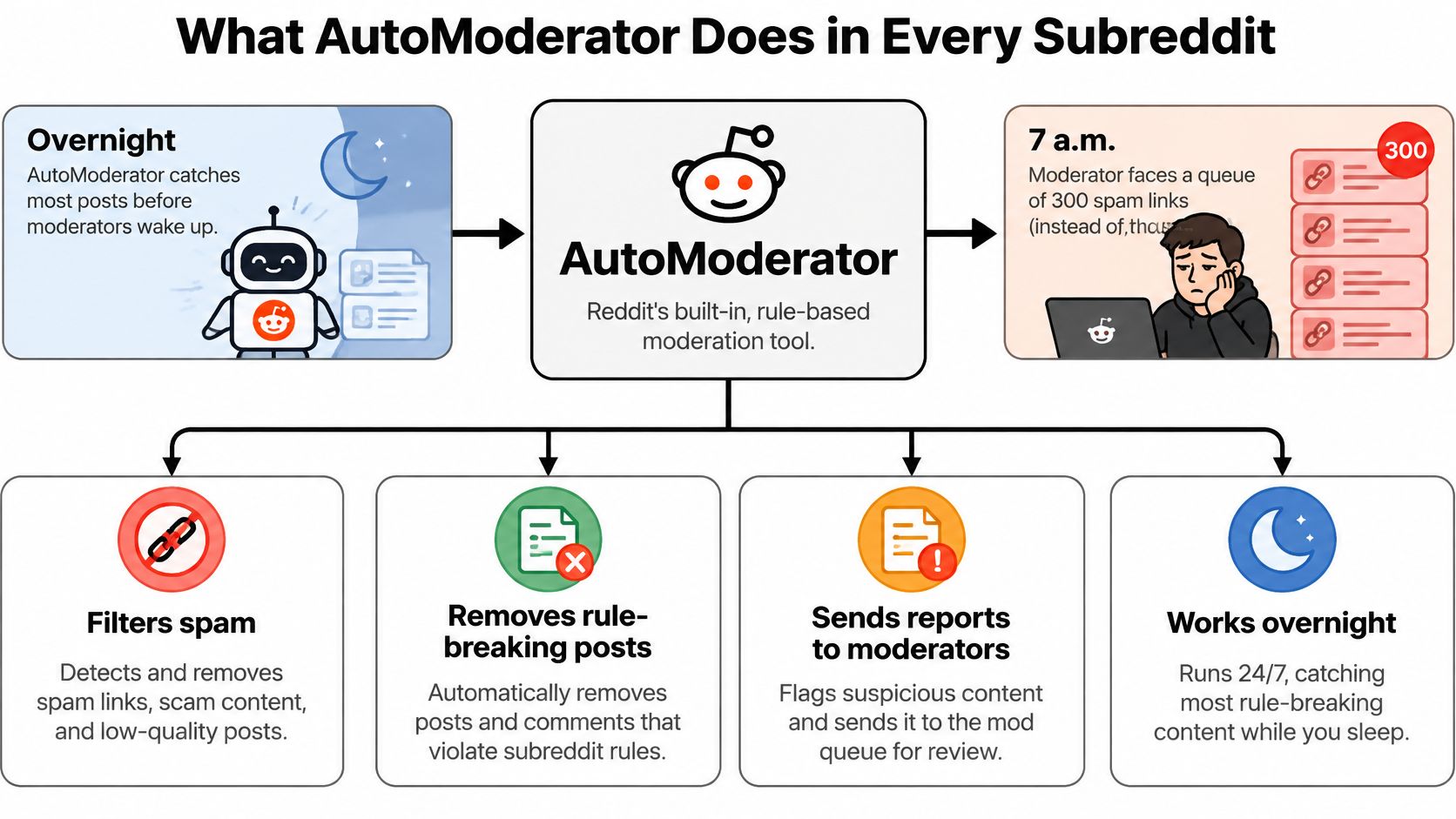
Say you open the queue at 7 a.m. and find 300 spam links posted overnight by accounts created four hours earlier. Every one of them matches a pattern you could have described in advance.
AutoModerator is Reddit's built-in, rule-based moderation system, and each subreddit's moderators configure it for their own community (Reddit's AutoModerator documentation). Chad Birch originally built it to cut the manual workload on r/gaming, and it became a sitewide Reddit tool in 2015. Rules inspect content such as keywords, titles, links and domains, alongside author attributes like username, account age, karma and report counts.
The architectural point matters more than the feature list: it is not one global policy engine. Your config governs your subreddit, nobody else's.
| Action | What it does | Typical use |
|---|---|---|
| Remove | Takes the item down | Spam domains and banned phrases |
| Filter | Holds the item in the mod queue | Uncertain matches a human should check |
| Report | Flags the item to moderators without removing it | Edge cases and heated threads |
| Lock | Stops new replies on a thread | Threads that turn hostile |
| Send message | Sends an automated message to the author | Explaining a removal |
| Assign removal reason | Attaches a stated reason to a removal | Consistent notices |
| Set flair | Assigns post flair | Sorting posts by topic |
Those actions stack. One rule can remove an item, attach a removal reason, and message the author in a single pass, which is why a tuned config reads less like a bot and more like a written house style. Because the engine acts at the moment content is evaluated, the post is stopped before it accumulates visibility.
Before you write a single line of YAML: list every decision you make in a normal week, then mark each one as automatic, filtered, or human. The decisions you'd defend in public are usually safe to automate. The ones that depend on tone, history or intent are not.
How to Write Your First AutoModerator Rule
The entire config lives on one wiki page in YAML. You don't need to learn YAML in general, just five keys and some discipline about indentation.
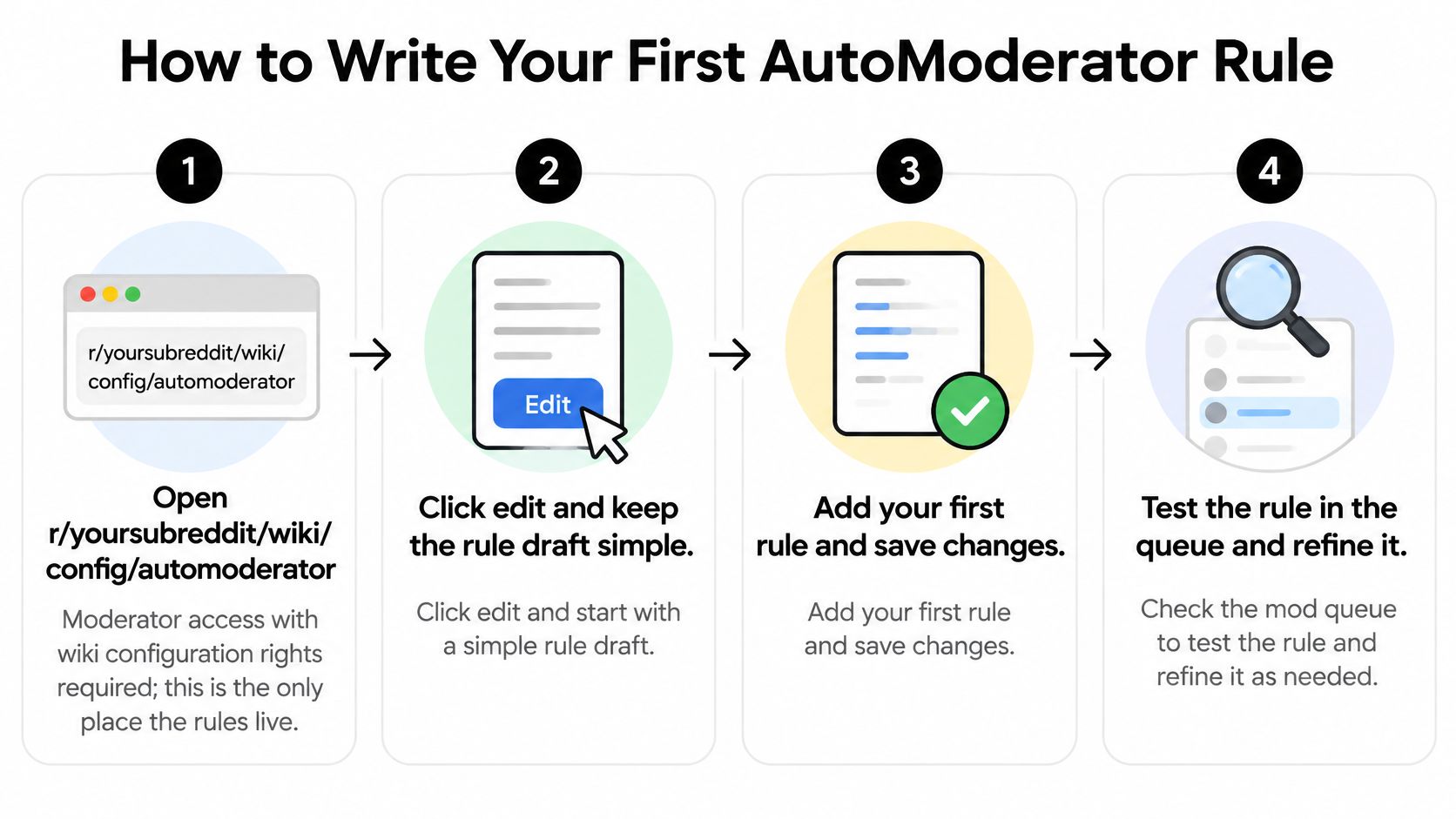
- Open the config page at r/yoursubreddit/wiki/config/automoderator. You need moderator access that includes wiki configuration rights; without them the page loads and you can't save it. This page is the only place the rules exist, so bookmark it.
- Keep the block structure. Each rule is separated by three dashes on their own line. The most common first failure is a tab character instead of spaces, usually pasted in from a chat window or a notes app. Indent with two spaces every time.
- Declare the type before the conditions. Every block starts with
type: submissionortype: comment, then the conditions you care about, such asdomain,titleoraccount_age. Skipping the type is how people end up catching every comment that mentions a competitor instead of the link posts they meant to target. - Pick the weakest action that solves the problem.
remove,filterandreportare all available for the same condition. For anything you haven't run in production before, start with filter or report. Removal is the action you graduate to, not the one you open with. - Tell the author why. Add a message and a removal reason. Someone who receives a sentence naming the rule argues far less than someone who receives silence and a dead post.
- Save and check within the hour. Changes take effect as soon as the wiki page is saved, so a broken rule is live immediately. Publish one test post from a non-mod account, or open the mod log straight away and confirm what matched.
- Know your undo. The wiki page keeps a revision history. When a save breaks something, open the diff and restore the previous revision instead of editing live and hoping the next version is better.
If you'd rather watch the edit screen before you touch a live config, this walkthrough takes you through a rule from blank page to saved:
A healthy first rule is boring. One condition, one action, one readable reason, and a note on the calendar to review it in seven days.
Copy-Ready AutoModerator Rule Examples
Treat this table as a starting library, not a finished ruleset. The shape of each pattern transfers between communities; the thresholds do not.
| Goal | Main conditions | Action |
|---|---|---|
| Block a spam domain | type submission and domain set to the site | Remove and send message |
| Hold posts that break a title format | type submission and title regex | Filter |
| Hold new accounts for review | account_age under 7 days | Filter |
| Hold low-karma authors | combined_karma below 10 | Filter |
| Flag heavily reported items | reports set to 3 | Report |
| Set flair by keyword | title includes keyword | Set flair |
| Explain a removal | body rule with a message | Remove and message |
Two scope rules that explain most surprises
Body rules read text posts by default. A condition written against body won't scan a link post or an image post, so an identical paragraph pasted into an image submission walks straight past your filter. If the rule has to cover every format, write it against the title and the author, not the body.
Broad keywords cost more than they save. A rule matching free will catch giveaway spam and also catch genuine giveaways, help requests and someone explaining a free tier. Narrow the phrase to the exact construction spammers use, and keep the action on filter while you check the matches.
Test each row against last month's removals
Before you save anything, pull your last month of removals and ask two questions of each row. How many of those removals would this rule have caught? How many items it caught would you have wanted to stay up?
A pattern that would have caught 40 items and missed 3 is ready for removal. One that would have caught 12 and wrongly caught 30 is a phrase that needs narrowing, and shipping it means a week of appeals written by people who did nothing wrong.
A keyword rule is a hypothesis about your community. Save it as a question, not a verdict.
Tune Rules to Avoid Unfair Removals
A rule that removes 200 posts a week also creates appeals, modmail, debugging work, and frustration among authors whose posts should have stayed up. AutoModerator shifts work from the queue to those tasks, so tune for accuracy before giving a rule permission to remove.
Reddit's official transparency report describes the scale of removals across the platform and the role of automated systems, including AutoModerator. That context is a reason to measure your own rule's false positives, not to assume a high-volume rule is accurate.
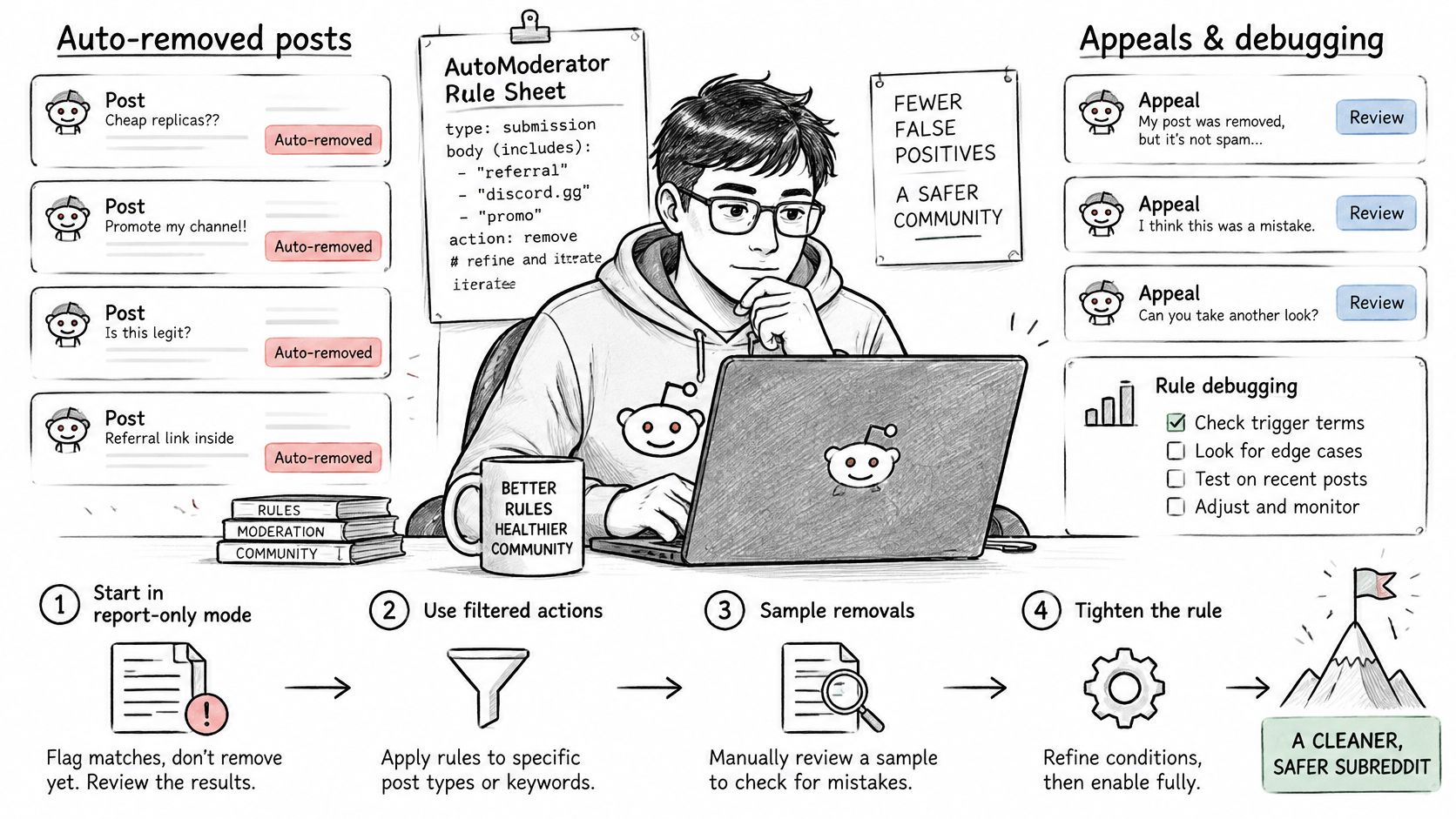
Calibrate a rule in stages:
- Start with report or filter. Let the rule flag likely matches while moderators review them.
- Sample the matches regularly. Check a consistent batch and count how many you would have approved. A rule with broad reach but many false positives is not ready to remove.
- Tune for the community. A phrase that signals spam in a support subreddit may be ordinary discussion in a debate subreddit. Keep separate thresholds where context differs.
- Explain each removal. Give authors a clear reason and a way to understand what rule their post triggered.
- Enable removal only after repeated checks show few false positives. Keep sampling after the change, since a rule that works on one set of posts can misfire on another.
AutoModerator can also behave differently than a simple rule order suggests. Removal rules run before other actions, and moderator posts are exempt from removal rules by default. Approval rules do not necessarily reverse every earlier removal or report, either, so approving a post may still leave cleanup to do.
Consider a rule that removes anything containing free. It may catch spam, but also legitimate giveaway threads and help requests. Narrow the match to the spam phrase pattern, then leave the action on filter while you review results. To check a community's rules before setting your own thresholds, use the Subreddit Rules Checker.
Track precision in sampled matches, appeal volume, and moderator time saved. If the queue shrinks but appeals rise, the rule has moved the workload rather than reduced it.
Common AutoModerator Problems and Fixes
The first failure many teams hit isn't a bad rule. It's a rule that never fires at all.
| Symptom | Likely cause | Fix |
|---|---|---|
| Rule never fires | Indentation or wrong content type | Fix spacing and set type correctly |
| Moderator posts are not removed | Moderator posts are exempt by default | Check the author, not the rule |
| Removed item stays removed after approval rule | Approval rules do not reverse all prior removals | Approve it manually |
| Too many false positives | Keyword is too broad | Narrow the phrase and switch to filter |
| Whole subreddit behaves oddly after an edit | Bad change saved | Revert via wiki revision history |
| Old posts not caught | Rules do not clean up history | Run a one-off manual review |
A silent rule is usually a five-minute edit: tabs where spaces belong, type: comment on something you meant for submissions, or a body condition pointed at a title. Check those three before you rewrite anything.
Moderator posts that stay visible after you build a removal rule are expected, so inspect the author field before you touch the YAML. This is minutes, not hours, but it wastes days if you don't know it.
An item that remains removed after your approval rule fired needs a manual approval, not another condition. Approval rules don't undo every prior removal or report state, and stacking conditions to force a reversal usually creates a new bug. Same-day fix, two clicks.
When a short word like free is eating genuine giveaways and help requests, narrow the phrase and switch to filter, then review matches for a week. That one is a week of review, not an afternoon, and it's worth the time. The mechanics of how filtered items sit relative to removed ones are worth reading once, and this explanation of Reddit filter versus removal covers the difference cleanly.
If one save makes the whole subreddit behave oddly, revert that revision from the wiki history the same day rather than patching forward. And if old threads are the problem, no rule will touch them: AutoModerator doesn't rescan history, so the answer is a single manual pass. That's a process decision, not a config change.
Where AutoModerator Falls Short
A title-format rule can catch a missing tag. It cannot tell whether a post deserves an exception, remember how a user's earlier appeal was resolved, or settle a dispute between moderators. Add more YAML and the rule may become harder to maintain without making those judgments better.
Reddit's AutoModerator documentation describes a rule engine that acts when content is evaluated. It handles title formats, blocked domains, flair assignment, and report-triggered actions. Its limits become clear when a task depends on past events, context, or a person's decision.
| Task | AutoModerator fit | Better workflow |
|---|---|---|
| Title and domain enforcement | Strong | Keep as rules |
| Report-triggered review | Partial | Use the mod queue and a regular sweep |
| Historical cleanup | Limited | Review past content manually |
| Duplicate detection over time | Limited | Use a moderator process |
| Appeals | None | Set a written appeals path with a named reviewer |
| Cross-community coordination | None | Agree on shared standards in a moderator channel |
Rules apply when content is evaluated. Saving a new config affects future posts, not old ones. Body rules also do not scan text embedded in images, even when that text matches a removal pattern.
Automation changes where the work lands. A rule can reduce routine queue processing, but borderline matches create appeals, and poorly scoped conditions create debugging work. The practical test is whether a rule produces consistent decisions without forcing moderators to explain a long chain of exceptions.
If a rule needs a paragraph of exceptions to explain itself, it is probably a job for a person with the thread open.
A general-purpose bot works differently from AutoModerator's condition-based rules. This Dyno bot review covers a command-driven bot, though its focus is not Reddit moderation.
Decide What Stays Automatic
The decision is narrower than most guides imply. Automatic removal stays for patterns with one defensible answer: a known spam domain, a required title format, a phrase that means exactly one thing in your community. Filter or report stays for new accounts, low karma and items crossing a report threshold, at least until sampled matches prove themselves.
Tone, context, appeals and user history go to a named moderator. Every time.
The go-live gate, in order:
- Read the wiki diff before saving and confirm only the intended rule changed.
- Publish one test post and open the mod log the same day, because the save is already live.
- Leave the new rule on filter for seven days.
- Count false positives against last month's removals.
- Switch to remove only if that count stays low, and write the reason in one sentence the author can read. The removal reasons and modmail workflow approach is worth copying here.
Someone posting about their own product still has to follow that subreddit's self-promotion rules, and no automation waives them. We hold the same line at Bazzly when you post from your own account through the Chrome extension: Reddit's guidelines apply, which means no spamming and no ignoring subreddit rules.
Today's next step is one condition, one action, and a review date on the calendar. That's the whole first version.
If you're spending your evenings clearing a queue that a rule could have handled, Bazzly was built for the other half of the problem: finding the Reddit threads where your product is relevant. It scans the subreddits you choose around the clock, scores each new post for buying intent and fit, and drafts a context-aware reply you can review before anything goes live. Visit Bazzly to see which conversations are already waiting on your answer.
Written by Bazzly Team
Bazzly builds software that finds buyer conversations on Reddit and posts helpful replies in them (227,592 posts flagged for customers since June 2, 2025). The Bazzly numbers we quote come from our own data, published with the method in our research studies. About us