How to Sell on Reddit Without Getting Banned
The most popular advice for founders trying to sell on Reddit is simple. Find relevant subreddits, be helpful, drop a link when it fits. That advice gets accounts removed every week because it skips the three problems that decide whether you survive, which are moderation, trust, and measurement. Posting is the easy part. Staying allowed to post, sounding credible when you do, and proving the channel works when clicks arrive days later are the hard parts. This guide treats Reddit as a rules first acquisition channel, not as another feed where you can repurpose LinkedIn or X content.
Table of Contents
- Why Selling on Reddit Works Differently
- Researching the Right Subreddits First
- Understanding Reddit's Self-Promotion and Spam Rules
- Writing Replies That Build Trust Before You Sell
- Converting Replies into Leads Without Breaking the Rules
- Measuring Results That Don't Show Up in Last Click
- A Practical Reddit Selling Checklist and Common Questions
Why Selling on Reddit Works Differently
Reddit isn't a single audience with a single algorithm. It's a network of moderated communities, each with its own rules, culture, and tolerance for commercial activity. A reply that's welcomed in a founder community can be removed in a hobby subreddit for the exact same wording. That fragmentation is why copying a Facebook or LinkedIn playbook fails. You're not publishing to followers who opted in. You're entering someone else's room, where volunteer moderators can end your distribution in seconds.
The commercial opportunity is real, and it's not fringe. Reddit generated approximately $804 million in total revenue in 2023, up from $668 million in 2022, representing year-over-year growth of about 20%, and large advertisers' spending increased 31% in 2022 even as overall ad spend declined, as shown in Sacra's breakdown of Reddit's business and revenue history. Big brands don't keep raising spend on a platform that doesn't convert. For a solo founder, the implication is practical, not abstract. Product discovery, organic discussion, and paid promotion already overlap on Reddit, so buyers are used to evaluating products there.
The Mismatch That Gets Sellers Banned
Most social platforms reward frequency and reach. Reddit rewards contextual relevance and punishes repetition. If your account history reads like a content calendar for one product, moderators don't need a keyword filter to spot it. They check your profile, see the pattern, and remove you. That's also why small teams that can't staff daily participation sometimes look at outsourced social media for Brisbane startups as a model for delegating research and community listening, rather than treating Reddit as an occasional launch post.
Disclosure alone doesn't make a sales post acceptable. A transparent founder can still be removed if the post is off-topic, transactional, or reads as an attempt to borrow the community's trust.
That principle should shape every decision that follows. You don't start by asking what to post. You start by asking where your buyers ask questions, what that community allows, and whether your account history proves you're a participant before you're a seller.
What works is slower at first and more durable later. You earn the right to mention a product by answering questions you'd answer even if you had nothing to sell. When your product helps, you say so plainly, disclose your connection, and let the reader decide. That approach converts fewer random viewers and more qualified buyers, which is the right trade for SaaS and niche products. It also protects the asset you can't rebuild quickly, an account with a clean moderation record.
Researching the Right Subreddits First
Don't start with a list of big subreddits in your category. Start with the exact phrases your buyers type when they don't know your product exists. Think in terms of problems, comparisons, and switching pain, such as alternatives to a named competitor, how to do a specific workflow, or what tool handles a narrow use case. Those intent phrases become your search terms across Reddit, and the threads they surface tell you where demand appears.
The workflow below turns that idea into a shortlist you can defend, instead of a spreadsheet of communities you found in an afternoon.
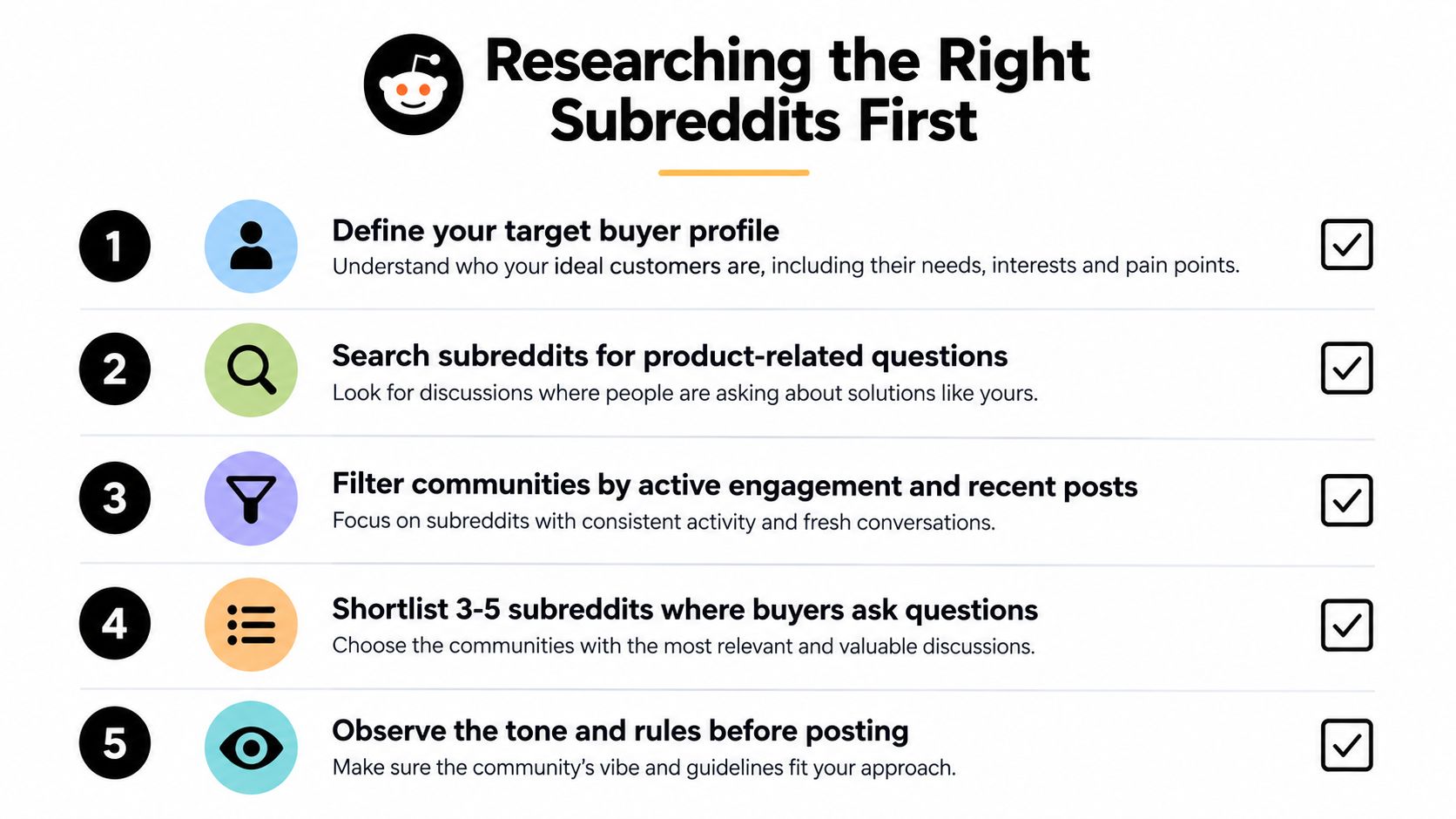
A Repeatable Shortlisting Workflow
- Define the buyer first: Write down who feels the problem, what job they're doing, and what they'd search before they know any brand names.
- Search the phrases, not the category: Run each intent phrase through Reddit search and note which subreddits repeatedly host those threads.
- Check recent activity: favour communities with fresh posts and real comment threads over large but quiet subscriber counts.
- Sample recent moderation: Read the newest posts and removed or locked threads to see what moderators enforce, not just what the sidebar says.
- Confirm the rules page: Shortlist only communities where you can find and follow written rules on promotion, links, and flair.
A tool can speed up the discovery step when you're scanning many phrases, and Bazzly's subreddit finder tool is useful for building that initial candidate list. It doesn't replace reading threads yourself. You still need to judge tone, because two subreddits with similar topics can have opposite norms on founder posts. One welcomes build in public updates. Another treats any product mention as advertising.
Demographics help you prioritize where to look, but they don't pick communities for you. Pew-linked reporting cited in Reddit's guidance on keeping spam out of communities indicates 26% of U.S. adults used Reddit in 2025, including 48% of adults aged 18 to 29 and 35% aged 30 to 49. For B2B SaaS, that pattern supports starting with founder, developer, technology, and career communities. Treat that as a hunting ground, not proof of fit. Validate with thread-level intent, because a small community where buyers ask specific product questions will outsell a huge general subreddit where your reply competes with memes.
Keep the shortlist tight. Three to five communities you read daily beat twenty you visit when you have something to promote. You'll learn the recurring questions, the regular commenters, and the phrasing that gets taken seriously. That familiarity is what makes your later replies sound native instead of pasted in.
Understanding Reddit's Self-Promotion and Spam Rules
Reddit's platform guidance gives you a workable ceiling, and you should build your whole workflow under it. Reddit's own self-promotion guidance recommends that roughly 10% or less of an account's posts and conversations link to its own content, with the rest made up of useful participation. Treat that as a budget, not a target. If nine out of ten contributions help someone without mentioning your product, your tenth reads as an exception. If half your history promotes one domain, moderators see a sales account, whatever your bio says.
The same guidance draws hard lines you shouldn't test. Don't buy votes. Don't coordinate votes from employees, friends, or fans. Don't disguise your affiliation, and don't send unsolicited private messages to pitch. Those aren't grey areas that better wording fixes. They're behaviours that get accounts banned and domains flagged, and no short term traffic spike compensates for losing the channel.
How Moderators Actually Interpret the Rules
Subreddit rules sit on top of platform rules, and they're often stricter. Some communities prohibit promotion entirely. Others allow it with flair, on specific days, or only from accounts with established participation. Enforcement also depends on moderator judgment, including the idea that conduct can violate the spirit of a rule even when it follows the exact wording. A reply that avoids a link but nudges everyone to message you for a product name isn't clever. It's indirect promotion, and moderators recognize it.
Before you post anywhere new, run the community through a structured check, such as Bazzly's subreddit rules checker, then read the full rules page yourself. Look specifically for policy on affiliate links, coupon codes, founder posts, market research, and Buy, Sell, Trade activity, because communities classify those differently. Save a note per subreddit on what's allowed, what's conditional, and what's banned. When a rule is ambiguous, message the moderators and ask. That one message prevents most avoidable removals.
| Behavior | Compliant | Risky or Banned |
|---|---|---|
| Mentioning your product | Answer the question first, disclose affiliation, mention it once if relevant | Leading with the product name or repeating it across threads |
| Using links | Link only where rules allow and link ratio stays low | Posting the same domain in many subreddits on the same day |
| Asking for feedback | Share a genuine problem or lesson and invite discussion | Framing an ad as a fake question to prompt product replies |
| Direct messages | Reply when a user asks you to message them | Sending unsolicited pitches after scraping thread participants |
| Votes and engagement | Let upvotes follow the quality of the answer | Coordinating employees or services to upvote your comment |
Build simple controls around that table. Cap how often any single account posts promotional content, track removals and moderator warnings, and pause in a community after a negative signal instead of arguing or reposting a variation. Don't let one account or one subreddit carry your entire program either. Concentration feels efficient until a single ban erases it.
Writing Replies That Build Trust Before You Sell
A reply that sells without sounding like an ad has a predictable anatomy. You open with the user's problem in their words, give a real answer that helps even if they never click anything, and only then mention your product if it materially solves part of the problem. The illustration below captures that order at a glance, helpful comment first, recommendation second.
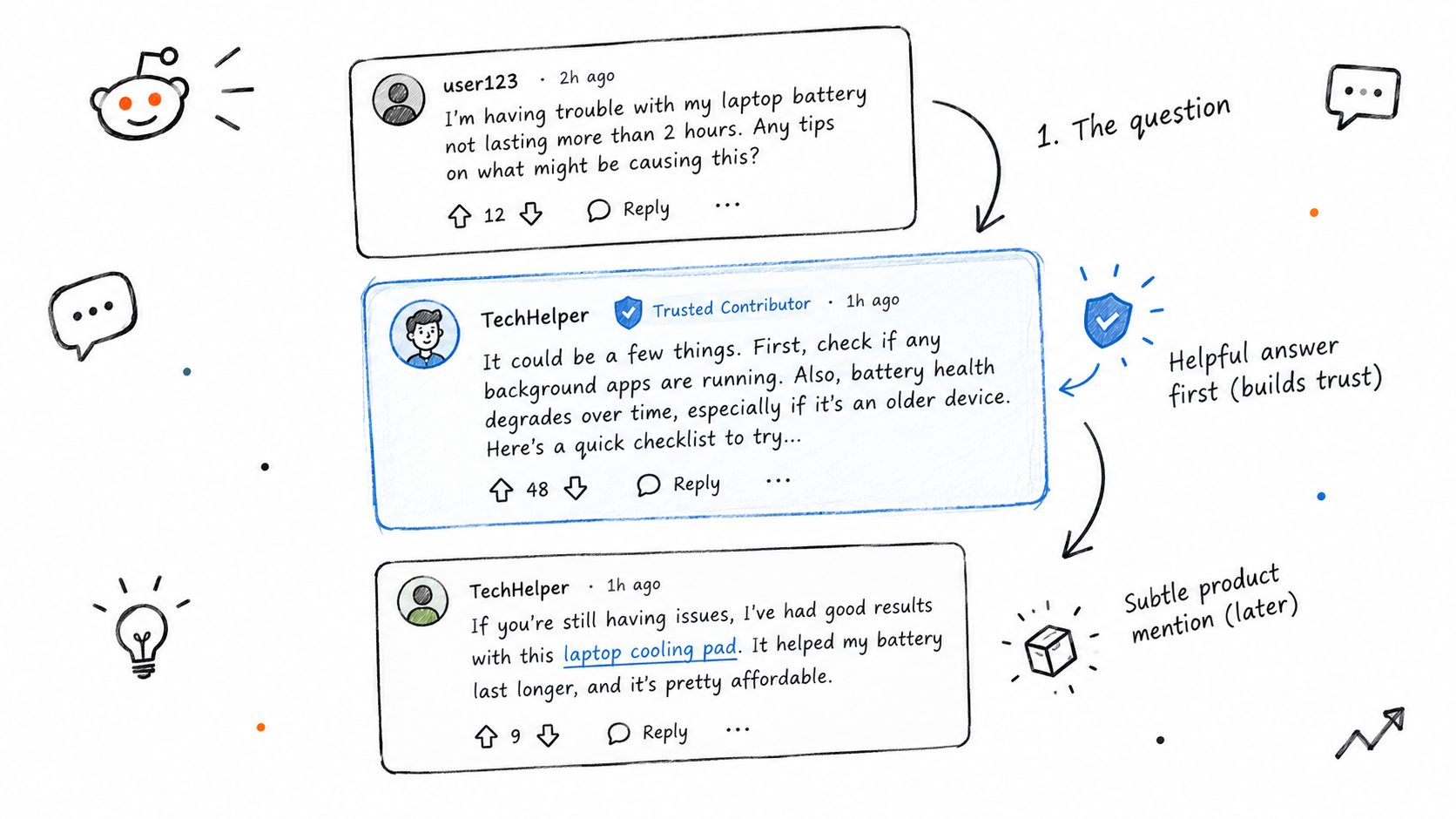
The timing matters because so many Reddit purchase conversations happen before a buyer has chosen a brand. Reddit's research on product recommendation journeys found discovery-stage recommendations account for 17% of consumer purchase conversations in consumer electronics and about two-thirds in beauty. Readers in those threads are comparing options and trying to reduce uncertainty. A reply that helps them think clearly earns attention. A reply that jumps straight to a pitch triggers the same skepticism they'd bring to an ad.
Weak Reply Versus Strong Reply
A weak reply is easy to recognize. It opens with the product, lists features, and drops a link, something like a short paragraph claiming your tool does exactly this and inviting the reader to try it. It gives the reader no way to judge whether you understood their situation. Moderators read it as advertising because it is.
A strong reply works in the opposite order. It restates the constraint the poster described, explains the options, including one that isn't yours, and then adds a disclosed, specific note on where your product fits and where it doesn't. Naming a limitation is the fastest credibility builder you have. Sellers hide trade-offs. Practitioners state them, and Redditors can tell the difference quickly.
Practical rule: If deleting your product sentence would make the reply useless, you wrote an ad. Rewrite it until the reply helps on its own.
Disclosure placement matters as much as wording. Put it in plain language near the product mention, not in a vague line at the end. A simple statement that you're the founder, or that you work on the product, gives readers the context to weigh your advice. Don't soften it into phrases like happy user or long time fan when you have a financial interest. That disguise is what rules against hidden affiliation are built to catch.
The short walkthrough below shows how that structure plays out in a live thread, from reading the question to deciding whether a product mention belongs at all.
Write each reply for the specific thread, every time. Reused paragraphs get spotted by readers who browse the same communities you do, and identical text across subreddits reads as automation. Vary your examples, reference details from the post, and answer follow-up questions without turning every response into another mention. Trust compounds across a thread when you stay to help after the link would normally appear.
Converting Replies into Leads Without Breaking the Rules
Picture a common scenario in a small SaaS community. A founder asks how others handle a tedious workflow, names the tool they're leaving, and says budget matters. You reply publicly with the approach you'd recommend regardless of vendor, disclose that you build one option in the category, and explain the one case where your product isn't the right fit. Two other users ask follow-ups. Because you stayed in the thread and answered them without pitching again, the original poster asks for a link. That's your conversion moment, and the prospect created it.
That sequence works because the public reply did the selling before any link appeared. The funnel shown here maps the safe version of that path, from public value to a private conversation the user invited.
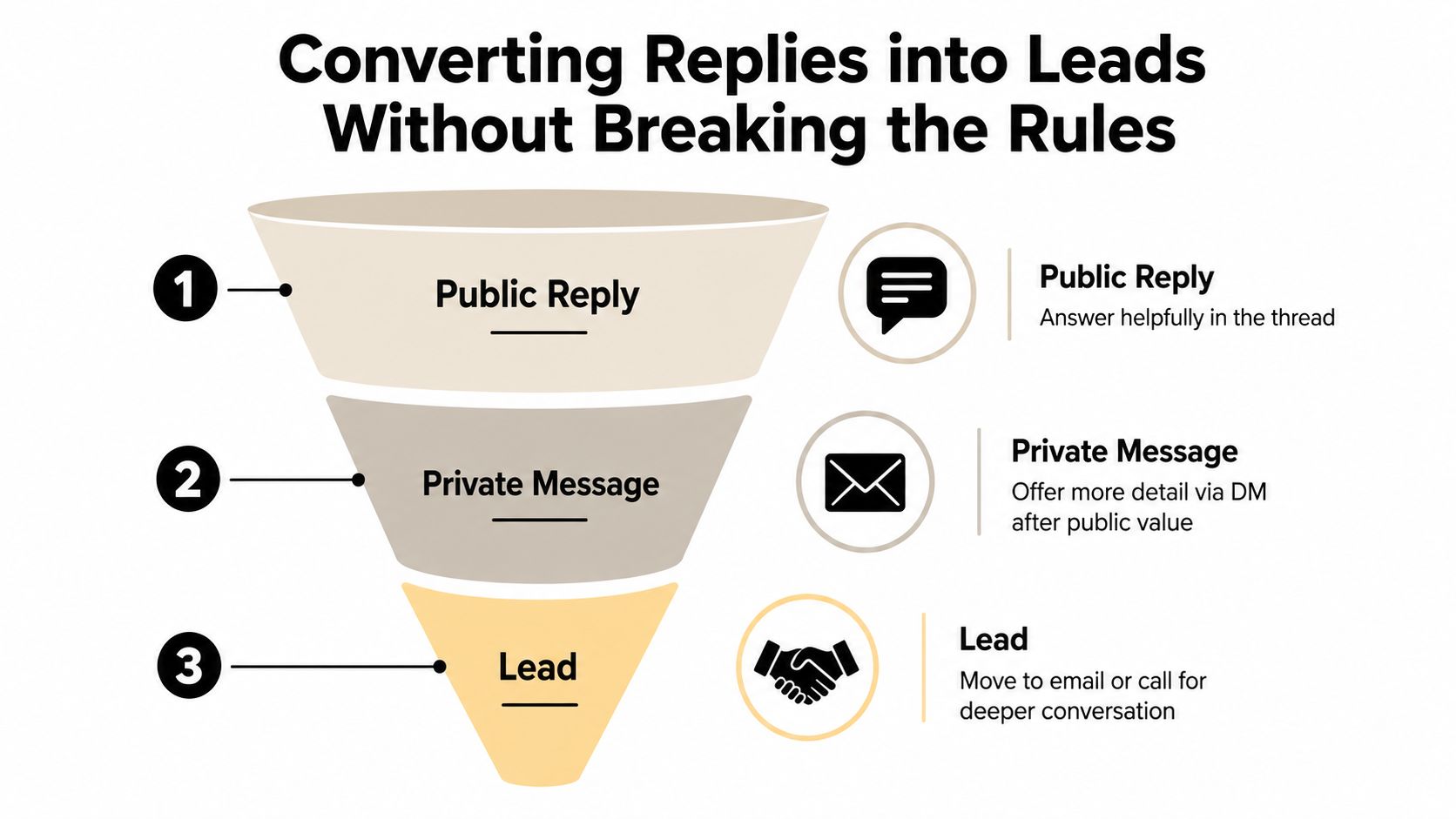
Three Safe Conversion Paths
- Public reply with a link: Use this only where community rules clearly allow links and your account history is mostly non-promotional. Put the link after the useful answer, never as the opening line.
- Public reply without a link: Answer fully, disclose your affiliation, and name the product without linking. Interested readers search for it or ask, which keeps you inside stricter rules.
- Invited direct message: When a user asks for details, pricing, or a link, continue privately and keep the message specific to their question. An invited DM follows consent. A cold pitch doesn't.
The DM handoff deserves care because it's where compliant sellers get lazy. Reference the thread, answer the actual question, and offer the next step once, whether that's a trial, a call, or a page that explains fit. Don't paste a generic pitch, don't add them to a sequence, and don't message other thread participants who never asked. If they don't reply, stop. Persistence that works in email outreach reads as harassment here.
Visibility mechanics need the same restraint. Early, useful replies tend to collect upvotes and stay visible, which is why monitoring threads promptly matters more than posting volume. Tools in this category, including Bazzly, monitor subreddits for high-intent threads, draft context-aware replies, and support publishing from your own account or assisted accounts. Used as monitoring and drafting help, that saves time. Used to mass-post similar replies or manufacture engagement, it recreates the exact patterns moderators remove. The tool choice doesn't transfer your responsibility for rules, disclosure, or tone.
Know when to pull back. If a thread is emotional, off-topic for your product, or hosted in a community that bans promotion, the right move is a helpful answer with no mention at all, or no reply. Every restrained decision protects your standing for the threads where a mention is welcome and likely to convert.
Measuring Results That Don't Show Up in Last Click
Judging Reddit by last-click conversions will talk you out of a channel that's working. Reddit-related reporting covered by Social Media Today on Reddit's impact on product discovery says 88% of people use Reddit to help make purchase decisions, while 57% of posts mentioning a brand or product continue receiving views for more than a year, and one in ten Millennials and Gen Z respondents prefer Reddit over Google for product reviews. That pattern describes a research and validation channel. People read, compare, leave, and buy later through search or direct visits your analytics credits elsewhere.
The cards below frame the three layers worth tracking, because each one shows up in a different report and on a different timeline.
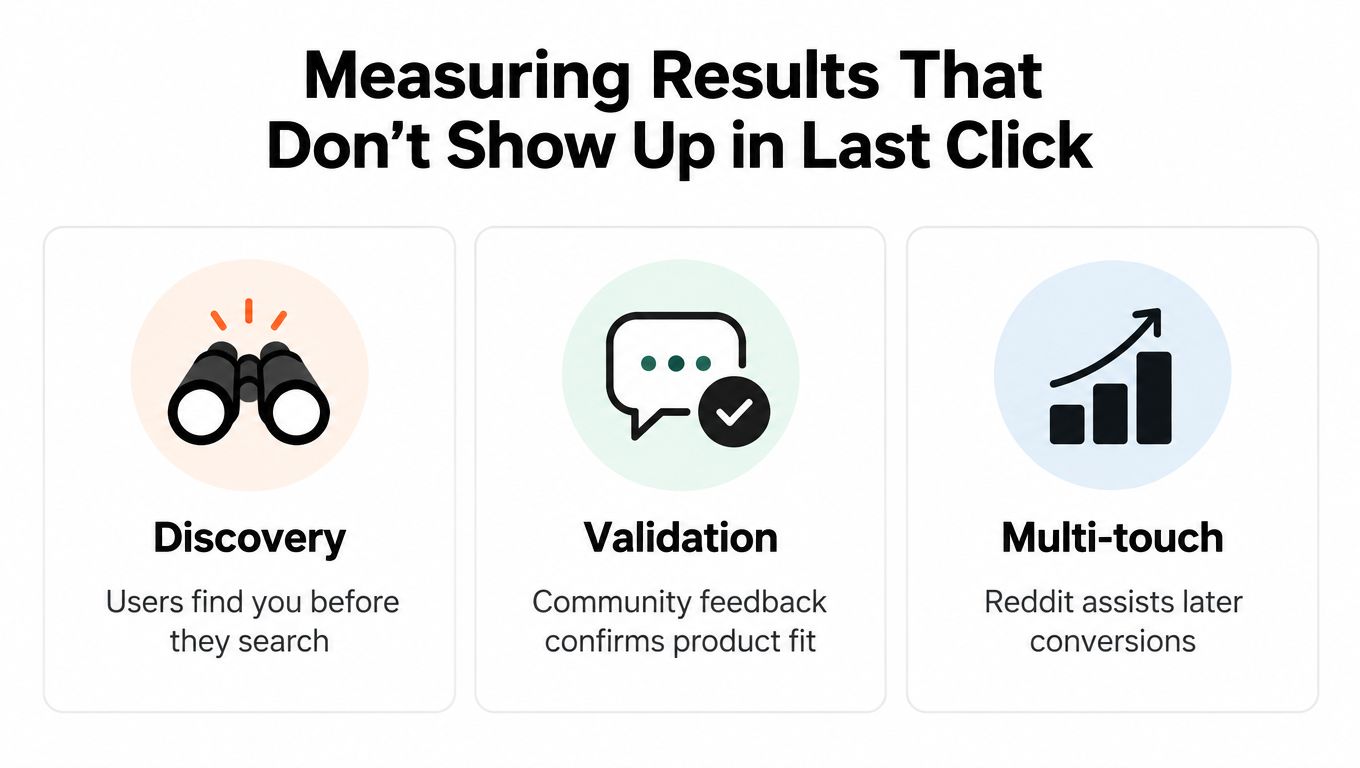
Build a measurement model around that behaviour. Track assisted conversions where Reddit appears earlier in the path, watch branded search volume after sustained activity in a community, and note signup lag between a thread's peak and the signups that reference it. Add a simple how did you hear about us field to onboarding, because self-reported Reddit mentions routinely reveal demand that click data misses. For a deeper view of how AI-driven discovery interacts with this, MyMentions AI visibility insights offers useful context on tracking traffic that doesn't follow a clean referral path.
Thread longevity deserves its own metric. A well-placed answer in a thread that ranks on Google keeps meeting new buyers long after you posted it, which changes how you value effort. Our notes on how Reddit activity relates to website traffic over time unpack that lag in more detail. Review your older replies monthly, answer new comments on threads that still draw views, and record which communities produce durable threads rather than one-day spikes.
A comment with few clicks can still drive pipeline if it sits at the top of a thread that ranks in search or gets cited by AI assistants. Judge it by qualified demand over time, not by its first day click count.
Use unique landing pages or codes sparingly, and only where rules allow. Aggressive tracking links look commercial and can undermine the trust your reply built. Cohort quality is often the cleaner signal. If Reddit-sourced users activate and retain well, keep investing even when raw click volume looks modest.
A Practical Reddit Selling Checklist and Common Questions
Run the same loop every week and Reddit becomes manageable. Research fresh threads in your shortlisted communities, recheck rules before posting anywhere new, draft replies that help without the product sentence, disclose affiliation plainly, choose the safest conversion path for that community, and log removals, warnings, and delayed signups. Founders who are newer to online channels can cross-check the basics against the AmaJova selling online guide, then apply the stricter Reddit-specific controls above.
Questions Most Guides Skip
- How many subreddits should you target at once: Start with a small shortlist you can read daily. Expand only after your replies survive and convert there.
- How do you recover from a warning or ban: Stop posting, read the moderator message carefully, apologize briefly if you broke a rule, and ask what compliant participation looks like. Don't return on a new account to evade a ban.
- Are aged accounts safe to use: Age doesn't override behaviour. An older account posting disguised promotion still gets removed, and it risks more history.
- When does a tool beat doing it manually: When monitoring many threads and drafting replies takes more time than reviewing them. Automation helps with finding and drafting. Judgment, disclosure, and moderator relationships stay human.
The goal isn't a traffic spike this week. It's a durable presence in the communities where your buyers already ask for help. Protect the account, respect the room, and let qualified demand compound.
If you're finding the right threads but losing hours to monitoring, rule checking, and drafting compliant replies, Bazzly can handle the scanning and drafting while you keep control of tone, targets, and what gets posted. It's built for founders who want to sell on Reddit consistently without risking the bans that come from shortcuts. Visit Bazzly to set up your first monitored subreddits and start turning high-intent conversations into signups.


