Lead Generation Rate Benchmarks and Tactics
The most popular advice about lead generation rate is also the least useful: find an average percentage and aim to beat it. That approach treats every form fill as equal, rewards channels that produce cheap curiosity, and hides the point where demand becomes pipeline.
A lead isn't a permanent category. It's a temporary stage between an observed buying signal and a commercial outcome. A Reddit user asking for a solution, a webinar registrant, an activated product user, and a sales-accepted opportunity may all appear in a lead report, but they represent very different levels of intent.
The practical question isn't “What's a good lead rate?” It's “Which stage are we measuring, what does the next stage require, and does this source create revenue?” That shift makes performance benchmarking more useful than chasing a universal conversion target. It also gives small B2B teams a clearer way to compare search, referrals, paid campaigns, and active communities.
Table of Contents
- Redefining the Lead Generation Rate
- Mapping the B2B Conversion Funnel
- Evaluating Lead Quality by Source
- The Hidden Impact of Response Latency
- Building an Intent-Driven Tracking Model
- Optimizing Your Pipeline for Revenue
Redefining the Lead Generation Rate
A higher lead generation rate can hide a weaker pipeline. Visitor-to-lead conversion, usually calculated as captured forms divided by website visitors, measures contact capture. It does not show whether those contacts fit the market, engage with the product, enter a sales process, or become customers.
A channel can raise its headline rate with a broader download, fewer form fields, or a larger audience. That may create more names and fewer sales conversations. A narrower campaign can produce fewer signups while generating stronger qualification and better revenue efficiency. Judging the first campaign only by its top-line percentage confuses activity with demand.
The denominator changes the decision
Benchmark compilations place visitor-to-lead conversion around 1% to 3%. The same synthesis reports approximately 31% of leads becoming MQLs, 13% of MQLs becoming SQLs, 30% to 59% of SQLs becoming opportunities, and 22% to 30% of opportunities becoming customers (benchmark data on lead quality). These figures describe directional stages, not universal targets. Offer, qualification rules, sales cycle, market, and traffic intent can shift each result.
Each rate answers a different operating question:
- Visitor to lead: Did someone submit contact details or an inquiry?
- Lead to MQL: Does the contact match the market and show enough engagement for marketing qualification?
- MQL to SQL: Has the buyer shown a signal that sales can act on?
- SQL to opportunity: Is there a defined problem, buying context, and credible commercial path?
- Opportunity to customer: Did the account produce revenue?
A founder who optimizes only the first rate may increase sales workload without improving pipeline value. Tracking the full chain supports a different decision: accept fewer visitors converting when the resulting contacts are more relevant and progress further.
Practical rule: Report the rate tied to the decision. Use visitor-to-lead conversion to diagnose capture, and qualified-opportunity-to-revenue to judge acquisition quality.
A SaaS benchmark reports 2.3% visitor-to-lead, 31% lead-to-MQL, and 13% MQL-to-SQL, with an end-to-end lead-to-customer rate of roughly 2% to 3% (SaaS lead generation benchmark analysis). Those figures do not set targets for every business. They illustrate how a lower top-of-funnel rate can coexist with better targeting when downstream efficiency improves.
For Reddit, measurement needs more resolution. Thread exposure, a useful reply, a click, a signup, an activated account, a qualified conversation, and a customer are separate events. Recording them as one “lead” removes the evidence needed to decide which conversations deserve more attention. That shift makes performance benchmarking more useful than chasing a universal conversion target.
Mapping the B2B Conversion Funnel
Raw lead volume can disguise a weak pipeline. B2B funnels narrow as each stage demands stronger evidence of fit, intent, and buying readiness. A visitor may click or submit a form. An MQL must match the target market and show meaningful engagement. An SQL signals a credible sales conversation, while an opportunity represents a defined commercial possibility.
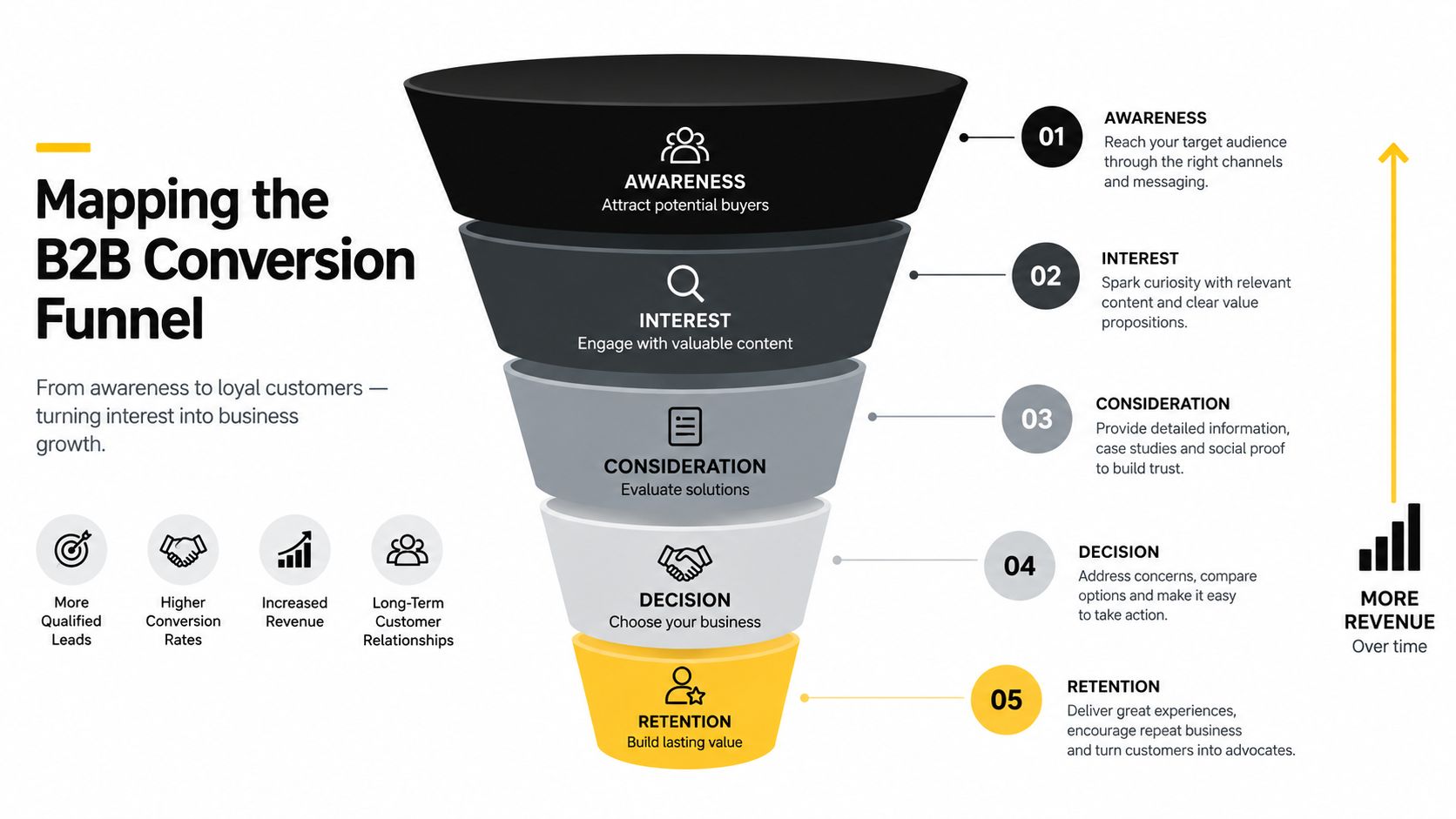
Use the stage rates introduced earlier as directional inputs, not targets. Offer type, qualification rules, sales cycle, market, and traffic intent can change the performance of every handoff. A high-intent Reddit conversation may produce fewer visitors than a broad campaign, yet create a stronger downstream rate when replies, clicks, signups, and qualified conversations are tracked separately. A practical explanation of how lead generation works reinforces this staged view.
A worked funnel example
Take 10,000 website visitors as an illustrative starting pool. A 2% visitor-to-lead rate creates 200 leads. Applying the earlier progression produces 62 MQLs at 31%, then roughly 8 SQLs at 13%. Opportunity and close rates determine how many customers remain, so the example should expose leakage rather than promise an outcome.
That decline is not automatically a failure. If 200 contacts become 62 MQLs, the audience definition and acquisition message may be working. If only a few MQLs become SQLs, examine qualification, relevance, product fit, and sales follow-up before increasing traffic.
Track each handoff with an agreed definition:
| Funnel stage | What to count | What the stage proves |
|---|---|---|
| Visitor to lead | Form fills, inquiries, or signups | Initial response |
| Lead to MQL | Contacts meeting agreed marketing criteria | Fit and meaningful interest |
| MQL to SQL | Leads accepted for sales action | Sales relevance |
| SQL to opportunity | Defined commercial evaluation | Pipeline potential |
| Opportunity to customer | Closed accounts | Revenue outcome |
Marketing and sales should document the behavior, account fit, and problem context required at every handoff. Keep channel reporting equally specific. For example, compare booked meetings over activity with Fypion Marketing, then judge whether those meetings progress, rather than rewarding outreach volume alone. This makes the lead generation rate a decision tool instead of a vanity metric.
Evaluating Lead Quality by Source
Source quality changes the meaning of every lead generation rate. A referral often arrives with trust and context. A website visitor may have searched for a problem and evaluated several pages. A webinar registrant may be interested in the topic without having a current buying project.
An analysis of anonymized CRM data reported a 3.6% lead-to-deal rate for employee and customer referrals, while company websites produced a 31.3% lead-to-opportunity rate. Webinars produced a 17.8% lead-to-opportunity rate but only a 2.5% opportunity-to-deal rate (B2B lead generation source analysis). The contrast matters because opportunity creation and deal creation aren't interchangeable outcomes.
Compare the stage that matters
| Acquisition channel | Lead-to-opportunity rate | Opportunity-to-deal rate |
|---|---|---|
| Employee and customer referrals | Not specified in the cited analysis | 3.6% |
| Company website | 31.3% | Not specified in the cited analysis |
| Webinars | 17.8% | 2.5% |
The missing cells are important. You shouldn't fill them with assumptions or compare a source on one stage against another source on a different stage. Instead, use the available figures to build a measurement plan, then collect the equivalent downstream events in your own CRM.
Reddit adds context that many conventional channel reports miss. Users often describe a problem in public, compare alternatives, and ask for recommendations in the same discussion. That doesn't make every Reddit visitor qualified, but a response to an explicit need can carry a stronger intent signal than a generic impression or an ungated content download.
Why context beats volume
A broad campaign may generate many clicks from people gathering information. A smaller set of replies in relevant discussions may create fewer clicks but more informed conversations. The comparison only becomes fair when both channels use the same definitions for signup, activation, qualified lead, opportunity, and customer.
For Reddit, record the subreddit, thread topic, original problem, response type, click, signup, and later qualification. Don't judge a reply by clicks alone. A high click count paired with weak activation suggests curiosity or message mismatch. A modest click count paired with strong sales acceptance suggests the channel is finding the right people.
The Hidden Impact of Response Latency
A qualified prospect can become unreachable because the business responds after the buying moment has passed. This is particularly visible in discussion channels, where a question has a live context, competing replies appear quickly, and the author may move on before a delayed response arrives.
Research summarized from Harvard Business Review found that contacting an online lead within five minutes makes qualification roughly 21 times more likely than waiting 30 minutes. Contact within one hour is associated with nearly seven times higher odds of reaching a decision-maker than waiting an additional hour, while delays of 24 hours or more sharply reduce qualification probability (lead response time research summary).
These figures concern inbound leads rather than Reddit specifically, so treat them as a response-speed benchmark, not a promise of Reddit performance. The operational lesson still applies: detection and handoff speed belong in the funnel.
Measure time as an attribution field
Most reports store source and conversion but omit the interval between intent and response. Add timestamps for:
- High-intent thread detection.
- Draft or reply publication.
- Click or profile visit.
- Signup or inquiry.
- First follow-up.
- Qualification decision.
Then segment outcomes into under 5 minutes, 5 to 30 minutes, 30 to 60 minutes, and over 24 hours, using the same definitions for every cohort. This helps separate a targeting problem from an execution problem. If fast responses convert while late responses do not, more audience research won't fix the bottleneck.
The fastest useful response usually beats the most polished late response.
Speed doesn't excuse irrelevant outreach. A rushed promotional reply can damage trust, trigger moderation, or attract low-intent clicks. The correct target is a fast response that addresses the stated problem, discloses its relevance, and gives the reader a low-friction next step.
Tools such as live chat software can support immediate acknowledgement and routing for inbound interest, but community workflows need their own controls. Set alerts for explicit buying language, route high-signal events to the right person, and keep a human review step where the discussion requires nuance.
For Bazzly-style Reddit acquisition, detection latency and publication latency should be separate metrics. Finding a relevant thread quickly isn't enough if the reply arrives after the conversation has moved on. Track both, then compare them with qualified conversations and opportunities rather than treating speed as an isolated productivity score.
Building an Intent-Driven Tracking Model
A reliable dashboard begins with a shared event vocabulary. Without one, “lead” can mean a discovered username to one person, a signup to another, and a sales-accepted opportunity to someone else.
1. Define the intent signals
Start with behaviors that indicate a real problem. On Reddit, examples include a direct request for recommendations, a comparison of vendors, a question about implementation, or a complaint that reveals an unmet need. Label the signal instead of storing only the subreddit name.
2. Tag the source and context
Capture the subreddit, thread URL, topic, date, reply author, and campaign identifier. UTM parameters can connect a reply to website behavior, but they won't explain why the user clicked. Store the original problem statement or a concise category so later analysis can compare intent types.
3. Instrument the event sequence
Use one consistent path:
- Thread exposure: A relevant discussion is identified.
- Contextual response: A reply is drafted or published.
- Click: The reader visits a tracked destination.
- Signup or inquiry: The reader submits contact details or starts an account.
- Activation: The user reaches the product event your team defines as meaningful.
- Qualified conversation: A person or rule confirms fit and intent.
- Opportunity and customer: Sales accepts the commercial path and records the outcome.
4. Separate cohorts
Don't blend self-serve signups with booked meetings. They require different activation events, follow-up paths, and time horizons. Create cohorts by subreddit, problem type, response speed, reply format, and first-touch date.
A simplified model using 10,000 relevant exposures and midpoint benchmark ranges produces about 230 visitors, 71 MQLs, 9 SQLs, 4 opportunities, and roughly 1 customer (MQL benchmark model). It's directional, not a forecast. Reddit may perform differently because active problem discussions can carry higher intent, while broad community exposure can remain low intent.
5. Connect rates to pipeline value
Review each transition separately. If exposure-to-click is weak, improve topic selection or relevance. If click-to-signup is weak, align the landing experience with the exact problem in the thread. If signup-to-qualification is weak, tighten targeting or adjust the qualification definition.
The dashboard should answer one business question: which intent signals produce accepted opportunities and revenue? Raw activity belongs in a diagnostic view. Pipeline value belongs in the executive view.
Optimizing Your Pipeline for Revenue
Optimization starts by identifying the type of problem. A volume problem means too few relevant people enter the funnel. A quality problem means the funnel attracts people who don't fit or lack a current need. A process problem means qualified prospects arrive but stall during response, activation, or handoff.
Don't fix all three with more traffic. First compare rates by stage and source, then choose the intervention that matches the leak.
Improve the weak transition
If the MQL-to-SQL rate is weak, sharpen the problem-context match. Rewrite replies and landing pages around the language buyers use, show the relevant use case early, and add qualification signals that reveal urgency, fit, or intended workflow. If click-to-signup is weak, remove the mismatch between what the discussion promised and what the destination page offers.
If SQL-to-opportunity is weak, sales may be receiving contacts before a real buying process exists. Create a clear acceptance rule and return poor-fit leads to an appropriate nurture path instead of forcing every contact into a sales forecast.
Make the operating checklist explicit
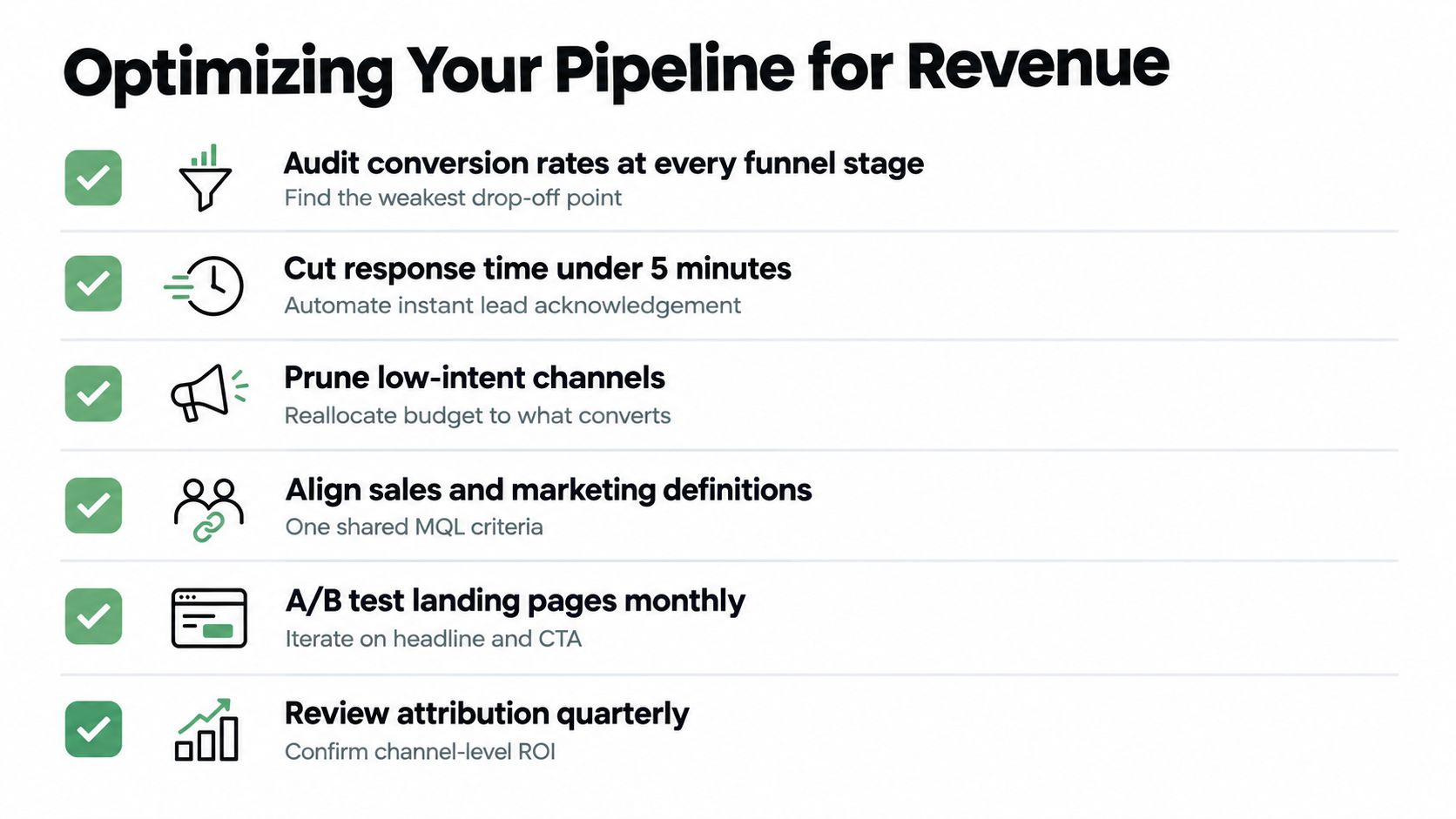
- Audit every transition: Find the stage with the largest meaningful loss, not the lowest percentage.
- Reduce avoidable delay: Route high-intent events to an owner and timestamp the first response.
- Prune weak sources: Reallocate attention when a channel creates activity without qualified pipeline.
- Align definitions: Make marketing and sales use the same MQL, SQL, and opportunity criteria.
- Test the message match: Compare problem-led copy with generic product-led copy.
- Review cohorts: Analyze subreddits, topics, response times, and conversion paths separately.
- Nurture unfinished demand: Keep relevant prospects engaged when they aren't ready for a sales conversation.
- Connect revenue: Judge channels by accepted opportunities and customers, not clicks alone.
Available 2025 reporting indicates that 58% of B2B marketers consider generating high-quality leads their biggest challenge, while companies with strong nurturing generate 50% more sales-ready leads at 33% lower cost (B2B lead generation trends). The figures reinforce a practical point: acquisition and follow-up are one system. More leads won't solve a pipeline that can't qualify or nurture them.
For teams evaluating automation, a guide to AI outreach for search firms offers a useful way to think about signal detection, personalization, and routing without confusing automation with indiscriminate volume. The same discipline applies to community marketing. Automation should surface relevant conversations and support timely, context-aware action, while people retain control over judgment and tone.
Your lead generation cost per lead becomes meaningful only after you connect it to activation, qualification, opportunity creation, and revenue. A cheap lead that never progresses is expensive in sales time. A lower-volume source that produces relevant conversations may deserve more investment even when its top-of-funnel rate looks less impressive.
The strongest lead generation rate is therefore not the highest percentage on a landing-page report. It's the rate that moves the right people through the next stage quickly, consistently, and profitably.
Bazzly monitors Reddit conversations, identifies high-intent threads, and helps founders and small teams draft or publish context-aware replies while the discussion is active. If you want to measure Reddit acquisition by clicks, signups, qualified conversations, and downstream pipeline instead of raw activity, visit Bazzly and set up your intent-driven workflow.


