10 Lead Generation Examples and How to Replicate Them
A founder can have a working product, a small marketing budget, and a clear idea of who should buy it, yet still face an empty pipeline this quarter. The difficult question usually isn't whether lead generation works. It's which channel can reach buyers while they're already describing the problem, comparing solutions, or asking someone they trust for a recommendation.
The strongest lead generation examples share that timing advantage. They meet prospects at a moment of active intent, then give them a useful next step instead of forcing a generic pitch. The ten examples below follow a practical sequence, from capturing demand in communities and search to building trust through content, reviews, outreach, and referrals. Reddit appears throughout because one customer-language insight can inform monitoring, content topics, comparison pages, and review positioning, rather than living inside one isolated campaign.
Table of Contents
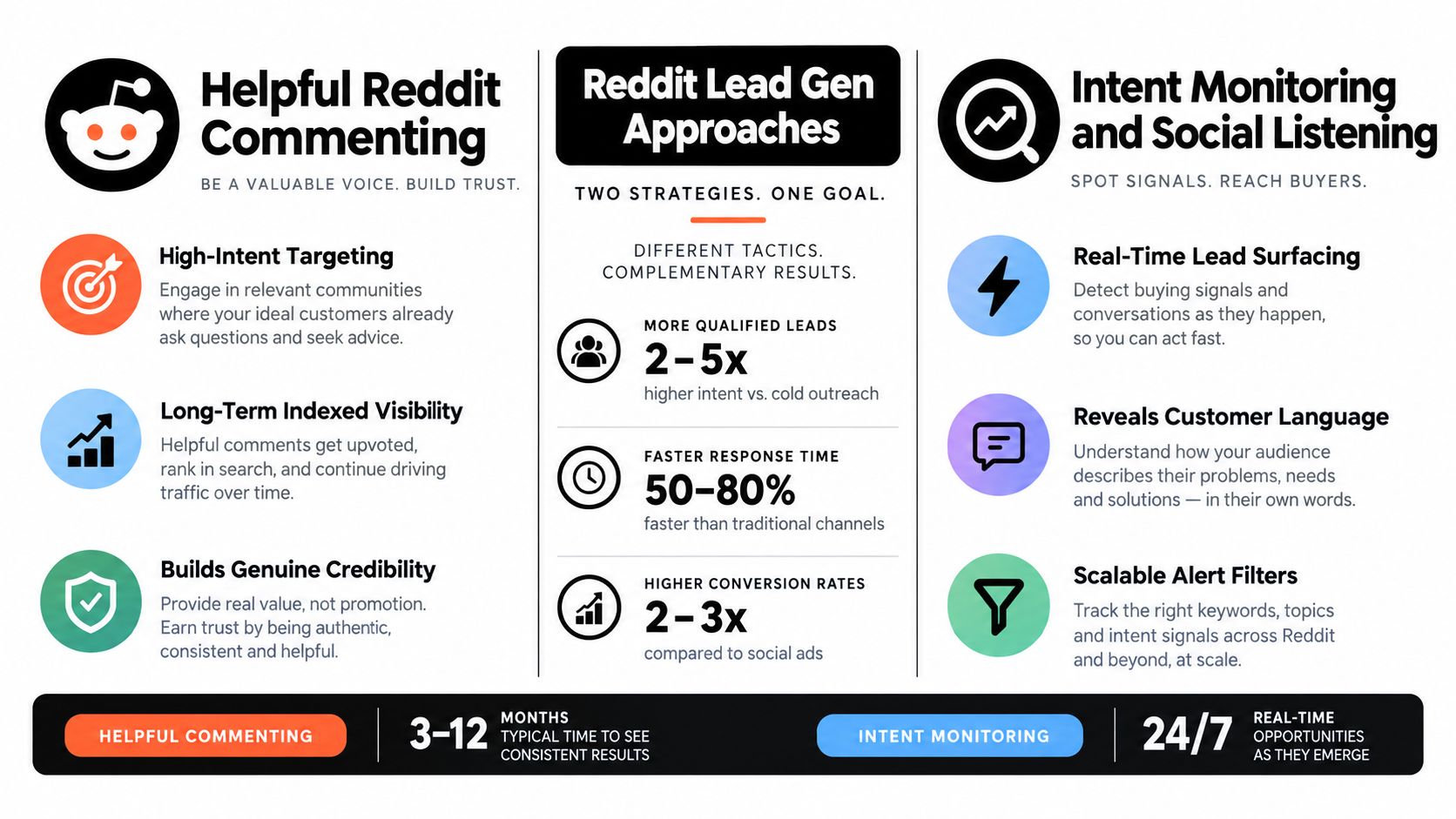
- 1. Helpful Reddit Commenting on High-Intent Threads
- 2. Intent Monitoring and Social Listening on Reddit
- 3. Builder-in-Public Launch Posts on Reddit
- 4. Show HN Launches on Hacker News
- 5. Alternative and Comparison Pages for SEO Lead Capture
- 6. Free Tools and Lead Magnets
- 7. Founder-Led Content on LinkedIn and X
- 8. Personalized Cold Outreach
- 9. Product Hunt Launches and Review Platforms
- 10. Referral and Affiliate Programs
- 10 Lead Generation Examples Comparison
- Turning These Examples Into Your Lead System
1. Helpful Reddit Commenting on High-Intent Threads
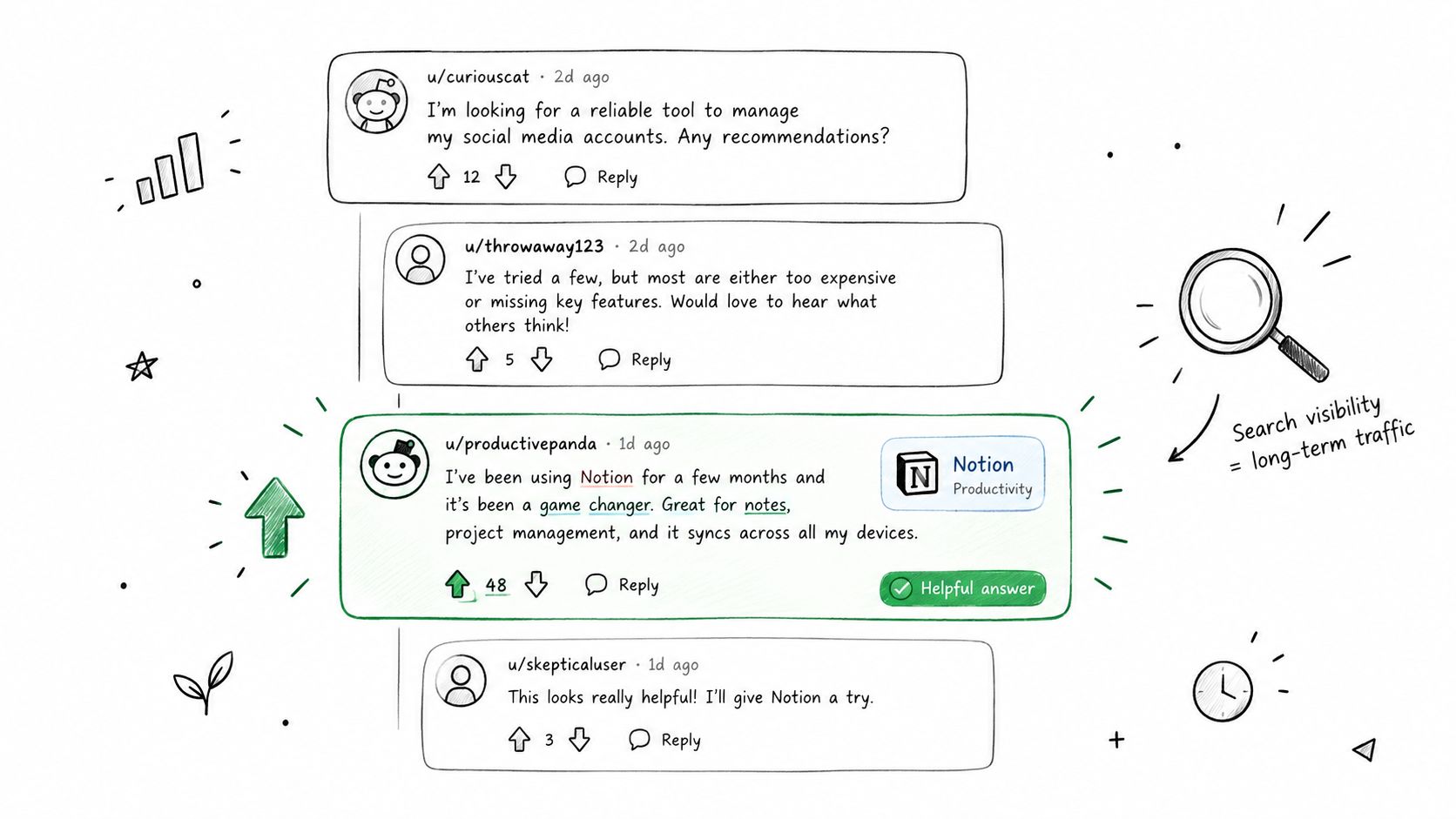
A Reddit thread can contain a buying signal in plain language. Someone asks how to handle recurring billing, compares deployment tools, or requests recommendations from people who have already solved the problem. A founder who answers that question completely can earn attention without opening with a sales pitch.
The mechanism is contextual intent capture. The reader has already named the problem, so the reply should explain trade-offs, point out common mistakes, and mention the product only when it fits. A disclosed recommendation is more credible than a forced link. Reddit discussions may also continue attracting discovery through search and AI-assisted research, which makes the quality of the original answer more important than its launch-day reach.
Practical rule: Write the answer you would have wanted before buying the product. Add the product only where it helps the reader make a better decision.
The main failure mode is treating a community as a list of advertising slots. Promotional replies can trigger downvotes, moderator action, distrust, or low-quality visits. A better approach is to study the subreddit rules, use the community's vocabulary, and track which threads produce meaningful conversations rather than counting every impression.
Replication checklist:
- Find active questions: Search for recommendations, comparisons, and detailed problem descriptions.
- Answer before pitching: Explain the relevant trade-offs in the comment itself.
- Disclose the connection: Make your affiliation clear when recommending your own product.
- Record outcomes: Log the thread, message, clicks, signups, and qualified conversations.
- Prioritize early engagement: Reply while the discussion is still developing, but don't manufacture activity.
For founders who want to systematize this work, Reddit launch strategy tips provide useful context on preparing community-led promotion.
2. Intent Monitoring and Social Listening on Reddit
Helpful commenting works better when the team knows where demand is appearing. Intent monitoring turns Reddit into a recurring research and acquisition workflow by watching for phrases such as “alternative to Trello,” “best tool for remote teams,” or complaints about a competitor's pricing.
The underlying mechanism is signal detection. Internal product language often differs from customer language, so the first keyword list should come from support tickets, sales calls, reviews, and real Reddit conversations. A project-management startup might discover that buyers rarely search for its category label. They may instead describe missed handoffs, scattered updates, or difficulty replacing a familiar tool.
A monitoring system should separate urgency from general discussion. Recommendation requests and explicit comparisons usually deserve faster review than broad educational questions. Negative keywords can remove unrelated threads, while a simple intent score can help a small team decide which conversations deserve a thoughtful response.
The best listening program doesn't maximize alerts. It reduces the time between a buyer expressing a problem and a useful human response.
The risk is automation without judgment. A keyword match isn't proof that the product fits, and replying to every mention can make the brand look opportunistic. Keep a record of the terms that lead to qualified conversations, refine the list regularly, and retire keywords that generate noise.
A practical workflow looks like this:
- Collect customer phrasing: Build terms from actual conversations, not only from product positioning.
- Filter aggressively: Add negative keywords and exclude promotional or irrelevant threads.
- Rank buying intent: Prioritize recommendations, comparisons, switching frustration, and requests for help.
- Review on a schedule: High-intent posts lose value when the team notices them too late.
- Feed the insights back: Use recurring phrases in landing pages, content, outreach, and onboarding.
The same research can support both manual replies and tools that surface promising conversations. The important asset is not the alert itself. It's the accumulated understanding of how buyers describe their problem.
3. Builder-in-Public Launch Posts on Reddit
A launch post performs differently when it tells a specific story instead of announcing that a product exists. A solo founder might share what they learned from building a feature, explain a failed experiment, or publish a progress update while asking the community for focused feedback. The product link becomes part of the story, not the whole story.
This format captures curiosity and peer-level trust. Readers in communities such as r/SideProject, r/startups, and r/SaaS often want to understand how a product was built and what the founder learned. A candid postmortem can attract early users because it gives prospects a reason to care before they evaluate the product itself.
The strongest posts have a clear tension. Perhaps a feature seemed valuable but produced confusing onboarding, or a founder chose a narrow customer segment rather than building for everyone. The useful detail creates conversation. The product earns attention by being attached to a lesson.
A builder-in-public post should give readers something worth discussing even if they never click the product link.
Avoid vague launch announcements, exaggerated claims, and updates that ask for support without offering substance. Community rules may require specific flair or post formats, so read them before publishing. After the post goes live, the founder needs to answer comments and direct messages while the discussion is active.
A repeatable launch format:
- Open with a concrete event: Share a product decision, failed feature, customer insight, or meaningful milestone.
- Explain the lesson: Tell readers what changed in your thinking.
- Ask one useful question: Invite feedback on a real decision rather than asking for general opinions.
- Link naturally: Send interested readers to the product or a relevant page.
- Publish follow-ups: Return with what changed after the community responded.
This approach often produces more than immediate signups. The replies reveal objections, vocabulary, and use cases that can strengthen later comparison pages, onboarding messages, and sales conversations.

4. Show HN Launches on Hacker News
A Show HN launch is a good fit for a working product with a technically literate audience. The post needs to explain what was built, why it exists, and what makes the approach different. A clear description gives readers enough context to test the product and ask informed questions.
The mechanism is concentrated technical attention. Developer tools, infrastructure products, and unusual technical projects can attract early adopters who care about implementation details. The discussion itself becomes a form of product research. Questions expose missing documentation, unclear positioning, and friction in the first-use experience.
Dropbox's early beta was discussed on Hacker News in 2008, and that attention is often cited as part of its early growth story. That example shouldn't be treated as a guarantee. A launch can create a burst of interest without producing durable adoption if the product is difficult to try or the team disappears from the comments.
Show HN rewards something people can inspect, use, and discuss. It isn't a substitute for product readiness.
Reduce signup friction where possible, provide a plain-language explanation, and be available to answer technical and practical questions. Don't ask for upvotes. The post should stand on its usefulness and the quality of the conversation.
Before publishing, confirm that:
- The product works: Visitors can reach a meaningful first experience without unnecessary barriers.
- The description is specific: Explain the problem, the approach, and the difference from alternatives.
- The comments have an owner: Someone can answer questions promptly and accurately.
- The landing page matches: The page should continue the same explanation rather than switching to broad marketing language.
- The learning loop is ready: Capture recurring questions and use them to improve the product and documentation.
A successful launch is not just a traffic event. It's a concentrated opportunity to hear how technically capable prospects evaluate the product when they aren't guided through a sales call.
5. Alternative and Comparison Pages for SEO Lead Capture
Comparison pages reach buyers who have moved beyond general education. A search for a competitor alternative or a direct product comparison usually means the visitor has a problem, a shortlist, or both. The page can convert that existing intent by making the decision easier.
The mechanism is decision-stage search capture. A strong page explains who each option suits, where the products differ, and which limitations matter in practice. It doesn't need to pretend that the competitor is bad. In fact, fair treatment often improves credibility because readers can see that the comparison reflects a real buying decision.
Reddit is useful here because community discussions reveal the words buyers use. If users repeatedly complain about setup complexity, missing integrations, or confusing billing, those phrases can shape the page's headings and examples. A comparison page that mirrors customer language usually feels more relevant than one built from internal feature categories.
The main failure mode is publishing thin pages with inflated claims. Competitor pricing and features change, so stale information can turn a high-intent visit into a trust failure. Each page also needs a clear next step, such as a relevant demo, trial, or product walkthrough.
For a focused comparison destination, teams can use Bazzly's comparison pages as a relevant example of how product differences can be organized around buyer evaluation.
Replication checklist:
- Choose a real decision: Target alternatives and comparisons that buyers already search for.
- Use customer wording: Pull topics from Reddit threads, support conversations, and sales objections.
- State the best fit: Explain which buyer should choose each option.
- Keep claims verifiable: Update features, integrations, and pricing whenever they change.
- Connect the CTA: Match the call to action to the visitor's stage and question.
The page should help someone decide, not merely create another opportunity to repeat a product pitch.
6. Free Tools and Lead Magnets
A useful free tool gives a prospect an immediate reason to engage. A website grader, calculator, template, or checker works because it turns a broad promise into a specific result. The visitor arrives with a problem, uses the tool, and receives an experience that demonstrates the company's expertise.
This is value-for-information exchange, but the value has to arrive before the form feels justified. A website grader can show an initial finding and ask for contact information before delivering the complete report. An SEO company can offer a limited backlink check, then use the result to introduce deeper research features.
HubSpot's Website Grader and Ahrefs' free backlink checker are widely cited examples of products built around this mechanism. Their strategic lesson is more useful than the brand names themselves: the tool should solve one narrow problem that naturally connects to the paid product.
A lead magnet should be useful enough to finish, and specific enough to reveal why the next step matters.
Overly broad tools create weak leads. A generic ebook may collect addresses without identifying whether the person has a problem your product solves. A tool that produces a clear diagnosis or recommendation gives the follow-up more relevance.
Build the experience around these decisions:
- Pick one urgent task: Focus on a problem your ideal customer already recognizes.
- Show useful output quickly: Don't hide all value behind an unnecessarily long form.
- Connect the result to action: Recommend a relevant next step based on what the user found.
- Write a short follow-up sequence: Help the user apply the result before presenting a sales request.
- Measure downstream quality: Track trials, qualified conversations, and customers, not only submissions.
A free tool can also become a helpful response in a Reddit thread, but only when it answers the question directly. Dropping a lead magnet into every discussion turns a useful asset into promotion.
7. Founder-Led Content on LinkedIn and X
Founder-led content creates demand before a prospect visits a pricing page. A founder shares lessons from customer conversations, explains a difficult product decision, or turns a recurring Reddit question into a concise post. Over time, readers learn how the founder thinks, which reduces the distance between first impression and sales conversation.
The mechanism is borrowed trust through consistent expertise. Justin Welsh is frequently cited as an example of building an audience around solo-founder lessons, while many SaaS founders use build updates on X to attract beta users and customer conversations. The durable asset isn't a single viral post. It's a recognizable point of view connected to a real customer problem.
The content should have boundaries. Posting every product update can make the feed feel like a changelog, while generic advice gives prospects no reason to remember the author. Choose recurring themes tied to the audience's work, then support them with specific observations.
A practical content system includes:
- Two or three durable themes: For example, acquisition experiments, onboarding lessons, and customer research.
- One source of raw material: Use support tickets, sales calls, or Reddit discussions to find real questions.
- A useful profile path: Put the main resource or product page in the profile rather than adding a link to every post.
- Direct engagement: Answer thoughtful comments and messages instead of treating publishing as the entire strategy.
- A sustainable cadence: Batch ideas and drafts so consistency doesn't depend on daily inspiration.
The trade-off is patience. Founder content may create conversations before it creates attributable leads, so track replies, profile visits, resource engagement, qualified conversations, and self-reported discovery alongside direct signups.
8. Personalized Cold Outreach
Cold outreach works when the recipient can immediately see why the message was sent to them. A prospect who has publicly described a problem, announced a relevant company change, or asked a product question has provided a useful signal. The outreach should reference that signal and offer one clear next step.
This is trigger-based relevance. A SaaS founder might contact someone after seeing a question about the exact workflow the product supports. A growth team might reference a company's recent expansion when introducing a tool that helps with the resulting operational problem. Personalization isn't adding a first name. It's proving that the sender understands the context.
The biggest failure mode is confusing research with permission. Public activity doesn't automatically justify unsolicited messages on every platform, and Reddit communities may restrict direct outreach. Respect platform rules, privacy expectations, and the recipient's right to ignore the message.
The best cold message feels like a relevant continuation of something the prospect already said, not a campaign copied onto their profile.
Keep the message short, specific, and easy to decline. Test openers in small batches before increasing volume, and protect email deliverability by warming sending domains and controlling daily volume. The team should also distinguish replies from qualified opportunities. A response alone isn't proof of buying intent.
For teams combining public signals with assisted drafting, AI outreach automation offers relevant context for designing a more controlled workflow.
A message-quality test:
- Specific trigger: Can the recipient identify the event or problem you noticed?
- Relevant value: Does the product address that exact situation?
- One CTA: Is there a single, low-friction next step?
- Respectful timing: Would the message still feel appropriate if the recipient says no?
- Clear measurement: Can you connect replies to qualified conversations and revenue?
Founder-led outreach also connects with turning LinkedIn activity into pipeline, especially when content and direct conversations share the same customer language.
9. Product Hunt Launches and Review Platforms
Product Hunt and software review platforms serve different moments. Product Hunt can create launch visibility and early-adopter discussion, while G2 and Capterra help buyers validate a shortlist after they know what category or product they need.
The mechanism is social proof at different stages of evaluation. A Product Hunt launch benefits from prepared assets, a clear product explanation, and a community plan. Review profiles support later comparison by showing how customers describe the experience, what they value, and where the product may not fit.
Many SaaS companies use Product Hunt to reach early adopters and use review profiles in sales materials and landing pages. The trade-off is that neither channel can manufacture product satisfaction. A launch may attract attention, but poor onboarding can turn that attention into negative feedback. Review platforms can build confidence, but only when the review process follows platform rules.
Execution differs by channel:
- Prepare the launch: Create the product page, images, explanation, and comment-response plan before launch day.
- Ask for honest reviews: Invite customers after a successful outcome, without pressuring them toward a specific rating.
- Follow platform policies: Don't use prohibited incentives or manipulate voting and review activity.
- Respond publicly: Thank reviewers and address criticism with concrete product or support information.
- Reuse carefully: Link profiles from relevant pages, but don't present reviews as a substitute for evidence.
A good review program also improves messaging. The phrases customers use in reviews can inform comparison pages, founder posts, onboarding emails, and future community replies.
10. Referral and Affiliate Programs
Referrals turn customer satisfaction into a distribution channel. A user recommends the product to a colleague, friend, or community member, while an affiliate or creator introduces it to an audience that already trusts them. The prospect arrives with context that a cold visitor doesn't have.
The mechanism is transferred trust with a clear incentive. Dropbox's referral program, launched in 2008, gave users extra storage for referrals and is widely cited as a growth driver. The lesson is not to copy the reward mechanically. It's to choose an incentive that matters to the existing user and the new customer, then make sharing simple.
Referral programs fail when the reward is unclear, the product hasn't delivered value, or the process creates awkward promotion. Fraud controls and transparent terms matter from the start. Affiliates also need accurate messaging, because exaggerated claims can create refunds and damage trust long after the initial signup.
Ask for a referral after the customer has experienced a clear win, not immediately after account creation.
Build the program around customer behavior:
- Choose a useful reward: Consider account credit, extra usage, extended access, or revenue share.
- Make sharing easy: Provide one-click links and a message the customer can edit.
- Set clear boundaries: Explain eligibility, attribution, payout timing, and fraud protections.
- Use milestone prompts: Invite referrals after activation, successful outcomes, or positive feedback.
- Measure quality: Compare referred activation, retention, qualified opportunities, and revenue with other sources.
Community-focused creators and trusted Reddit participants can be strong partners when their recommendations are genuine. The program should reward relevance, not indiscriminate posting. For a deeper framework, see customer referral programs and the practical guide to a program to earn by referring.
10 Lead Generation Examples Comparison
| Strategy | Implementation (🔄) | Resources & Speed (⚡) | Expected outcomes (⭐ 📊) | Ideal use cases (💡) | Key advantages (⭐) | Main drawbacks |
|---|---|---|---|---|---|---|
| Helpful Reddit Commenting on High-Intent Threads | 🔄 Moderate, requires contextual replies and community knowledge | ⚡ Low monetary cost, high time investment for manual posts; automation can reduce effort | ⭐ Targeted, compounding organic traffic and signups; 📊 long-term visibility via search/AI citations | 💡 Early-stage SaaS / solo founders with clear problem-solution fit | ⭐ Builds credibility, low cost, evergreen reach | Risk of removal/bans, time-consuming, ROI variable |
| Intent Monitoring & Social Listening on Reddit | 🔄 Moderate, set up alerts and scoring rules | ⚡ Low to medium cost; needs ongoing monitoring or tooling for scale | ⭐ Steady pipeline of high-intent threads; 📊 repeatable lead feed when tuned | 💡 Growth teams wanting repeatable discovery and messaging insights | ⭐ Surfaces intent, reveals customer language, prioritizes leads | Can overwhelm teams, some threads found too late, API/tool volatility |
| Builder-in-Public Launch Posts on Reddit | 🔄 Low to moderate, craft honest posts and follow-up updates | ⚡ Low cost; requires recurring time for posts and replies | ⭐ Awareness, early adopters, qualitative feedback; 📊 social shares and community traction | 💡 Indie hackers and solo founders in beta/early launch | ⭐ Engaged feedback loop, shareable narrative, builds audience | Often reaches other founders (not buyers), needs cadence, can be downvoted |
| Show HN Launches on Hacker News | 🔄 Low, prepare clear Show HN post and be available for comments | ⚡ Low cost but requires readiness to support traffic spikes | ⭐ Big, short-lived traffic and technical signups; 📊 strong backlinks and technical feedback | 💡 Developer tools and technical SaaS seeking early adopters | ⭐ High visibility and detailed community feedback | Harsh criticism, short-lived attention, can overwhelm small teams |
| Alternative & Comparison SEO Pages | 🔄 Medium to high, research, honest comparisons, structured content | ⚡ Moderate upfront effort; low ongoing cost if maintained; slow payoff | ⭐ High-intent organic traffic and conversions over months; 📊 compounding SEO value | 💡 SaaS with clear competitors or frequent comparison searches | ⭐ Captures buyers mid-funnel, addresses objections directly | Slow results, needs upkeep, risk of thin content penalties |
| Free Tools & Lead Magnets | 🔄 Medium to high, build useful, focused tool and gating flow | ⚡ Higher upfront dev cost and maintenance; can scale long-term | ⭐ Hands-on leads and email captures; 📊 strong conversion when tool is relevant | 💡 B2B SaaS and marketing tools with measurable problems | ⭐ Immediate value, shareable, can demonstrate product value | Build/maintenance cost, may attract non-ideal users, gating tradeoffs |
| Founder-Led Content on LinkedIn & X | 🔄 Low, consistent content creation and engagement | ⚡ Low monetary cost, high time/attention required for consistency | ⭐ Builds trust and warm inbound leads over time; 📊 profile visits and DMs | 💡 Solo founders and small teams targeting professional audiences | ⭐ Fast trust-building, flexible format, partnership opportunities | Hard to attribute revenue, dependent on founder's time and voice |
| Personalized Cold Outreach (Email/DMs) | 🔄 Moderate, research + tailored sequences required | ⚡ Moderate tooling and human time; scalable with templates | ⭐ Measurable meetings and pipeline; 📊 direct control over targeting | 💡 B2B teams with defined ICP and sales motion | ⭐ Direct access to decision-makers, testable and controllable | Low response rates without personalization, deliverability risks |
| Product Hunt Launches & Review Platforms (G2/Capterra) | 🔄 Moderate, prepare launch assets and review-generation plan | ⚡ Low cost for posting; ongoing effort to solicit reviews | ⭐ Short-term launch spikes (Product Hunt) and long-term trust signals (G2); 📊 improves evaluation-stage conversion | 💡 SaaS launching publicly or seeking buyer trust during evaluation | ⭐ Early visibility, social proof, indexed review content | PH attention fades quickly; review collection is ongoing work |
| Referral & Affiliate Programs | 🔄 Medium, design incentives, tracking, and fraud controls | ⚡ Requires budgeting for rewards/commissions and integration | ⭐ Lower CAC over time; 📊 scalable channel when user base is active | 💡 Products with satisfied users and viral potential | ⭐ High retention for referred users, self-reinforcing growth | Needs happy user base, potential fraud, time to ramp results |
Turning These Examples Into Your Lead System
The ten lead generation examples work best as connected parts of one system. Monitoring finds the language and situations that reveal intent. Helpful Reddit replies capture some of that demand directly, while builder-in-public posts and founder content turn the same customer insight into trust-building material.
Comparison pages and free tools then give interested prospects a place to continue. A person who discovers a product through a community discussion may later search for an alternative page, use a diagnostic tool, read a review, or reply to a targeted outreach message. If those assets use consistent language, the buyer doesn't need to restart the evaluation at every touchpoint.
The system also needs operational discipline. A landing page can generate leads without creating qualified opportunities if the offer attracts the wrong audience or the form captures too little context. Unbounce's Q4 2024 benchmark analyzed 41,000 landing pages, 464 million visitors, and 57 million conversions, with a 6.6% median conversion rate across industries, according to its cited benchmark summary on lead-generation statistics. The same summary reports different performance by traffic source, including 19.3% for email visitors, 12.0% for paid social, and 10.9% for paid search. The practical lesson is to evaluate the offer, source, and visitor intent together, not traffic volume alone.
Follow-up deserves equal attention. A Harvard Business Review audit of 2,241 U.S. companies found that 37% responded to an online lead within one hour, while 23% never responded, as reported in this lead-generation benchmark summary. The same source cites later analysis reporting that conversion rates can fall eightfold after the first five minutes. Whatever channel creates the inquiry, assign ownership and define the next action before launch.
Measurement should follow the full journey:
- Capture the source: Record the subreddit, thread, post, page, referral, or campaign.
- Define the qualification event: Decide what separates a curious visitor from a genuine prospect.
- Track lifecycle movement: Include signup, activation, sales acceptance, opportunity creation, and customer conversion.
- Separate direct and assisted influence: Use CRM fields, branded-search movement, referral mentions, and buyer interviews where last-click data misses the path.
- Review trust signals: Monitor downvotes, removals, complaints, poor-fit signups, and review feedback alongside clicks.
Integrated lifecycle work can change outcomes more than adding another channel. EclecticIQ reported a 300% increase in new leads and a 50% increase in lead-conversion rate after implementing a more integrated marketing-and-sales workflow, according to the EclecticIQ case study. That case also cites broader HubSpot customer benchmarks, including 129% more leads acquired, 36% more deals closed, and a 37% improvement in ticket-closure rates after one year. These are case-specific or benchmark figures, not promises for every team. They reinforce the need to synchronize records, definitions, routing, and follow-up.
Start with two channels for the next thirty days. Choose one intent channel, such as Reddit monitoring and helpful replies, and one conversion or trust channel, such as a comparison page, founder content, or outreach. Define one primary metric for each, schedule fixed reviews, and judge performance by qualified conversations and downstream opportunities rather than activity alone.
A documented systems-integration case reported website conversion improving from 0.2% to more than 2%, described as a 150%+ uplift, after lifecycle redesign, nurture workflows, a marketing-platform migration, and improved tracking, as described in this systems-integration case study. Treat that result as case-specific. The repeatable idea is to make lifecycle stages explicit, route high-intent visitors, and report both absolute conversion and lead quality.
Bazzly can fit the Reddit portion of this system by identifying relevant conversations, surfacing high-intent threads, drafting context-aware replies, and supporting personalized direct messages. Use it as part of a measured workflow, with human review, clear disclosure, and quality metrics that protect community trust.
Choose the two channels today, write down the qualification event, and assign the first review date before publishing anything. After thirty days, keep the channel that creates qualified movement, revise the one that creates attention without intent, and let the customer language you collected shape the next experiment.
Bazzly helps founders and small teams monitor Reddit conversations, identify high-intent threads, and create context-aware replies or personalized outreach. Visit Bazzly to connect Reddit activity with a more repeatable lead generation process.


