7 B2B SaaS Examples and the Lessons Behind Them
Successful B2B SaaS products don't win because they have more features. They win because they connect a sharp product wedge to a buyer, a monetization unit, and a repeatable distribution loop. The most useful B2B SaaS examples therefore aren't generic lists of CRM, HR, or collaboration companies. They're comparisons of different growth systems and their trade-offs.
This list examines seven mechanics: Reddit-led demand capture, bundled platforms, AI-assisted service delivery, sales-led prospecting, organic acquisition, workflow automation, and payments infrastructure. Bazzly offers the focused demand-capture example, while HubSpot, Intercom, Apollo.io, Ahrefs, Zapier, and Stripe show how products expand, price, distribute, and become embedded in daily operations. For readers building a SaaS product, the question isn't “Which company should I copy?” It's “Which mechanism can I test in a narrower market?”
Table of Contents
- 1. Bazzly
- 2. HubSpot
- 3. Intercom
- 4. Apollo.io
- 5. Ahrefs
- 6. Zapier
- 7. Stripe
- B2B SaaS, 7-Tool Feature Comparison
- Turn These SaaS Patterns Into Your Next Experiment
1. Bazzly
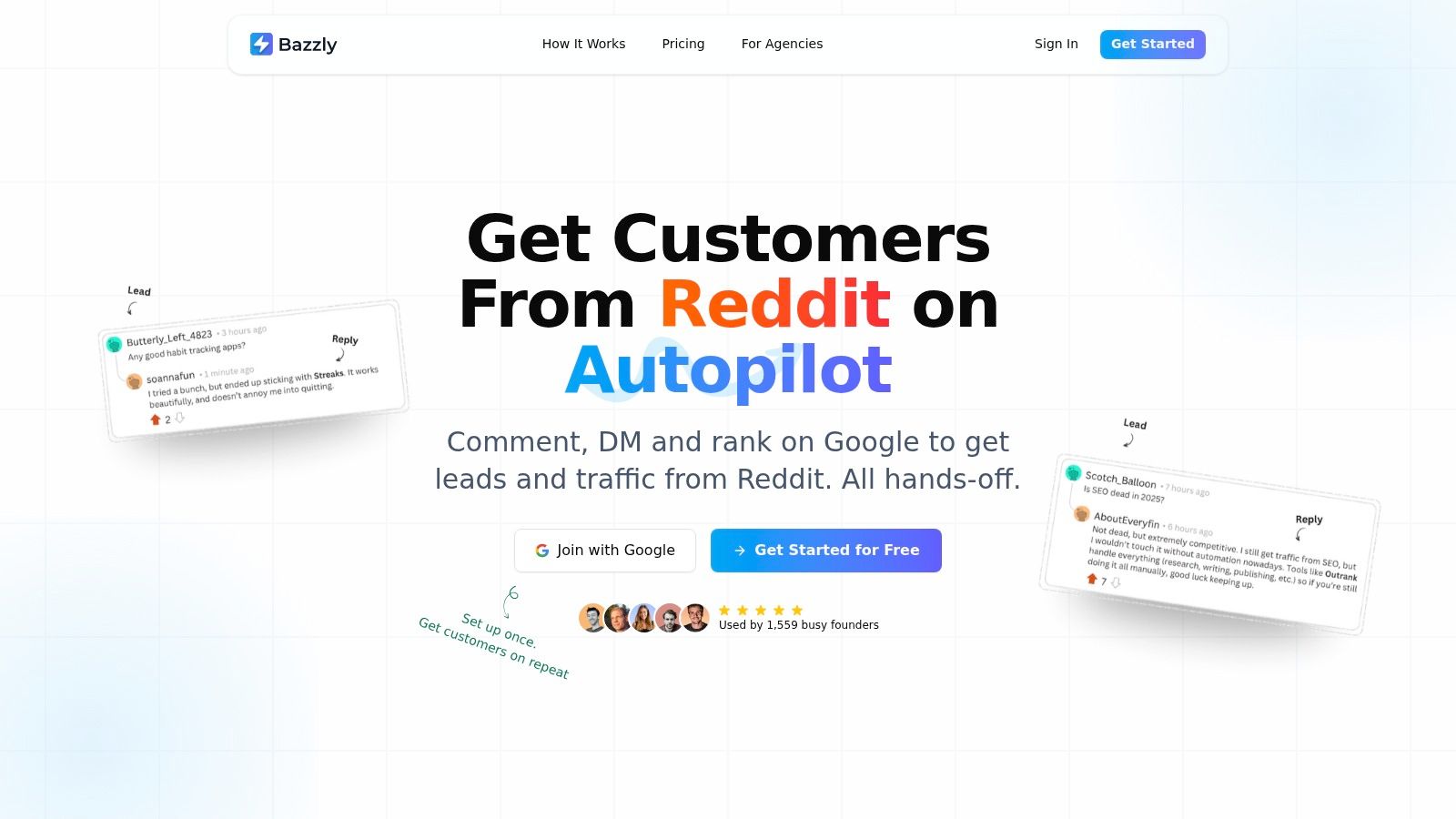
Bazzly targets a specific acquisition gap: founders and small B2B teams want qualified demand from Reddit without manually searching threads, writing replies, and monitoring conversations. Its product wedge is intent capture inside existing discussions, separating it from outbound databases and broad content suites.
The product scans relevant subreddits, identifies threads where a product may fit, drafts context-aware AI replies, and can publish through aged, warmed-up Reddit accounts. Users can keep control with a Chrome extension and post from their own account. The workflow also includes smart upvotes, prospect detection, and personalized direct messages.
Bazzly uses credit-based monetization. The Bazzly website lists an all-in-one plan at $199 per month with 170 credits, while other product materials reference a $99 monthly variant. Buyers should confirm the current price and credit costs before choosing a plan. The underlying model charges for actions and opportunities rather than seats alone, which aligns revenue with usage.
The growth mechanic
Bazzly combines automation with compounding distribution. A relevant Reddit reply can generate clicks immediately, while a useful discussion may later appear in Google results or AI assistant answers. The broader distribution thesis depends on creating durable, relevant contributions, not only publishing at scale. Automated posting and upvotes also carry moderation and community-trust risks.
Founders can test the mechanic with a narrow operating loop:
- Find expressed intent: Search conversations where buyers describe a problem, compare tools, or request recommendations.
- Add context before automation: Draft replies that answer the thread first, then mention the product only when it fits.
- Separate scale from control: Provide autopilot for repeatable work and a browser extension for users who prefer to publish personally.
- Price the action: Credits make usage visible, but the unit must remain clear enough for a small team to forecast.
Practical rule: Automate search and preparation before automating the voice. Relevance protects distribution better than volume.
Bazzly gives indie hackers a concrete model because its buyer, channel, and paid action are easy to define. The trade-off is platform dependence: Reddit controls access, moderation, and community norms. A practical experiment starts with one audience and one problem category, measures qualified conversations rather than raw posts, and adds human review before expanding across projects or communities.
2. HubSpot
HubSpot took the opposite route from a narrow channel product. Its wedge is consolidation. The platform brings marketing, sales, service, content management, and data into a Smart CRM organized around Hubs. For a small company, the appeal isn't that every module is best in isolation. It's that lead capture, email automation, chat, pipeline management, reporting, and website operations can share customer context.
The buyer is usually a team that has outgrown disconnected tools but doesn't want to manage a complex enterprise stack. HubSpot's distribution benefits from templates, educational content, a partner ecosystem, and self-serve entry points. Those assets reduce implementation friction and create a path from an initial CRM need into adjacent workflows.
The expansion mechanic
HubSpot monetizes through hub tiers, seats, contact levels, and credits. That structure supports expansion as customers add users, contacts, or capabilities, but it also creates a purchasing challenge. Advanced functionality often sits behind higher tiers, and buyers need to understand both the immediate use case and the longer-term cost of adopting multiple Hubs.
The replicable lesson isn't “build an all-in-one platform on day one.” It's to make adjacent workflows share the same core object. In HubSpot's case, that object is customer and company data. A narrower founder product might start with one operational record, such as a qualified lead, support issue, or invoice, then add workflows that use the same record without forcing customers to re-enter information.
- Start with one system of record: Make the first workflow valuable before adding modules.
- Expand along existing context: Add features that use the same customer, project, or transaction data.
- Use education as distribution: Templates and practical guidance can make a complex product easier to adopt.
- Expose expansion paths carefully: Customers should understand what the next module solves and why it belongs in the same system.
The platform opportunity appears after a workflow has earned trust, not before.
HubSpot demonstrates the strength of bundling, but also its cost. More modules create more value and more pricing complexity. Founders should treat platform expansion as a response to repeated adjacent demand, not as a substitute for a focused initial product.
3. Intercom
Intercom's product wedge is customer communication at the point of use. It combines live chat, email, help content, bots, workflow automation, and in-app messaging, then adds Fin AI for automated answers grounded in a company's support knowledge. That makes the platform relevant to both support leaders trying to reduce repetitive tickets and product teams trying to improve activation or expansion.
Its monetization model illustrates a shift from purely seat-based SaaS toward outcome-linked usage. Intercom uses different seat types for different roles and charges for AI outcomes, allowing a company to control the cost of some human access while paying more as automated service handles more customer interactions. This aligns the bill with a measurable service event, but it can make total spend harder to predict when conversation volume changes.
The service-delivery mechanic
Intercom's distribution is tied to a painful operational queue. A team can adopt the shared inbox, add a help center, introduce in-product messages, and then automate a portion of support. Each feature supports the same customer communication context, so expansion feels operational rather than arbitrary.
The useful playbook is to identify a task where labor and software cost move together:
- Define the outcome: Choose a resolved issue, qualified conversation, completed workflow, or another event the buyer already values.
- Keep human escalation visible: AI can handle routine questions, but customers need a clear path to a person.
- Use product context: In-app messaging and tours work because they appear close to the user's action.
- Model variable cost early: Outcome pricing can improve alignment, but only if customers can forecast usage.
For founders, the lesson is more specific than “add AI.” AI becomes commercially meaningful when it handles a bounded service outcome and the customer can judge whether that outcome was achieved. A support assistant that answers vaguely creates cost and trust problems. A workflow that resolves known questions, routes exceptions, and records the result has a clearer path to retention.
Teams designing that kind of system can also study personalization at scale, especially where message relevance determines whether automation feels helpful or intrusive.
4. Apollo.io
Apollo.io combines two products that are often bought separately: a B2B contact and company database, and sales engagement software. Users can search for prospects, apply filters and intent signals, enrich records, sync with a CRM, and execute outreach through sequences, email, SMS, or a dialer. Its wedge is shortening the distance between finding a prospect and contacting one.
That integration gives Apollo.io a practical distribution advantage among small go-to-market teams. A founder or sales operator doesn't need to assemble a data provider, sequencing tool, dialer, and enrichment workflow before testing outbound. The product's value appears in the handoff between research and execution.
The consolidation mechanic
Apollo.io uses seats alongside credits or usage controls. That lets the company monetize both access to the workspace and consumption of data or engagement actions. The trade-off is familiar in data products: buyers need to examine data quality in their niche and understand how usage can create overages.
The replicable tactic is workflow compression. A product becomes more valuable when it removes the blank spaces between tools, even if each individual capability is not unique.
- Join discovery to action: Let users move from a record to a campaign without exporting data.
- Make filters operational: Search criteria should produce a usable next step, not just a list.
- Expose data confidence: Buyers need to know where enrichment may be incomplete or outdated.
- Price the scarce resource: Credits can reflect records, enrichments, or sends, but the customer should understand the unit.
If customers repeatedly export from one product into another, the handoff is a product opportunity.
Apollo.io is especially relevant to indie hackers because it shows how an integrated workflow can beat a collection of technically capable point tools. The risk is that the product inherits the weaknesses of both categories. Weak data damages outreach, while strong data with poor execution still fails to create pipeline. A smaller competitor could focus on one vertical, one buyer role, or one high-value trigger instead of recreating a general database.
For a more focused automation angle, compare this model with AI outreach automation, where timing and message context matter as much as contact volume.
5. Ahrefs
Ahrefs is built around organic acquisition work. Its product wedge is the ability to investigate search demand, backlinks, competitors, technical issues, and ranking movement from connected workflows. Site Explorer, Keywords Explorer, Site Audit, and Rank Tracker serve different jobs, but they support one recurring objective: deciding what to create, improve, or monitor for search visibility.
The buyer is usually a founder, SEO specialist, agency, or content team that needs evidence before investing in a page or campaign. Ahrefs distributes through product-led education, free tools, a limited free plan for verified sites, and content that demonstrates how the product can solve a specific research problem. That approach turns expertise into acquisition while giving prospective users a reason to experience the workflow before committing to a premium plan.
The organic-acquisition mechanic
Ahrefs shows how a SaaS company can make its own operating method part of its marketing. A useful article or tool can attract a person with a real problem, then connect that problem to a product action. The content isn't separate from the product. It teaches the same research process the product supports.
Founders can adapt the mechanism without building a full SEO suite:
- Target a decision, not a topic: Build content around what the buyer must choose, fix, or prioritize.
- Offer a product-assisted next step: Let readers inspect a domain, calculate an issue, or generate a useful starting point.
- Create free entry points selectively: A limited tool can demonstrate value without giving away the entire workflow.
- Connect content to recurring work: Retention improves when the initial insight leads to monitoring, reporting, or repeated optimization.
Premium data depth creates a learning curve and can make Ahrefs feel more suited to serious SEO programs than casual users. That isn't a flaw in the model. It shows the importance of matching product depth to buyer sophistication.
Founders evaluating organic acquisition should first decide whether their product can produce useful evidence. If it can, content and free tools may become distribution. If it can't, publishing broad educational articles alone may attract attention without creating a product habit. A practical starting point is to assess whether SEO is worth it for the specific buying journey rather than treating search traffic as an automatic growth channel.
6. Zapier
Zapier's wedge is simple to explain: connect applications and automate repetitive work without requiring a software team. Its app ecosystem and Zaps let users define triggers and actions across tools, while AI steps, code steps, Tables, Interfaces, and SDK capabilities extend the product from basic automation into lightweight internal systems.
The target buyer isn't only an automation specialist. It includes small teams that need a workflow now, before they can justify custom development. That positioning gives Zapier a broad self-serve distribution model. Documentation, templates, app integrations, and searchable use cases help users discover the product through the task they need to complete rather than through a technical category.
The workflow-automation mechanic
Zapier monetizes around tasks, including automation steps and newer AI or code actions. This is a useful example of pricing around work performed, not people logged in. It also creates a predictable strategic question for customers: how much automation do we run, and what does each completed task cost?
The strongest lesson is the product's role as a bridge between experimentation and infrastructure. A team can prototype a lead-routing workflow, internal request form, or notification system before building a permanent application. But complex Zaps can become difficult to debug, and heavy usage may make alternatives attractive.
- Start with a visible trigger: The customer should know exactly what event begins the workflow.
- Show the complete path: A trigger without a reliable action doesn't solve the operational problem.
- Design for failure: Logs, retries, alerts, and clear ownership matter once automation touches revenue or customer data.
- Turn prototypes into learning: Measure which workflows recur before investing in deeper product development.
Zapier's replicable mechanic is not its enormous integration catalog. It's the decision to make the first automation useful before asking the customer to rebuild their stack. A niche founder could apply that approach to one industry's repetitive handoffs, using a small set of integrations and stronger domain-specific defaults.
7. Stripe
Stripe is infrastructure SaaS for money movement. Its product family covers payment acceptance, subscriptions, invoicing, tax, fraud prevention, and revenue operations through APIs, SDKs, and hosted interfaces such as Checkout. The wedge is implementation speed and modularity. A startup can begin with payment collection, then add billing, tax, fraud controls, or usage-based pricing as its business model becomes more complex.
The primary buyer is a software company or online business that needs reliable payment infrastructure without building every component internally. Stripe distributes through developer documentation, prebuilt interfaces, SDKs, integrations, and self-serve onboarding. Developers can test an implementation, while finance and operations teams gain access to products that address recurring billing and revenue management.
The infrastructure mechanic
Stripe supports payments across 195 or more countries, 135 or more currencies, and 100 or more payment methods, according to its product materials. Those figures are quantitative product claims and should be confirmed against current Stripe documentation before implementation, because availability can vary by product and geography.
Its monetization is modular. Core payment processing can lead to Billing, Tax, Radar, invoicing, or other add-ons. That creates a strong expansion path, but fees vary by product and location, and marketplace or merchant-of-record configurations can require more planning.
Stripe offers several lessons for SaaS founders:
- Make the first integration fast: Hosted components and clear documentation reduce activation friction.
- Support the business model, not only the transaction: Subscription and usage-based billing become strategic as the product matures.
- Separate infrastructure from policy: Let customers configure tax, fraud, invoicing, and revenue rules without rebuilding payment flows.
- Earn the right to expand: Add-ons work when they solve the next operational constraint created by adoption.
Infrastructure products face high trust requirements. Downtime, compliance issues, or unclear money movement can outweigh feature breadth. Stripe succeeds as a B2B SaaS example because the initial wedge, payment collection, naturally leads into adjacent financial workflows without abandoning the same underlying transaction context.
B2B SaaS, 7-Tool Feature Comparison
| Product | Implementation Complexity 🔄 | Resource Requirements ⚡ | Expected Outcomes 📊 ⭐ | Ideal Use Cases 💡 | Key Advantages ⭐ |
|---|---|---|---|---|---|
| Bazzly | Low, 2‑minute setup; optional Chrome extension | Credit-based plan; warmed‑up accounts; minimal operator time | 📊 Predictable Reddit signups & lead flow; compounding organic reach (⭐⭐) | Busy founders, indie hackers, small B2B teams needing Reddit growth | Automates end‑to‑end Reddit outreach; smart upvotes; one‑click DMs |
| HubSpot | Medium‑High, multi‑hub setup and onboarding | Seat & credit model; admin/config time | 📊 Unified CRM-driven growth; reduced tool sprawl (⭐⭐⭐) | SMBs wanting an all‑in‑one marketing/sales/service stack | Mature ecosystem, templates, extensive integrations |
| Intercom | Medium, product integration and bot tuning | Seat types + outcome‑based AI charges; ongoing training | 📊 Lower ticket volume via AI; improved in‑app engagement (⭐⭐) | Product-led companies needing in‑app support & automation | AI‑first answers (Fin), unified inbox, in‑product messaging |
| Apollo.io | Low‑Medium, list setup and sequence configuration | Credits/usage for enrichment; seat costs; prospecting time | 📊 Faster outbound prospecting and sequence execution (⭐⭐) | Indie hackers and small GTM teams doing outbound sales | Large contact DB + native outreach tools; cost‑efficient stack |
| Ahrefs | Medium, tool learning curve and audit execution | Premium subscription; analyst/implementation time | 📊 Deep SEO insights; improved rankings and technical fixes (⭐⭐⭐) | Founders focused on organic acquisition and competitive research | Industry‑leading backlink/keyword data; site audits & rank tracking |
| Zapier | Low, fast to start; complexity grows with nested Zaps | Task‑based pricing; monitoring/debugging time | 📊 Automates cross‑app workflows; speeds ops and prototyping (⭐⭐) | Small teams automating workflows without engineers | Huge app ecosystem; no‑code automation and prototyping |
| Stripe | Low‑Medium, basic Checkout quick, custom flows need dev | Transaction fees; dev time for custom integrations | 📊 Reliable payments & subscription billing at scale (⭐⭐⭐) | Startups to enterprise needing global payments & billing | Global payment methods, Billing, Radar fraud tools, extensive docs |
Turn These SaaS Patterns Into Your Next Experiment
The seven examples point to different choices, not one universal SaaS formula. Bazzly captures demand where buyers already ask for solutions. HubSpot expands from a shared customer record into a bundled platform. Intercom aligns automation with service outcomes. Apollo.io compresses prospect discovery and outreach. Ahrefs turns product expertise into organic acquisition. Zapier prices workflow execution and makes integrations accessible. Stripe begins with infrastructure and expands around the transaction.
The common thread is a specific wedge. Each company gives a buyer a reason to start before asking that buyer to adopt the full product. The wedge may be a high-intent conversation, a CRM record, a support resolution, a prospect list, a search decision, a completed task, or a payment. Once that first job becomes valuable, adjacent features can reduce friction around it.
The market context supports taking this category seriously. One independent report values B2B SaaS at about USD 390 billion in 2025 and projects USD 1.578 trillion by 2031, with a 26.24% CAGR over the forecast period, as reported by Mordor Intelligence. The same report identifies CRM as 29.12% of the market, public-cloud deployment as 61.85%, and large enterprises as 60.60% of spend. Those figures describe a large, established category, but they don't mean a new founder should build another broad suite.
Use this exercise instead. Choose one example and write down:
- Buyer: Who experiences the problem and who approves the purchase?
- Wedge: What is the first job valuable enough to trigger adoption?
- Expansion path: Which adjacent workflow uses the same data or context?
- Monetization unit: Is the customer paying per seat, outcome, task, record, transaction, or another measurable unit?
- Acquisition loop: Does distribution come from search, integrations, referrals, communities, education, sales, or product usage?
Then design a two-week test around one assumption. A Bazzly-inspired test could identify relevant Reddit threads and measure qualified conversations, while an Apollo.io-inspired test could connect one narrow data source to one outreach sequence. A Zapier-inspired test could automate a single handoff. A Stripe-inspired test could validate whether billing complexity, rather than payment collection, is the actual pain.
The goal isn't to copy HubSpot, Intercom, Apollo.io, Ahrefs, Zapier, Stripe, or Bazzly. It's to adapt one proven mechanism to a specific underserved market, with a buyer, value unit, and distribution channel you can reach. Start narrow, bundle only after the wedge earns trust, align pricing with customer value, and build acquisition into the product from the beginning.
Bazzly helps founders and small B2B teams monitor Reddit conversations, identify high-intent opportunities, draft relevant replies, and turn community discussions into a repeatable acquisition workflow. If Reddit fits your market, visit Bazzly to test demand capture without turning daily prospecting into a full-time job.